The Return of Tacit Knowledge in an Age of Explicit Answers
Why abundant explicit answers may increase the value of situated perception, relationships, practice, exception handling, and knowledge that resists prompts.
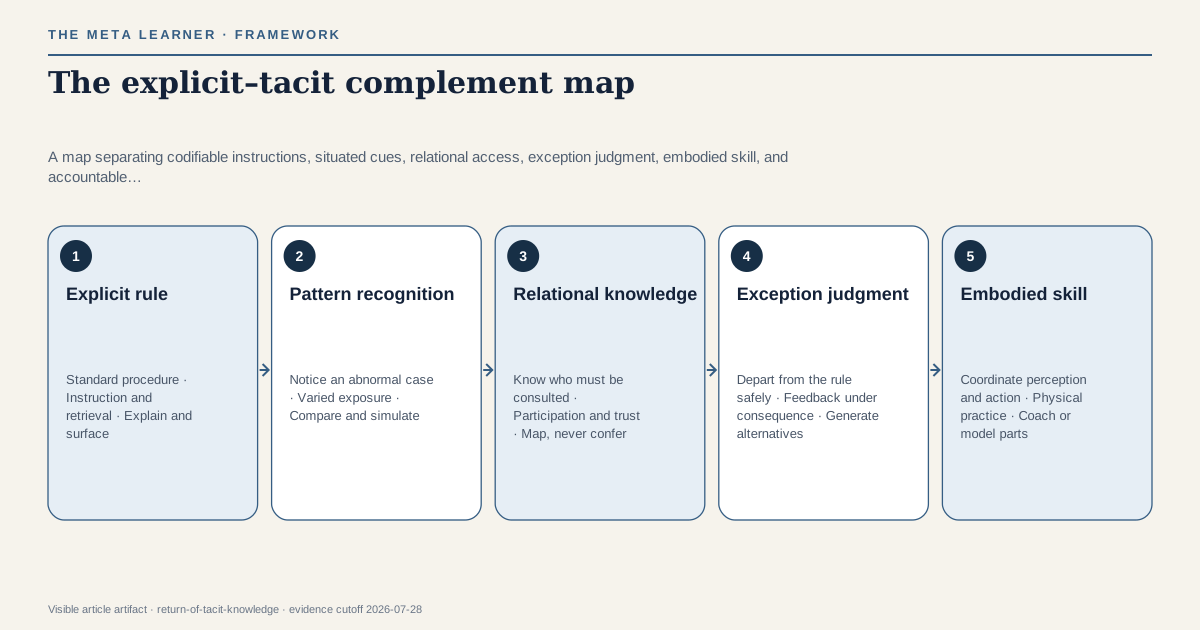
AI’s abundance of explicit answers may make tacit knowledge more—not less—important. Tacit knowledge is the situated capacity to notice meaningful cues, navigate relationships, handle exceptions, and act under real constraints. AI can help surface and transmit parts of it, but participation, feedback, and accountable experience remain central to acquiring it.
What the sources let us observe
A National Academies guide distinguishes explicit knowledge that can be formalized from tacit knowledge grounded in experience, skills, insights, intuition, and context.nasem-knowledge, nasem-learning, oecd-ai-skills, nber-genai-work Learning research likewise shows that expertise is not merely a larger list of facts; knowledge becomes organized around meaningful patterns, use conditions, and domain practice.nasem-learning
OECD analysis describes AI-era skill needs as combinations of technical, foundational, and complementary capabilities rather than one generic “AI skill.”oecd-ai-skills A field study of generative AI in customer support found heterogeneous productivity effects, including larger measured gains for less experienced workers in that bounded deployment.nber-genai-work That result suggests explicit assistance can transmit some high-performer patterns; it does not establish that tacit knowledge has been automated away.
Evidence supports the importance of organized, context-sensitive expertise and shows that AI assistance can change how performance is distributed in at least some settings. The “return” of tacit knowledge is an interpretation about relative scarcity, not a measured economy-wide trend.
Claim sources: nasem-knowledge, nasem-learning, oecd-ai-skills, nber-genai-work
Why explicit abundance changes the complement
Suppose nearly everyone can retrieve a competent checklist, draft, explanation, or code pattern. Merely possessing the explicit procedure becomes weaker differentiation. Value can move to five things the procedure leaves unresolved:
- Which situation are we actually in?
- Which exception is material?
- Whose trust or permission is required?
- Which trade-off can this institution accept?
- When should the procedure stop?
These are not inherently human forever. They are difficult because context is incomplete, social, local, changing, or costly to represent. AI may encode more of it over time. But encoding also requires someone to recognize, elicit, validate, and maintain the knowledge.
Our inference: the edge moves into participation
The strongest advantage may come from being close enough to reality to know what the explicit answer omitted. That proximity can mean working with customers, maintaining machinery, negotiating across teams, observing a classroom, or handling failed cases.
This creates a strategic reversal. Organizations once tried to extract tacit knowledge into manuals so it could scale. They may now use AI to make those manuals interactive—while discovering that the new bottleneck is continued contact with the situations that keep the manuals true.
Tacit knowledge becomes a complement to AI, not a romantic refuge from it.
The explicit–tacit complement map
| Layer | Example | How it develops | AI role | |---|---|---|---| | Explicit rule | Standard procedure | Instruction and retrieval | Explain and surface | | Pattern recognition | Notice an abnormal case | Varied exposure | Compare and simulate | | Relational knowledge | Know who must be consulted | Participation and trust | Map, never confer | | Exception judgment | Depart from the rule safely | Feedback under consequence | Generate alternatives | | Embodied skill | Coordinate perception and action | Physical practice | Coach or model parts | | Authority | Decide and bear responsibility | Institutional mandate | Support, not self-grant |
The map prevents two mistakes: calling every unexplained skill “tacit,” and assuming that documentation captures all conditions of use.
Bounded case: enterprise software discovery
A consultant can ask AI for a discovery interview guide and a process map. Those explicit artifacts are useful. During a live interview, however, the client hesitates when ownership is mentioned, describes an unofficial spreadsheet, and contradicts the formal workflow. An experienced researcher notices that the adoption problem is political and operational, not a missing feature.
The consultant records the cue, interpretation, alternative explanations, and a question for a second stakeholder. AI helps compare accounts, but it did not possess the relationship or decide whether the hesitation mattered.
The lesson is not “intuition wins.” Tacit impressions can encode bias. They become professional knowledge only when tested against further observation and feedback.
Use How to Learn on Real Projects to protect this exposure and How to Build a Feedback Network Without Waiting for One Perfect Mentor to challenge interpretation.
Scenario map and signposts
Codification acceleration. AI elicits expert reasoning, turns cases into simulations, and spreads context faster. Signposts: structured case libraries, narrated exceptions, improved novice transfer, and fewer single points of knowledge.
Tacit premium. Explicit production commoditizes while situated judgment remains scarce. Signposts: hiring for domain access, client trust, field exposure, exception handling, and responsibility.
Tacit enclosure. Senior judgment becomes more valuable but novice access to formative work shrinks. Signposts: fewer entry roles, less shadowing, concentrated authority, and claims that “only veterans understand” without teachable evidence.
The third scenario is not a defense of keeping knowledge secret. It is a warning that removing novice participation can turn complementary expertise into a bottleneck.
Signposts worth measuring
Track who handles exceptions, whether novices observe decisions, which workarounds remain undocumented, how often formal procedures fail, and whether AI-generated guidance improves performance on genuinely new cases. Distinguish fewer questions from better learning; a novice may ask less because the interface answers quickly while missing the cues that would reveal a deeper problem.
The End of the Entry-Level Learning Ladder? follows this signpost into apprenticeship.
What would invalidate this view
The interpretation would weaken if AI systems consistently acquired, updated, and transferred situated expertise across organizations without ongoing human participation or local validation. It would also weaken if explicit information remained the dominant bottleneck despite broad access.
Within a profession, the claim should reverse where tasks are stable, feedback is fast, exceptions are rare, and context can be fully represented. There, codification and automation may absorb most of the advantage.
Boundaries of tacit advantage
Tacit knowledge is difficult to measure and can become a flattering label for habit, gatekeeping, or unexamined bias. Experience alone does not produce expertise. Some situated knowledge can be documented, simulated, or learned with AI support. Access to participation is unequal, and any tacit premium can reinforce exclusion. The scenario analysis is bounded by evidence available on July 28, 2026.
The return is not to secrecy. It is to the neglected fact that answers become knowledge only when someone learns where they apply.
Named sources
Evidence and further reading
Published July 29, 2026. No substantive revision has been recorded. Evidence last verified July 28, 2026.