How to Learn on Real Projects Without Turning Work Into a Course
Learn through real work by selecting one capability bottleneck, protecting delivery, arranging feedback, and capturing evidence from repeated attempts.
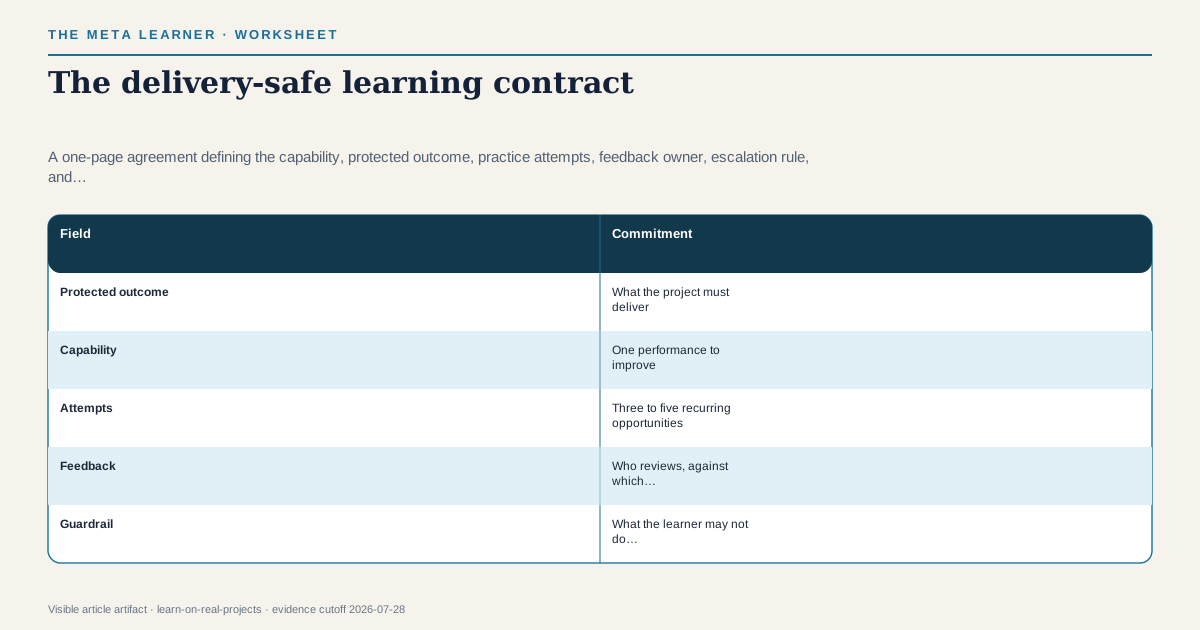
Learn on a real project by choosing one capability bottleneck, not by treating every task as a lesson. Define the work outcome that must be protected, identify repeated low-risk attempts, arrange feedback from someone accountable, and keep an error-and-change log. Deliver the project first; use its variations and corrections as evidence of learning.
The tension between delivery and development
Real projects contain context, consequence, ambiguity, and feedback that courses often simplify. They also belong to clients, colleagues, and users who did not consent to become someone’s practice environment.
The solution is a delivery-safe learning contract: one bounded capability is practised inside authorized work, while the project’s quality, privacy, schedule, and accountability remain protected.
This approach rejects two extremes. “Just learn by doing” can repeat the same errors. Turning every meeting and deliverable into a curriculum can burden everyone else.
Scenario: the delivery-safe learning contract under organizational constraints
A policy analyst wants to improve data visualization during a live quarterly report.
The protected outcome is an accurate report on schedule. The capability is choosing a visual form that represents uncertainty. The analyst creates three draft charts from non-sensitive data, uses a rubric for scale, denominator, comparison, and interval, then receives a fifteen-minute review from a senior analyst. Final publication still requires the normal approval.
The evidence artifact contains the three versions, feedback, correction rationale, and a transfer chart for a different dataset. It demonstrates a learning loop without making the public report an experiment.
Select the capability bottleneck
Choose one observable performance:
- framing a researchable question;
- writing an executive recommendation with evidence;
- conducting a structured user interview;
- reviewing AI output for unsupported claims;
- estimating a project and stating uncertainty;
- facilitating a decision across conflicting stakeholders.
Avoid broad targets such as leadership, strategy, or AI skill. Define what another person could watch or judge.
How People Learn II emphasizes prior knowledge, motivation, metacognition, context, and the organization of knowledge.nasem-learning, dunlosky-techniques, oecd-skills A real project supplies context; your design must supply reflection and feedback.
Write the delivery-safe learning contract
| Field | Commitment | |---|---| | Protected outcome | What the project must deliver | | Capability | One performance to improve | | Attempts | Three to five recurring opportunities | | Feedback | Who reviews, against which rubric | | Guardrail | What the learner may not do alone | | Escalation | Where uncertainty or error goes | | Evidence | What artifact shows progress | | Stop rule | When learning must yield to delivery |
Share it with the relevant manager or collaborator when it changes how work will be reviewed. Learning goals do not authorize extra access, risk, or delay.
Learning evidence supports active practice, retrieval, feedback, and application rather than exposure alone. OECD evidence highlights changing skill requirements and unequal access to adult learning. The contract is an editorial workflow and has not been tested as a standardized workplace intervention.
Claim sources: nasem-learning, dunlosky-techniques, oecd-skills
Design repeated attempts
A project may offer one major presentation but ten smaller framing decisions. Practice on the smaller units before the consequential event.
For each attempt:
- predict the difficult part;
- perform without excessive support;
- compare with the rubric;
- receive specific feedback;
- classify the error;
- change one behavior;
- try again in a varied case.
Reviews of learning techniques support practice testing and distributed practice as broadly useful, with implementation limits.dunlosky-techniques Workplace attempts are not identical to classroom tests, but they should expose what the learner can produce.
Separate feedback from approval
Approval asks, “Can this go forward?” Feedback asks, “What pattern should change in the next attempt?” One reviewer can do both, but the records should separate them.
Ask for:
- one decision that was strong;
- one error with consequence;
- one missing cue the learner should notice earlier;
- one changed condition for the next attempt.
Do not ask colleagues to “mentor me” without boundaries. Specify time, artifact, and question.
Capture capability evidence
Keep:
- starting artifact;
- rubric;
- feedback;
- revised artifact;
- explanation of the change;
- independent evaluation;
- transfer attempt;
- limitation and next gap.
OECD’s skills work underlines that labour-market transitions involve changing occupational and skill mixes, but broad reports cannot certify one worker’s capability.oecd-skills Your evidence must connect to real standards and outcomes.
Write a delivery-safe learning contract
- Choose one current project with permission and suitable risk.
- Name one capability bottleneck.
- define the protected outcome and stop rule.
- Find three repeated attempts.
- Agree on a rubric and feedback owner.
- Log error, change, and next attempt.
- Complete one transfer test.
- package the evidence without exposing protected information.
Use Deliberate Practice, Feedback, and the Path to Expertise for practice design, turn results into Build a Skill Portfolio for an AI-Shaped Career, and coordinate goals through How to Build a Personal Learning System.
Workplace learning that burdens the project
- Practising several capabilities at once.
- Experimenting on high-consequence work.
- Asking for vague, unlimited mentorship.
- adding documentation that no decision uses.
- treating colleague correction as a free course.
- publishing internal errors as a portfolio.
- claiming learning from participation without independent performance.
The final test belongs outside the delivered artifact. Reperform the core task on a changed case, with one support removed, and explain the reasoning to a qualified reviewer. That transfer check separates project-specific success from a capability that is becoming portable. The more consequential the work, the more the practice environment should use simulations, staged responsibility, or reversible components before live execution. The Deliberate Practice method provides a fuller protocol for calibrating difficulty and feedback.
Some practice should not happen live
Clinical, legal, financial, safety, security, and regulated work may require formal training, supervised practice, simulation, credentialing, or exclusion from live tasks. Employers and clients own constraints around data, time, quality, and disclosure. Workplace opportunity is unequally distributed, and a learner cannot solve structural access problems with a worksheet.
Real work becomes a powerful teacher when the learning design respects the people who need the work to be real.
Named sources
Evidence and further reading
Published July 29, 2026. No substantive revision has been recorded. Evidence last verified July 28, 2026.