The End of the Entry-Level Learning Ladder? AI and the Future of Apprenticeship
A scenario map for what happens when AI absorbs junior production tasks that also taught observation, repetition, feedback, exceptions, and trust.
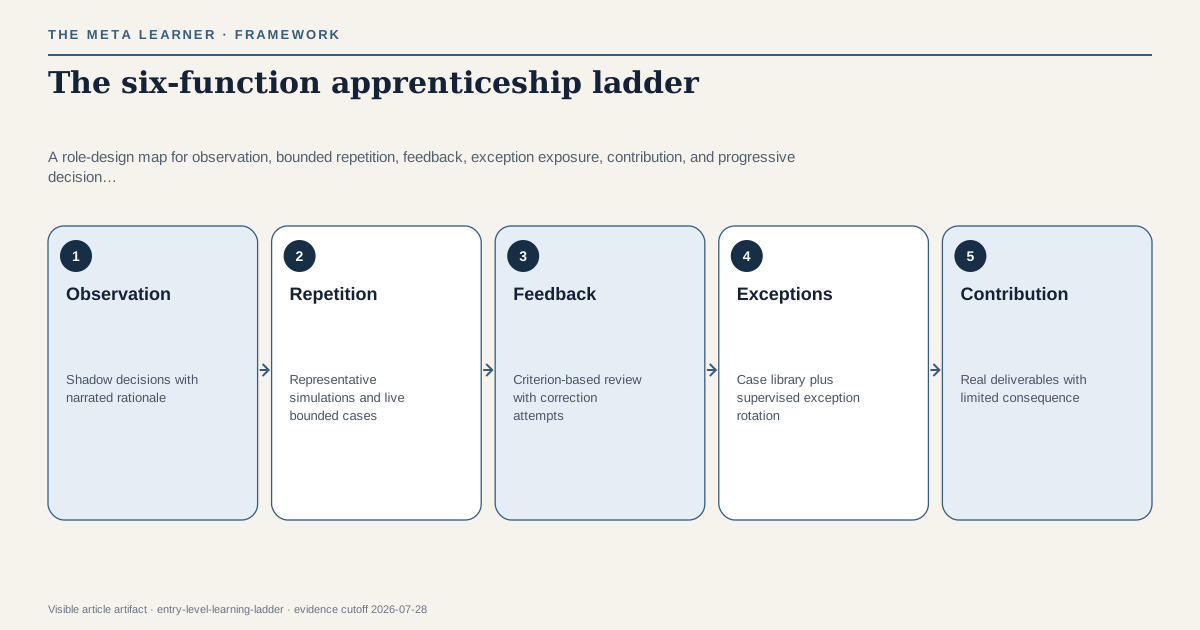
AI could shrink the traditional entry-level ladder because many junior production tasks are increasingly assistable. But those tasks often performed hidden learning functions: observing expert standards, repeating components, receiving feedback, encountering exceptions, and earning trust. The right response is not to preserve drudgery; it is to redesign apprenticeship before removing its developmental infrastructure.
What is observed today
The ILO’s 2026 empirical review identifies uneven productivity gains, limited aggregate displacement to date, and emerging risks for younger workers and work organization.ilo-empirical, ilo-junior-programmers, oecd-skills-first, nasem-learning An ILO analysis of junior programming distinguishes the ability to solve specific tasks from the practical ability to replace a worker across duties, while noting pressure around entry-level activities.ilo-junior-programmers
The OECD’s skills-first work highlights work-based learning and apprenticeships in skill development, along with work samples and scenario-based simulations in skills assessment.oecd-skills-first Learning science emphasizes practice, feedback, context, and transfer rather than information exposure alone.nasem-learning
The evidence supports concern about younger-worker pathways and the developmental value of work-based learning. It does not establish that the entry-level ladder is ending, nor that AI is the sole cause of hiring change.
Claim sources: ilo-empirical, ilo-junior-programmers, oecd-skills-first, nasem-learning
The ladder was never just cheap labor
Entry work can be repetitive, underpaid, exclusionary, and poorly supervised. It should not be romanticized. Yet a functioning apprenticeship converts limited responsibility into six learning opportunities:
- observe how experienced people frame the work;
- repeat bounded components until patterns appear;
- receive feedback tied to real standards;
- encounter exceptions absent from manuals;
- make a contribution others depend on;
- earn progressively wider authority.
Automation can remove the component and its learning function together. A firm may save senior review today while finding, years later, that too few workers can handle the exceptions.
Our inference: firms can consume their own expertise pipeline
An organization views a junior task as a cost because its learning return is not recorded. It automates drafting, triage, documentation, or testing. Senior workers retain consequential judgment, but novices no longer see the raw cases or corrections that built it.
The result can be a pipeline inversion: entry roles demand judgment that historically developed inside the work they no longer perform.
This is a scenario, not a forecast. AI may instead create richer simulation, immediate feedback, and access to expert patterns. Whether it hollows or strengthens apprenticeship depends on role design.
The time horizon matters. A firm can observe a quarterly productivity gain while the loss of independent judgment appears years later, after senior attrition or an unfamiliar incident. Apprenticeship measures therefore need leading indicators—exception exposure, feedback quality, progression, and transfer—rather than waiting for a shortage of trusted experts to become the first visible result.
The six-function replacement audit
When a junior task is automated, do not ask only “Who does the output now?” Ask how each developmental function will be replaced.
| Lost function | Deliberate replacement | |---|---| | Observation | Shadow decisions with narrated rationale | | Repetition | Representative simulations and live bounded cases | | Feedback | Criterion-based review with correction attempts | | Exceptions | Case library plus supervised exception rotation | | Contribution | Real deliverables with limited consequence | | Authority | Explicit progression gates and decision rights |
The replacement should produce evidence: attempts, errors, improvements, transfer, and supervisor judgment. A video course cannot substitute for every function.
Bounded case: junior software development
A team uses AI to generate routine tests, documentation, and code scaffolds. Junior developers appear faster, but senior review finds that some cannot explain dependencies or diagnose failures outside the generated pattern.
The team retains AI assistance but changes the ladder. Juniors predict failure before running code, review generated tests for missing cases, own one bounded service, participate in incident retrospectives, and complete periodic unfamiliar tasks with limited support. Seniors narrate trade-offs rather than silently correcting.
The aim is hybrid capability, not artificial scarcity. How to Learn on Real Projects Without Sacrificing Delivery offers a delivery-safe contract; The 30-Day Capability Sprint supplies a bounded evidence cycle.
Apprenticeship scenarios and signposts
Hollowed ladder. Entry hiring falls and remaining junior work becomes monitoring. Signposts: fewer supervised cases, rising experience requirements, weak transfer, and senior verification bottlenecks.
Accelerated apprenticeship. AI supplies examples, simulations, and feedback while real responsibility grows progressively. Signposts: faster rubric gains, maintained unaided performance, more varied cases, and earlier meaningful contribution.
Dual track. Elite organizations preserve rich apprenticeship while others hire only “ready” workers. Signposts: concentrated training access, widening network premiums, unpaid portfolio work, and mobility barriers.
New intermediary roles. Evaluation, data stewardship, workflow operations, and customer context become entry points. Signposts: explicit ladders into higher judgment rather than permanent support tiers.
Signposts through the pipeline
Track entry-level openings, required experience, time to independent performance, senior review load, exposure to exceptions, internal promotion, error detection, worker autonomy, and transfer under changed tools. Do not use headcount alone; a smaller cohort with better development could outperform a larger but stagnant one.
The Return of Tacit Knowledge explains why access to participation may become more valuable as explicit answers spread.
Invalidation and reversal conditions
The pipeline concern would weaken if longitudinal evidence showed that AI-assisted novices reach equal or stronger independent judgment, transfer, and progression with fewer traditional junior tasks. It would also weaken where old entry work produced no relevant learning and better simulations or projects replace it.
Reverse a local redesign when junior error detection, unaided transfer, exception handling, or progression deteriorates beyond a precommitted threshold—even if short-run throughput improves.
What cannot yet be forecast
Early-career labor outcomes reflect macroeconomic cycles, education, offshoring, firm strategy, demographics, and hiring practices as well as AI. The evidence does not establish a universal decline in entry roles or the long-term effect on expertise. Apprenticeship models differ across occupations and countries. The scenarios are current to July 28, 2026 and should not be read as employment predictions.
The entry-level ladder is not sacred. Its learning functions are.
Named sources
Evidence and further reading
Published July 29, 2026. No substantive revision has been recorded. Evidence last verified July 28, 2026.