How to Build a Feedback Network When You Do Not Have a Mentor
Replace the search for one ideal mentor with a small network of bounded reviewers who can judge different artifacts, decisions, and blind spots.
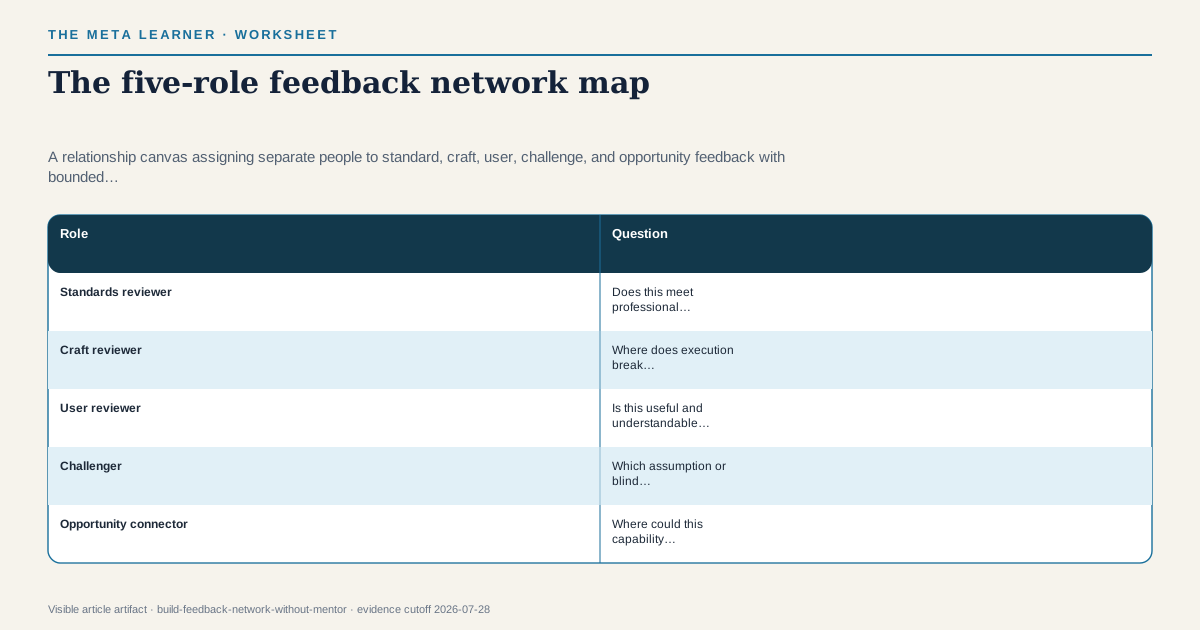
Build a feedback network instead of waiting for one mentor. Find separate people who can judge standards, craft, user value, blind spots, and opportunity. Ask each person one bounded question about a concrete artifact, provide context and a rubric, limit the time, show what you changed, and offer appropriate reciprocity. Track patterns across reviewers rather than obeying every comment.
The ideal-mentor bottleneck
The imagined mentor is senior, generous, available, well connected, expert in every relevant domain, and willing to take responsibility for your development. Waiting for this person creates dependence before the relationship exists.
Real professional growth draws on different forms of judgment. The person who knows technical standards may not understand your target user. A peer may see process errors a sponsor never observes. A client can judge usefulness but should not be asked to design your curriculum.
Build a network with explicit roles.
Adoption case: the five-role feedback network map
An independent analyst lacks a manager. She produces a four-page market brief.
- A librarian challenges search coverage.
- A domain practitioner checks operational assumptions.
- A peer analyst reviews the claim-evidence matrix.
- A target reader judges decision usefulness.
- A former client, with permission, suggests a low-risk next problem.
Each request is twenty minutes or less and addresses one artifact. The analyst records conflicting feedback: the practitioner wants more detail; the executive reader wants less. She resolves it through a technical appendix rather than choosing a winner.
The five feedback roles
| Role | Question | |---|---| | Standards reviewer | Does this meet professional or domain requirements? | | Craft reviewer | Where does execution break down? | | User reviewer | Is this useful and understandable in context? | | Challenger | Which assumption or blind spot is most dangerous? | | Opportunity connector | Where could this capability be tested next? |
One person can fill several roles, but do not assume it. Diversity of role matters more than collecting prestigious names.
Make the request easy to answer
Send:
- a short artifact or decision;
- the intended user and context;
- one rubric or standard;
- one precise question;
- the requested time;
- a clear permission to decline;
- any confidentiality restriction.
Example:
Could you spend fifteen minutes on the one-page evidence map? Please identify the claim whose source support is weakest. I am not asking for copyediting or an introduction. I will send the revision and a short note on what changed.
This is more respectful and more learnable than “Would you mentor me?”
Feedback can improve performance, but meta-analytic evidence shows that interventions vary and sometimes reduce performance. Learning guidance supports specific feedback and metacognition, while structured-assessment guidance illustrates the value of common questions and rating standards. The five-role network is an editorial model.
Claim sources: feedback-meta, nasem-learning, opm-structured
Keep attention on the work
Kluger and DeNisi’s meta-analysis found substantial variation in feedback effects and reported that more than a third of observed feedback interventions reduced performance; their theory emphasizes where feedback directs attention.feedback-meta, nasem-learning, opm-structured Do not convert this into a claim that feedback is usually harmful. Use it to reject indiscriminate praise, ranking, or identity judgment.
Ask:
- What did the artifact need to achieve?
- What observable choice helped or hurt?
- What cue should I notice next time?
- Which change would most improve the next attempt?
Then perform again.
Standardize enough to compare
When several reviewers assess the same capability, use a small common rubric. OPM structured-interview guidance illustrates how consistent questions and rating scales can improve comparability in formal assessment.opm-structured Your informal network is not a selection process, but the principle helps distinguish feedback differences from question differences.
Record:
- reviewer role;
- artifact version;
- question;
- observation;
- proposed change;
- your decision;
- outcome on the next attempt.
Do not average incompatible comments. A user and a standards reviewer answer different questions.
Create reciprocity without transaction theater
Useful reciprocity can include:
- preparing the material well;
- respecting the agreed time;
- showing the result;
- sharing a source or tool genuinely relevant to them;
- reviewing peer work within your competence;
- acknowledging help with permission;
- paying when the work is professional consulting.
Do not imply that minor help purchases continuing access. Seniority and power differences require care.
Build the five-role network
- Choose one capability and one artifact.
- Map the five roles.
- list two plausible people for each, including peers.
- Prepare one bounded request.
- send no confidential material without authorization.
- apply feedback and perform another attempt.
- report back briefly.
- review network gaps without turning contact into a quota.
Study feedback boundaries in Deliberate Practice, Feedback, and the Path to Expertise, provide evidence through Build a Skill Portfolio for an AI-Shaped Career, and log changes in How to Build a Personal Learning System.
Feedback requests that exhaust trust
- Sending large unfinished work with no question.
- Asking for reassurance disguised as critique.
- Treating every expert as a free mentor.
- Ignoring feedback without explaining the decision.
- collecting comments but making no new attempt.
- sharing private work outside its permitted audience.
- asking opportunity connectors to endorse capability they have not seen.
How People Learn II supports the importance of context, feedback, and metacognition, but it does not prescribe a networking formula.nasem-learning
Map feedback to the task and workflow rather than to your identity. One reviewer can test factual accuracy, another the decision logic, another the audience effect, and another whether the work survives use in practice. Give each person a bounded question, relevant artifact, and response format. Then compare corrections across repeated attempts. This makes the network a distributed measurement system instead of a loose collection of opinions. Use the Deliberate Practice method to decide which error deserves the next practice cycle, while keeping approval and employment decisions with the people who actually hold that authority.
Networks do not erase power
Access to capable reviewers is unequal. Feedback can reproduce bias, gatekeeping, harassment, or conflicts of interest. Informal reviewers are not substitutes for licensed supervision, formal assessment, sponsorship, or accountable management. Protect privacy, pay for substantial professional labor, and use organizational channels where feedback affects employment decisions.
The network is successful when it produces better attempts and more independent judgment—not when it produces the appearance of being well connected.
Named sources
Evidence and further reading
Published July 29, 2026. No substantive revision has been recorded. Evidence last verified July 28, 2026.