The Quiet Rebundling of Knowledge Work
How AI may separate, relocate, and recombine research, production, review, coordination, and responsibility before occupations visibly change.
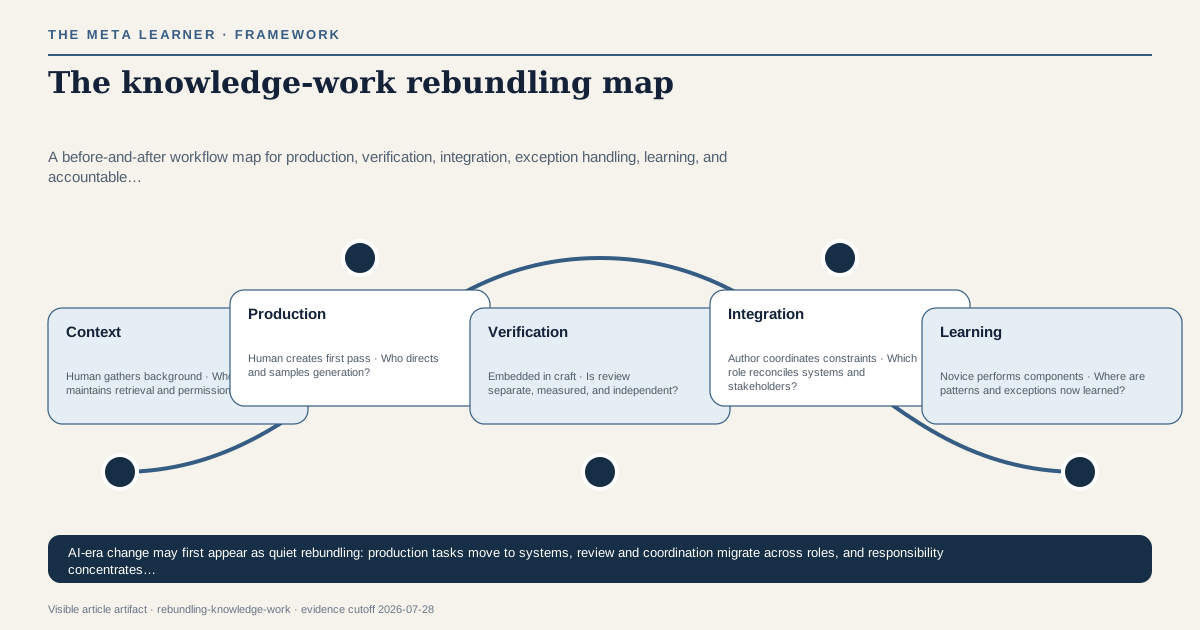
The quiet rebundling of knowledge work is the movement of tasks, review, context, and responsibility across people and systems before job titles visibly change. AI may reduce first-pass production while increasing data preparation, verification, exception handling, coordination, and accountability. The central question is not which task disappeared, but what the new bundle asks each role to own.
Observations beneath stable job titles
O*NET’s content model describes occupations through tasks, work activities, skills, knowledge, context, and other dimensions, showing how much a title conceals.onet-content, oecd-adoption, ilo-empirical, nber-genai-work The OECD’s firm-adoption study documents uneven adoption shaped by complementary capabilities and organizational conditions.oecd-adoption
An ILO review finds emerging productivity effects but limited large-scale displacement so far, while emphasizing changes in work organization, autonomy, coordination, and risks for younger workers.ilo-empirical The NBER customer-support field study found measured gains within one deployed workflow and heterogeneous effects across workers.nber-genai-work
Evidence supports task heterogeneity, uneven deployment, and early changes in work organization. “Quiet rebundling” is an interpretive frame; current evidence does not identify one common before-and-after bundle.
Claim sources: oecd-adoption, ilo-empirical, onet-content, nber-genai-work
Why work can change before the job does
Job titles are institutional objects. They sit inside pay bands, career ladders, contracts, professional identities, and reporting systems. Tasks can change weekly while titles persist for years.
Generative AI makes this lag consequential. A researcher may produce fewer first drafts but spend more time resolving sources. A developer may write less routine code but inspect more generated dependencies. A manager may receive more analysis but face a larger decision queue. None of these changes requires an immediate new title.
Four movements can happen at once:
- unbundling: a coherent activity is split into machine and human components;
- rebundling: fragments are assembled into a new role or service;
- upstream movement: effort shifts into data, instructions, and context;
- downstream movement: effort shifts into review, integration, and correction.
Productivity claims that count only the automated step miss the new geography of labor.
Our inference: interfaces hide organizational migration
AI interfaces often appear personal: one worker asks, receives, and edits. Yet the useful context came from colleagues; review costs may fall on another team; errors may reach customers; data and security obligations sit elsewhere.
The interface can therefore make a collective workflow look like individual productivity. Rebundling becomes “quiet” because invisible labor is absorbed by reviewers, operations staff, junior workers, or users rather than recorded as a formal redesign.
This is why time saved is not enough. A serious analysis asks where the time went, whose autonomy changed, which learning task disappeared, and who now owns the exception.
The rebundling map
Create two columns—before and after—and map six functions:
| Function | Before | Questions after AI | |---|---|---| | Context | Human gathers background | Who maintains retrieval and permissions? | | Production | Human creates first pass | Who directs and samples generation? | | Verification | Embedded in craft | Is review separate, measured, and independent? | | Integration | Author coordinates constraints | Which role reconciles systems and stakeholders? | | Learning | Novice performs components | Where are patterns and exceptions now learned? | | Ownership | Role owns delivered work | Did authority move with responsibility? |
Add volume, severe-error cost, queue time, and worker for each row. The result is not an automation score; it is a migration record.
Bounded case: a research agency
An agency once assigned one analyst to search, read, synthesize, draft, and revise a market brief. With AI, a junior researcher gathers sources, a system generates comparisons, a senior analyst verifies claims, and an account lead translates the result for the client.
The apparent gain is faster drafting. The rebundling risks are different: the junior may stop learning synthesis, the senior becomes a verification bottleneck, and the account lead may make claims whose evidence they did not inspect.
The agency responds by rotating claim reconstruction, sampling source work, giving the junior an unaided case, and limiting client claims to the verified ledger. It measures total cycle time and reviewer load.
This bounded design does not establish an optimal agency structure. It shows how Redesign Your Role Before the Job Title Changes can follow observed migration instead of slogans.
Distributional questions
Rebundling can upgrade a role, intensify it, or hollow it out. A worker may gain higher-value judgment and lose tedious production. Another may inherit more monitoring without authority. A junior may receive better scaffolding or lose the repetitions that made advancement possible.
Ask who controls the tools, who sees performance data, who bears the severe errors, whose work becomes legible, and who receives the saved value. Organizational design is not neutral simply because the technology is general-purpose.
Use From Task Automation to Workflow Redesign to trace these movements and compare them with Jobs, Tasks, and Accountability.
Rebundling scenarios and signposts
Role enrichment. Routine production falls and workers gain context, judgment, and client access. Signposts: broader decision rights, learning time, higher autonomy, and measured outcome quality.
Review factory. Output volume rises and human labor concentrates in correction. Signposts: growing queues, reviewer fatigue, hidden repair, and no corresponding authority or reward.
Micro-firm leverage. Small teams assemble capabilities once requiring departments. Signposts: narrower headcount, wider tool integration, reliance on external infrastructure, and stronger need for owner judgment.
Fragmented accountability. Multiple agents and contractors perform pieces while nobody owns the whole. Signposts: unclear provenance, duplicated checking, and incident disputes.
Invalidation signals for the knowledge-work rebundling map
The frame would weaken if job titles, task bundles, and formal responsibility changed synchronously and transparently with AI deployment. It would also weaken if local automation consistently reduced end-to-end labor without creating meaningful upstream, downstream, learning, or coordination work.
Within a firm, the interpretation should be revised when measurement shows that the new bundle reduces total cost, preserves capability, improves job quality, and assigns authority clearly. Rebundling is not inherently harmful; invisibility is the concern.
What the map leaves unresolved
The cited evidence does not provide a representative global map of task migration. Effects differ by demand, sector, country, firm size, worker voice, business model, and labor institutions. Observed productivity in one workflow cannot establish economy-wide rebundling. The framework does not predict headcount, pay, or job quality. Its evidence cutoff is July 28, 2026.
The job title may look stable while the work, learning, and responsibility underneath it have already moved.
Named sources
Evidence and further reading
Published July 29, 2026. No substantive revision has been recorded. Evidence last verified July 28, 2026.