How to Redesign Your Role Before Your Job Title Changes
Redesign a role by mapping tasks, decisions, handoffs, learning value, and accountability before capability shifts are reflected in formal job titles.
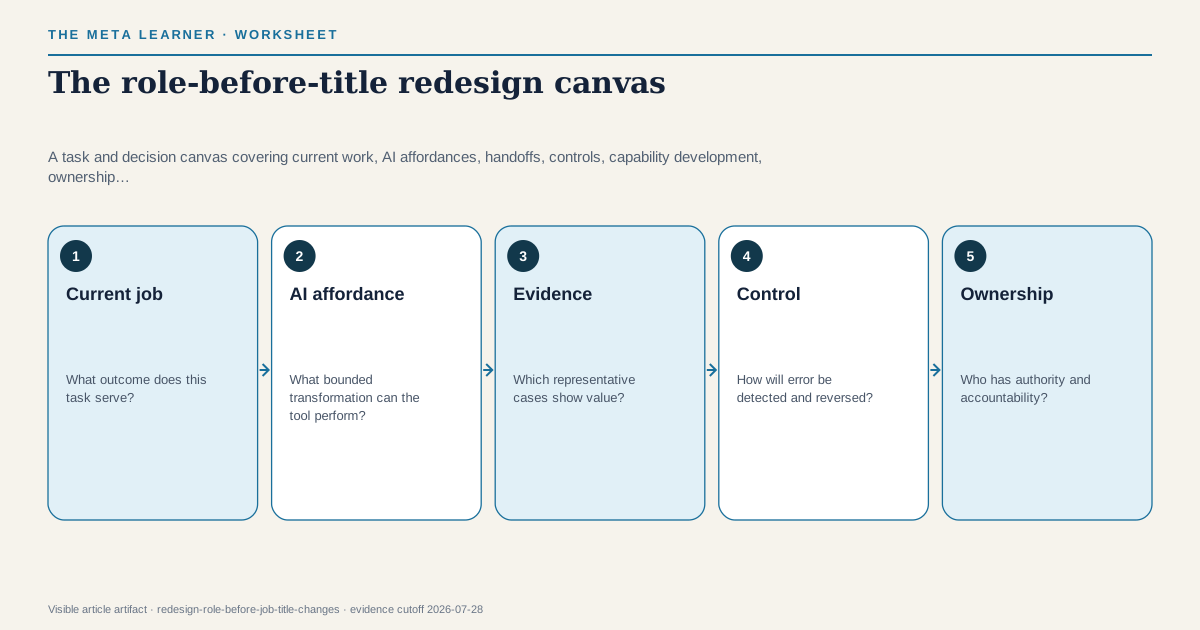
Redesign your role before its title changes by mapping the actual tasks, decisions, handoffs, controls, and learning loops. Move only bounded work where AI has demonstrated value; define who verifies and owns each output; protect tasks that build judgment; and measure total workflow quality, not model speed. Then propose the new bundle with evidence from a reversible pilot.
Titles lag behind the real work
Job titles are administrative containers. Work changes earlier: a draft moves from human to AI, a reviewer inherits new checking, a junior loses an apprenticeship task, or a manager becomes accountable for a system no one has mapped.
ILO exposure research is built from task-level assessment rather than assuming an occupation changes uniformly. The bounded NBER workplace deployment further shows why observed value must be located in a specific workflow rather than inferred from a general model demonstration.ilo-genai, onet-content, nist-rmf, nber-work O*NET likewise distinguishes tasks, work activities, knowledge, skills, context, and decision impact within occupations.onet-content Use that granularity before requesting a new title or buying a new tool.
Map the current role honestly
For two weeks, record:
- trigger, frequency, and recipient;
- inputs and sensitivity;
- transformation performed;
- decisions embedded;
- output standard;
- handoffs and waiting;
- errors and rework;
- consequence and reversibility;
- how the task develops capability.
Separate official process from actual work. Hidden coordination and exception handling often carry more value than the visible deliverable.
The role-before-title canvas
Create one row per task:
| Field | Design question | |---|---| | Current job | What outcome does this task serve? | | AI affordance | What bounded transformation can the tool perform? | | Evidence | Which representative cases show value? | | Control | How will error be detected and reversed? | | Ownership | Who has authority and accountability? | | Learning | Which capability does the task build? | | Reallocation | Stop, automate, augment, retain, or redesign? |
Do not use “AI can do it” as evidence. Capability in a demonstration is different from reliable adoption in your data, workflow, incentives, and risk environment.
Official task models and exposure research support analyzing roles below the job-title level. NIST supports mapping context, measuring risk, managing controls, and governing responsibility. These sources do not determine the employment terms or optimal redesign of one organization.
Claim sources: onet-content, ilo-genai, nist-rmf
Redesign the workflow, not one step
Moving draft production to AI can shift work into:
- source preparation;
- prompt or specification design;
- factual verification;
- exception handling;
- approval;
- monitoring;
- documentation;
- stakeholder explanation.
Calculate total time and error, including these new tasks. Inspect who receives the less visible burden. A local speed gain can create downstream delay or concentrated accountability.
NIST’s AI RMF organizes risk work through govern, map, measure, and manage and emphasizes defined roles and responsibilities.nist-rmf Its framework is voluntary and general; organizational policy and sector rules may be stricter.
Protect the capability pipeline
Ask which current tasks teach patterns, client context, standards, or exceptions. If AI produces every first draft, how will a junior learn to recognize a bad one?
Options include:
- manual cases before AI access;
- blind review before showing model output;
- rotation through exceptions;
- error libraries;
- paired explanation;
- periodic unaided work samples.
The goal is not to preserve repetitive labor. It is to prevent oversight from losing the knowledge it claims to provide.
Decomposing a case with the role-before-title redesign canvas
An analyst spends eight hours each week assembling a market update. AI can extract and classify public items.
The redesigned role:
- AI proposes classifications from approved sources;
- the analyst verifies high-impact claims and resolves conflicts;
- a log records source, change, and confidence;
- time saved moves to interviewing internal decision-makers and testing implications;
- a monthly work sample checks independent synthesis.
The pilot uses twenty representative updates and measures total time, missed material items, unsupported claims, and stakeholder usefulness. It does not automate publication or confidential-source handling.
Complete the role-before-title canvas
- Map ten recurring tasks.
- Choose one low-consequence, reversible candidate.
- Save representative cases and define the baseline.
- Specify the AI transformation and forbidden actions.
- Assign review, escalation, and final ownership.
- measure total workflow time and error.
- Document what capability might be lost.
- Propose a revised task bundle with a stop condition.
Start with Audit Your Work for Automation, Augmentation, and Human Judgment, preserve proof in Build a Skill Portfolio for an AI-Shaped Career, and study the bounded workflow in Build Your First Useful AI Workflow.
Role redesigns that merely add work
- Adding AI without removing or changing a task.
- measuring generation time but not review and rework.
- assigning accountability without decision authority.
- automating clean cases while hiding exceptions.
- shifting verification to junior staff without support.
- removing developmental tasks with no replacement.
- proposing a new title before demonstrating the new outcome.
Run the proposed role through a “Tuesday morning” simulation before rewriting a job description. Take one normal case, one exception, and one high-consequence case. For each, name the task owner, AI input, independent evidence, decision right, escalation route, and learning opportunity. Estimate review time rather than assuming it is free. If the new workflow gives a worker responsibility without access or authority, it is not role enrichment. If it removes every novice task that once exposed the reasoning of experienced colleagues, it may improve current throughput while weakening the capability pipeline. Redesign until work, authority, feedback, and progression tell the same story.
Authority and employment boundaries
An individual canvas cannot authorize tool use, data processing, surveillance, role change, performance monitoring, or employment decisions. Consult applicable policies, contracts, worker representatives, security, privacy, legal, accessibility, and domain owners. Role redesign can redistribute power and workload even when aggregate productivity rises.
A title describes a role after an organization recognizes it. Good redesign begins earlier, where tasks, decisions, and responsibility actually move.
Named sources
Evidence and further reading
Published July 29, 2026. No substantive revision has been recorded. Evidence last verified July 28, 2026.