From Jobs to Tasks to Accountability: The Real Unit of AI Change
Why AI exposure begins at tasks, work redesign happens across workflows, and the decisive boundary is who owns outcomes, exceptions, and correction.
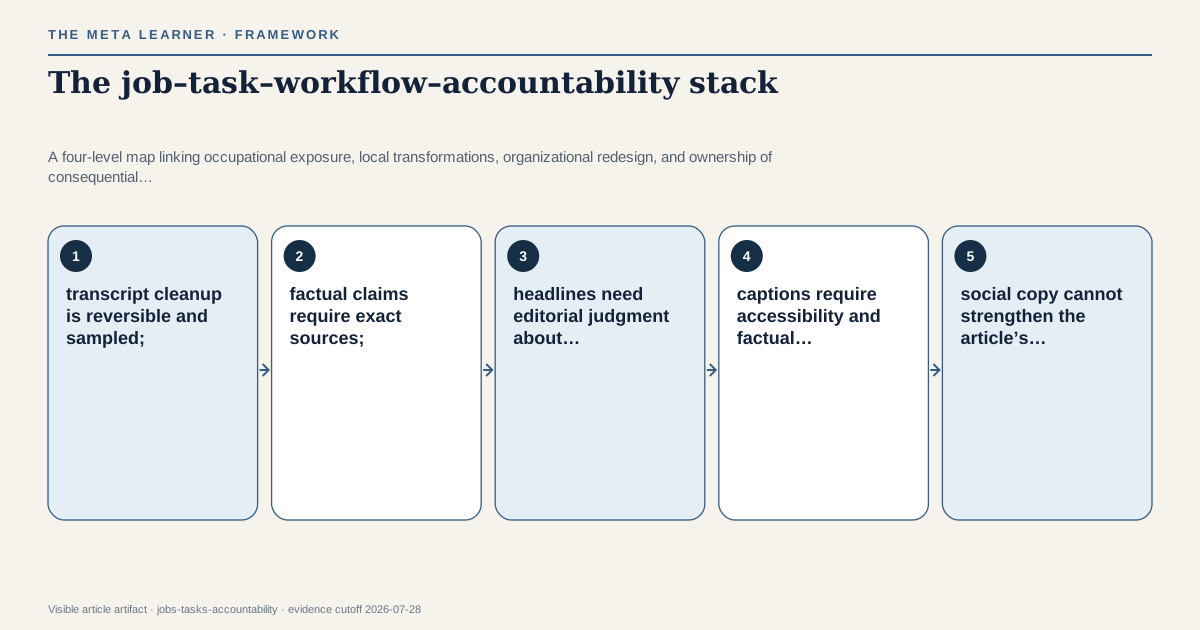
AI exposure appears first at the task level, but task scores cannot explain what ultimately happens to a job. Organizations recombine tasks into workflows, move work into review and exception handling, and allocate authority. The real unit of consequential change is therefore the accountable workflow: the chain of tasks, handoffs, controls, learning, and ownership that produces an outcome.
Observed labor and task evidence
The observed facts at this cutoff are provisional: task exposure is widespread, realized effects are uneven, aggregate displacement remains limited in the reviewed evidence, and organizational choices mediate the result.
The ILO’s 2025 exposure work assigns scores across thousands of tasks and concludes that transformation is generally more likely than simple redundancy, while emphasizing the continuing need for human input.ilo-exposure, ilo-empirical, onet-content, gao-accountability A 2026 ILO review of empirical evidence reports real but uneven productivity gains, limited large-scale displacement to date, and implications for younger workers, autonomy, coordination, and job quality.ilo-empirical
O*NET represents occupations through tasks, work activities, skills, knowledge, context, and other dimensions rather than titles alone.onet-content GAO’s accountability framework places governance, data, performance, and monitoring around AI use.gao-accountability
The evidence supports task-level heterogeneity, uneven realized effects, and the importance of organizational context and accountability. It does not identify one inevitable path from exposure to employment change.
Claim sources: ilo-empirical, ilo-exposure, onet-content, gao-accountability
Four units that answer different questions
Job: How is work bundled into an employment relationship, identity, progression path, and compensation?
Task: Which recurring transformation, decision, or interaction might AI affect?
Workflow: How do tasks, information, people, systems, queues, and exceptions combine?
Accountability: Who has authority, bears consequences, explains the decision, and corrects failure?
Debates fail when one level is used to answer another. A high task-exposure score is not a layoff forecast. A successful task demonstration is not proof that the workflow improves. A human approval box is not accountability if the person lacks evidence or authority.
Our inference: accountability is the terminal boundary
Automation can move along a chain, but eventually a consequence reaches a person, institution, customer, citizen, or environment. At that boundary, someone must decide whether the result is acceptable and what happens when it is not.
This is not a claim that every task remains human. Machines, processes, and organizations already allocate operational responsibility in complex ways. The inference is that “AI did it” is not a stable endpoint for governance. Authority must resolve back to an accountable arrangement.
The more tasks are recombined, the more important this boundary becomes. A writing assistant changes one transformation. An agent that gathers data, chooses a path, and sends an external message changes the workflow and its responsibility map.
A bounded case: a publishing workflow
A publisher introduces AI into transcript cleanup, headline options, fact extraction, image captions, and social copy. Counting tasks suggests high exposure.
The workflow analysis finds different boundaries:
- transcript cleanup is reversible and sampled;
- factual claims require exact sources;
- headlines need editorial judgment about implication;
- captions require accessibility and factual review;
- social copy cannot strengthen the article’s claim;
- final publication authority remains named.
Some production time falls. Verification and correction capacity become more visible. The editor’s job changes even though no single task score predicts the new bundle.
Use From Task Automation to Workflow Redesign to map the chain and How Teams Can Adopt AI Without Losing Accountability to assign control.
The accountability transfer test
For each changed step, ask:
- What evidence is available to the next person?
- Can that person independently detect the material failure?
- Do they have time and authority to intervene?
- Is the action reversible?
- Who informs affected people and corrects the record?
- Which learning task disappeared, and how is capability preserved?
If responsibility moves downstream without evidence, time, or authority, the workflow has transferred liability rather than accountability.
Add one distributional field to the test: who receives the saved time or financial gain? A redesign can be operationally coherent and still shift risk toward workers or users with the least bargaining power. Accountability includes the capacity to contest that allocation, not only to sign the final output.
Scenarios and signposts for redesign
Task substitution. Firms automate bounded components while job architecture changes slowly. Signposts: fewer routine steps, stable titles, increased sampling, and local productivity gains.
Workflow rebundling. Tasks move across roles and systems; new exception, data, and evaluation work appears. Signposts: rewritten process ownership, new handoffs, redesigned entry roles, and measurement of total review.
Accountability fracture. Automated chains expand while ownership remains ambiguous. Signposts: approval theater, unresolved incidents, workers correcting outputs off-system, and disputes over who authorized action.
Institutional redesign. Organizations align tasks, authority, learning, and worker participation. Signposts: explicit decision rights, incident exercises, transition support, and measured job quality alongside output.
Individual career signposts
For a person, watch which tasks teach domain patterns, which decisions carry authority, and which relationships supply context. A durable Career Moat will be built less from guarding one task than from owning a meaningful outcome with inspectable judgment.
At the market level, watch employment, wages, hours, job transitions, autonomy, entry-level openings, and worker voice—not exposure alone.
Invalidation signals for the job–task–workflow–accountability stack
The model would weaken if task-level capability reliably predicted whole-job and workforce outcomes without workflow or institutional mediation. It would also weaken if fully automated systems could absorb consequences and correction without any accountable organizational arrangement.
For a local redesign, reverse the change when severe error, total review cost, worker autonomy, customer outcome, or capability development crosses a precommitted threshold.
Limits of the unit-of-change model
The four-level stack is an editorial synthesis, not a labor-econometric model. It cannot forecast jobs, wages, inequality, or bargaining outcomes. ILO evidence remains early and heterogeneous, and organizational effects differ across countries, sectors, firm sizes, occupations, and worker groups. Accountability has legal meanings that vary by jurisdiction. Evidence is current through July 28, 2026.
Jobs tell us where people stand, tasks where technology touches, workflows how work moves, and accountability why the change matters.
Named sources
Evidence and further reading
Published July 29, 2026. No substantive revision has been recorded. Evidence last verified July 28, 2026.