What Is a Career Moat When AI Can Do More of the Work?
Build a career moat from scarce judgment, domain context, relationships, accountable decisions, workflow design, and inspectable proof—not task volume.
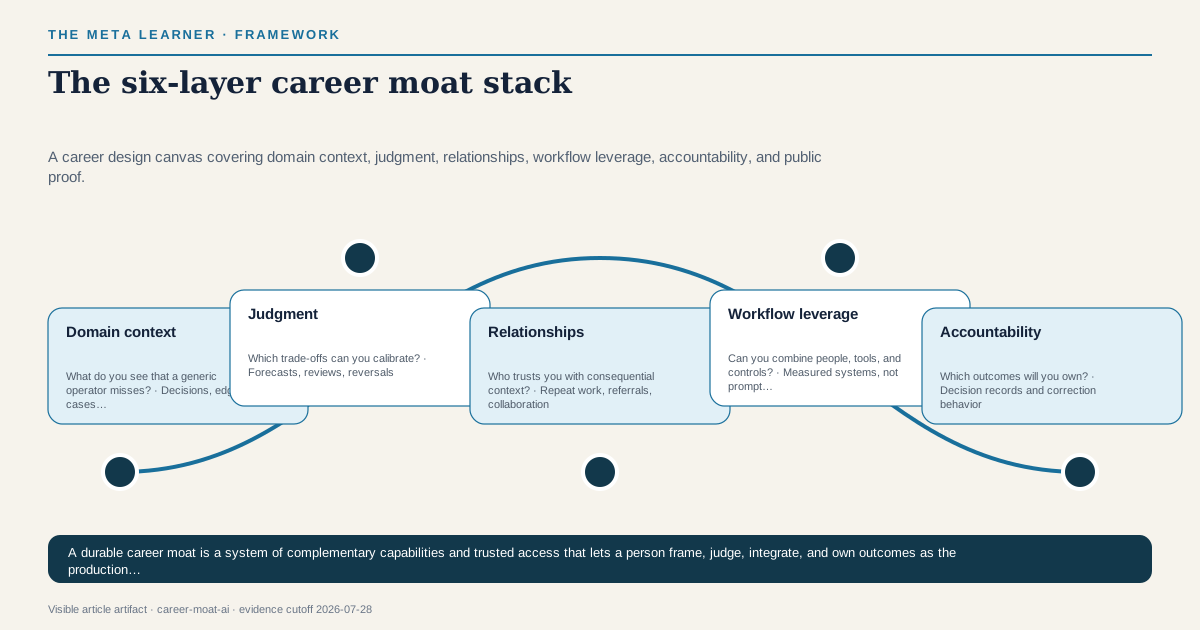
A career moat is not one task that AI cannot perform. It is a reinforcing stack: domain context, calibrated judgment, trusted relationships, workflow design, accountable ownership, and evidence that you can produce outcomes under real constraints. As AI lowers the cost of drafts and analysis, the moat moves toward choosing the right problem, verifying the work, integrating people and systems, and bearing responsibility for the result.
Why task scarcity is a weak moat
Advice about “AI-proof skills” assumes capability changes one task at a time and leaves the surrounding market still. In reality, tools alter task bundles, review costs, expectations, team structure, and the price clients will pay. A currently difficult task may become cheap; a previously minor coordination problem may become the bottleneck.
The ILO’s 2025 exposure index analyzes thousands of tasks and distinguishes gradients of occupational exposure. A separate field deployment in customer support found effects bounded to one firm, task, tool, and period—useful evidence that capability and workplace value must not be collapsed into a universal career forecast.ilo-exposure, oecd-ai-skills, onet-model, nber-work Exposure is not the same as displacement. Adoption, institutions, job design, worker voice, demand, and new tasks influence what happens.
Design your position from the work, not the headline.
Scenario: the six-layer career moat stack under organizational constraints
A freelance market researcher competes with tools that can generate a polished competitor report in minutes.
The weak defense is faster report production. The stronger stack is:
- access to specialized bilingual sources;
- a claim-level evidence ledger;
- interviews conducted with permission;
- explicit uncertainty and counterevidence;
- business-specific decision thresholds;
- a briefing where the client can challenge the reasoning;
- a correction record.
AI assists search and comparison. The paid outcome is a decision-grade view with provenance and accountable interpretation. This case illustrates a positioning design; it does not prove demand or pricing in another market.
The six-layer career moat stack
| Layer | Question | Evidence | |---|---|---| | Domain context | What do you see that a generic operator misses? | Decisions, edge cases, causal models | | Judgment | Which trade-offs can you calibrate? | Forecasts, reviews, reversals | | Relationships | Who trusts you with consequential context? | Repeat work, referrals, collaboration | | Workflow leverage | Can you combine people, tools, and controls? | Measured systems, not prompt collections | | Accountability | Which outcomes will you own? | Decision records and correction behavior | | Proof | Can another person inspect the capability? | Work samples, cases, artifacts |
The stack matters because each layer reinforces the others. Domain knowledge improves questions; better questions improve workflow design; reliable work deepens trust; accountability creates evidence.
Current official evidence supports task-level change, uneven exposure, and continued value for broad foundational, digital, managerial, and human capabilities. It does not identify a universally safe occupation or prove that the six-layer stack will create market power for a particular worker.
Claim sources: oecd-ai-skills, ilo-exposure, onet-model
Map work at two levels
O*NET organizes occupations through worker characteristics, skills, knowledge, tasks, work activities, context, and labour-market information.onet-model Use that structure to make two maps:
Task map: recurring transformations, decisions, interactions, exceptions, and outputs.
Outcome map: who needs the result, what quality means, what failure costs, and who is accountable.
AI may automate parts of the task map while increasing the value of someone who can own the outcome map.
Build complements, not slogans
The OECD argues that AI-era adaptation involves foundational, digital, complementary, and advanced skills, while effects differ across sectors, regions, and skill levels.oecd-ai-skills “Human skills” is too vague to guide action. Specify complements:
- interviewing domain experts to expose tacit constraints;
- evaluating model output against an explicit standard;
- negotiating among stakeholders with incompatible incentives;
- designing an escalation path for rare, consequential cases;
- translating evidence across technical and executive contexts;
- making a decision with uncertainty visible.
Each complement should produce an artifact or observed performance.
Build the six-layer moat stack
- Decompose your role into ten tasks and five accountable outcomes.
- Mark which tasks are becoming cheaper or easier.
- identify the new bottlenecks created by that change.
- Select one capability in each moat layer.
- Build a work sample that combines at least three layers.
- Ask a real evaluator what evidence is missing.
- Update the stack from observed demand, not self-description.
Use Audit Your Work for Automation, Augmentation, and Human Judgment for decomposition and Build a Skill Portfolio for an AI-Shaped Career for proof. Compare assumptions with The State of AI-Assisted Learning in 2026.
Career defenses that decay quickly
- Building identity around one tool.
- Calling communication or creativity “uniquely human” without performance evidence.
- Accumulating certificates without work samples.
- Keeping domain knowledge while ignoring workflow change.
- Automating junior learning tasks until oversight becomes ceremonial.
- Confusing social-media visibility with trusted access.
- Assuming responsibility is valuable without the authority to act.
Test the moat as a system, not as a self-description. Choose a representative assignment and ask what happens when generic production becomes nearly free. If the advantage disappears, the “moat” was output scarcity. If the work still depends on proprietary context, stakeholder trust, calibrated trade-offs, integration, or accountable correction, record how those elements changed the result. Then expose the evidence to a buyer or domain reviewer. A defensible moat should survive a harder tool, a different task, and an evaluator who does not already believe your story. It should also reveal a learning agenda: which layer is currently constraining the others, and which observed market signal would justify investing in it?
No moat removes market risk
Career outcomes depend on geography, language, credentials, discrimination, health, networks, capital, regulation, organizational strategy, and macroeconomic demand. The framework does not guarantee income or job security. Current AI and labour evidence is evolving, and official exposure measures are not forecasts for one person. Test positioning through real work and local market evidence.
The strongest moat is not distance from technology. It is a position from which better technology makes your judgment, reach, and accountability more valuable together.
Named sources
Evidence and further reading
Published July 29, 2026. No substantive revision has been recorded. Evidence last verified July 28, 2026.