AI Fluency Is Spreading Faster Than AI Governance
Why rapid tool use can outrun authority, evaluation, incident response, and worker participation—and which governance signposts show real institutional learning.
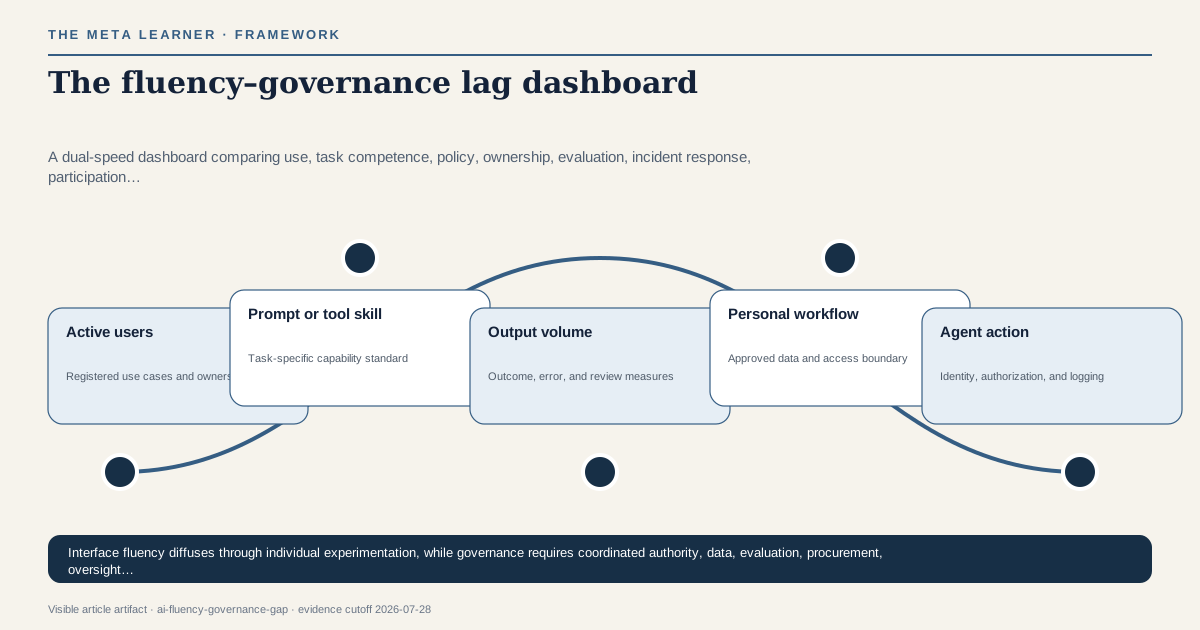
AI fluency spreads quickly because one person can begin using an accessible tool immediately. Governance is slower because it must coordinate authority, data, procurement, evaluation, worker and user interests, monitoring, and correction across an institution. The lag is not proof that governance has failed, but unmanaged fluency can turn local experimentation into system-wide exposure.
Observed evidence of two speeds
Observed facts at the cutoff include broad reported use, continued early agent deployment, formal responsible-AI activity, and documented gaps in implementation capacity. They do not establish that every institution is behind or that a longer policy document signals better control.
Stanford’s 2026 economy chapter reports extensive organization-level AI use, though the depth and type of use vary.stanford-economy, stanford-responsible, oecd-governing, nist-rmf Its responsible-AI chapter describes growing formalization alongside measurement, knowledge, and budget gaps.stanford-responsible
The OECD’s study of AI in government identifies seven enabling areas—governance, data, infrastructure, skills, investment, procurement, and partnerships—alongside guardrails and engagement.oecd-governing NIST’s framework organizes risk management across Govern, Map, Measure, and Manage functions.nist-rmf
The evidence supports rapid use, emerging governance, and persistent implementation gaps. It does not provide a single comparable clock proving that fluency always precedes governance in every organization.
Claim sources: stanford-economy, stanford-responsible, oecd-governing, nist-rmf
Why the speeds differ
Fluency is modular. A worker can try summarization, drafting, coding, or translation inside an existing task. Benefits appear personal and immediate.
Governance is interdependent. A rule about data affects security and procurement. A review gate affects staffing and turnaround. A model change affects evaluation. A transparency commitment affects communication, legal obligations, and worker trust.
Governance also faces an information problem. Rules written before use may be abstract; rules written after decentralized adoption may arrive after sensitive data, undocumented workflows, and hidden dependencies have spread.
The challenge is not to make governance as fast as clicking “sign up.” It is to create a learning system that can observe use, distinguish risk, and adjust authority without either paralysis or denial.
Our inference: shadow adoption becomes governance debt
When policy lags, people do not necessarily wait. They improvise. Useful practices and unsafe ones grow together. The organization accumulates governance debt:
- unknown tools and model versions;
- unclear data exposure;
- decisions without contribution records;
- duplicated evaluation;
- missing incident routes;
- workers responsible for outcomes they cannot control;
- dependencies that become visible only when access changes.
Like technical debt, governance debt can enable early learning. It becomes dangerous when nobody records or repays it.
Debt also compounds through precedent. A temporary exception becomes the normal workflow; a personal tool becomes a shared dependency; an unverified metric enters a management report; and a worker learns that raising concerns only delays delivery. The ledger should record not merely which rule is missing, but which behavior is becoming institutionally difficult to reverse.
The lag dashboard
Measure two columns:
| Fluency indicator | Governance counterpart | |---|---| | Active users | Registered use cases and owners | | Prompt or tool skill | Task-specific capability standard | | Output volume | Outcome, error, and review measures | | Personal workflow | Approved data and access boundary | | Agent action | Identity, authorization, and logging | | Adoption story | Incident, appeal, and correction route | | Training completion | Demonstrated judgment and escalation |
A red gap is not automatically a ban. It signals where experimentation should be contained until the counterpart exists.
Bounded case: a distributed communications team
Writers across regions adopt AI for translation, summarization, and social copy. A central policy says “verify output and protect confidential data,” but provides no approved source collection, language-quality tests, or disclosure boundary.
The team inventories three use cases, names an owner for each, specifies prohibited inputs, tests high-risk languages with qualified reviewers, and records material corrections. Social copy cannot strengthen claims beyond the source article. Incidents route to a visible channel.
This is a modest governance layer around actual work, not a complete responsible-AI program. AI Literacy for Adult Learners distinguishes fluency from judgment, while How Teams Can Adopt AI Without Losing Accountability supplies a charter.
The case against governance theater
A policy can make the lag look smaller without changing behavior. Warning signs include principles without task owners, mandatory review without reviewer time, prohibited tools with no viable alternative, inventories nobody uses, and training measured by attendance.
Effective governance must reach the workflow. It asks which action is permitted, which evidence is required, who can stop, and what the organization learns from correction. The objective is not paperwork density; it is accountable adaptation.
Governance scenarios and signposts
Adaptive convergence. Institutions learn from bounded pilots and close the gap. Signposts: use-case inventories tied to owners, proportionate controls, incident exercises, worker participation, and retired failed deployments.
Permanent shadow layer. Formal policy remains detached from real work. Signposts: unsanctioned tools, vague exceptions, missing logs, and widespread quiet repair.
Crisis catch-up. A public incident produces sudden restriction. Signposts: emergency bans, access withdrawal, blame without workflow evidence, and governance concentrated after harm.
Governance by infrastructure. Approved platforms embed identity, data boundaries, provenance, and evaluation. Signposts: automatic logging and least privilege—but also risk that one infrastructure provider sets institutional norms.
For agentic systems, Are Organizations Ready to Absorb AI Agents? raises the standard from content governance to action governance.
Invalidation signals for the fluency–governance lag dashboard
The lag thesis would weaken if representative evidence showed governance maturity rising at least as fast as use, with clear reductions in incidents, shadow adoption, and accountability gaps. It would also weaken where infrastructure makes proportionate governance effectively automatic.
At a local level, a risk-control gap should be considered closed only when behavior and outcomes—not policy publication—show that authority, evaluation, and correction work.
Boundaries of the lag
“Fluency” and “governance” lack common measures, and organizations report them selectively. Regulation, sector, firm size, national capacity, worker voice, and technology architecture create different speeds. Some governance should deliberately take time because it mediates rights and consequences. The dashboard is an editorial instrument, not a maturity certification, current through July 28, 2026.
The danger is not that people learn quickly. It is that institutions mistake widespread use for a system capable of owning what that use changes.
Named sources
Evidence and further reading
Published July 29, 2026. No substantive revision has been recorded. Evidence last verified July 28, 2026.