The Steelman–Red-Team Protocol: Improve an Argument Before Rejecting It
Reconstruct the strongest supportable argument, secure fidelity, then test its premises, evidence, alternatives, and reversal conditions adversarially.
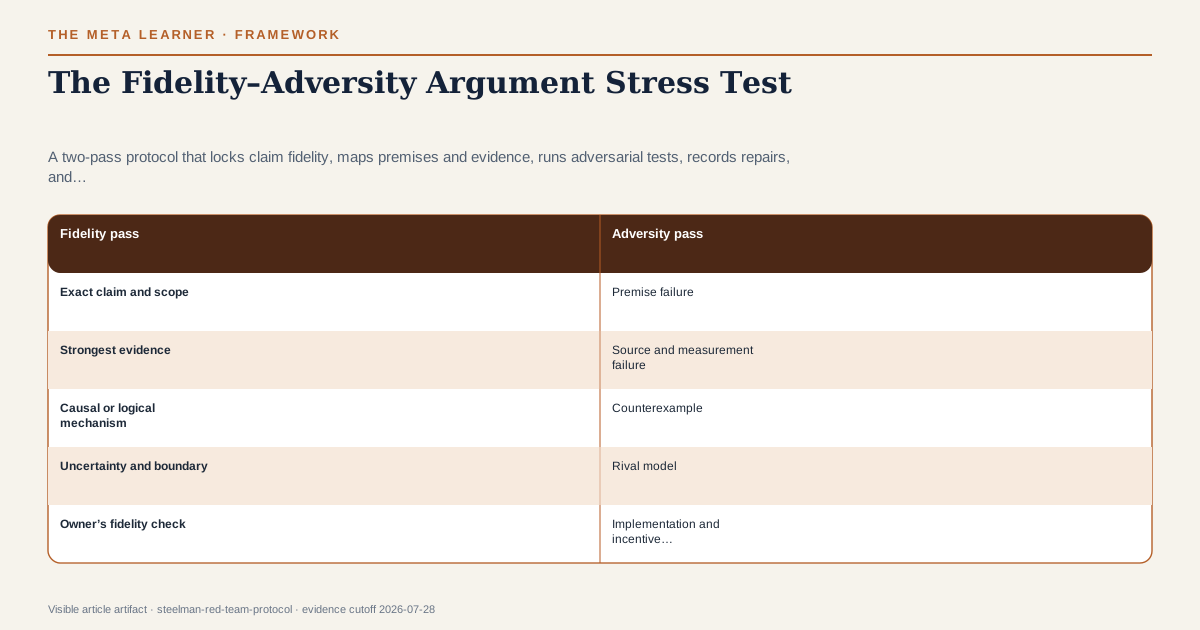
First reconstruct the strongest version of the argument that its owner and evidence can support: claim, premises, mechanism, scope, evidence, and uncertainty. Obtain a fidelity check. Then red-team it with premise, source, counterexample, rival-model, implementation, incentive, and reversal tests. Repair surviving weaknesses and report what would change the conclusion. Considering an opposite can create false balance, and red-team practice can be distorted by power, incentives, missing expertise, or unsafe debate.
Use this for a consequential contestable claim
Use this protocol before a strategy decision, research synthesis, policy recommendation, product thesis, or public argument where disagreement is meaningful and evidence can be inspected.
Do not use it to create debate around established rights, harass a vulnerable speaker, manufacture uncertainty against overwhelming evidence, or decide an emergency when the governing procedure is clear. A steelman is the strongest supportable argument, not the most persuasive fantasy. A red team tests the claim in scope, not the dignity or motives of the person.
Experimental work on “consider the opposite” found that generating alternative explanations can reduce some judgment biases under studied conditions. opposite, nist NIST’s generative-AI profile treats red teaming as part of broader testing and risk management, with limitations and governance rather than a single attack exercise. nist
Failure modes that reward clever attack
- Steelmanning a claim beyond its evidence.
- Asking the opponent to approve wording under social pressure.
- Attacking tone or motivation rather than premises.
- Generating many weak objections instead of one discriminating test.
- Treating an anecdote as a decisive counterexample.
- Ignoring base rates and rival models.
- Letting the advocate grade the attack alone.
- Reporting the repaired argument as if it was the original.
Stop when further objections do not change scope, confidence, action, or required evidence.
The two-pass stress test
| Fidelity pass | Adversity pass | |---|---| | Exact claim and scope | Premise failure | | Strongest evidence | Source and measurement failure | | Causal or logical mechanism | Counterexample | | Uncertainty and boundary | Rival model | | Owner’s fidelity check | Implementation and incentive failure | | Decision consequence | Reversal evidence |
No adversity score is valid until the fidelity pass is accepted or disagreements about representation are recorded.
Evidence for the diagnosis: the Fidelity–Adversity Argument Stress Test
Research supports alternative-generation as a corrective under some conditions, and official risk guidance supports adversarial evaluation within a wider governance process. Evidence does not validate this exact two-pass protocol or imply that balanced treatment means equal evidential weight.
opposite, nistRun fidelity before adversity
Step 1 — Lock the question. State the decision and exact proposition, including population, time, and consequence.
Step 2 — Reconstruct. Write premises, inferential bridge, conclusion, strongest opened evidence, uncertainty, and boundary.
Step 3 — Check fidelity. Ask the argument owner or a competent advocate: “Would you endorse this as the strongest supportable version?” Record unresolved representation disputes.
Step 4 — Freeze attack criteria. Define what counts as source failure, counterexample, mechanism break, rival explanation, implementation failure, and reversal.
Step 5 — Attack independently. Red-team members produce tests before group discussion. Separate factual defects from value disagreement.
Step 6 — Repair. Narrow, condition, or strengthen the argument. Do not erase the original.
Step 7 — Re-attack the repaired claim. A repair can create a new boundary or contradict another premise.
Step 8 — Decide. Report surviving claim, residual risk, strongest counterargument, and evidence that would reverse the conclusion.
Worked example: “AI will halve research time”
The steelman becomes: “For experienced analysts performing a defined evidence-extraction workflow on approved documents, an AI-assisted prototype may reduce median handling time by 50 percent while meeting predeclared citation and error thresholds.”
The red team tests the baseline, selection of easy documents, review time, citation fidelity, hidden data preparation, expert versus novice effects, and whether errors concentrate in consequential cases. A rival model says time shifts from extraction to verification.
The repaired claim may survive as “reduced first-pass extraction time,” while the original total-work claim fails. The protocol has improved the decision by reducing the territory claimed.
Adaptations for power and expertise
- Solo: write the fidelity pass one day and attack it later using fixed prompts.
- Team: separate advocates, red team, evidence arbiter, and decision owner.
- Technical claim: add executable tests and independent reproduction.
- Value conflict: separate empirical premises from ethical priorities; do not pretend data resolves the value choice.
- AI assistance: AI may generate candidate objections, but humans must verify sources and detect false balance.
Adaptation must preserve fidelity, independence, and the right to record minority evidence.
Build an attack portfolio rather than rewarding volume. Select one test for evidence provenance, one for the inferential bridge, one for an alternative mechanism, and one for implementation under adverse conditions. Rank them by the conclusion they could change. A devastating-sounding objection that cannot alter scope, confidence, or action is rhetoric, not a useful red-team result.
The transfer test for the Fidelity–Adversity Argument Stress Test
Present a new contentious claim without labels. The practitioner must create an endorsed reconstruction, identify the inferential bridge, set attack criteria, generate at least one rival, seek a decisive test, repair the claim, and state reversal evidence. An independent reviewer scores fidelity before analytical aggression.
Slow the inference path with The Ladder of Inference, preserve rival claims in The Hypothesis Ledger, and continue to source-level review with Critical Thinking: A Practical Framework.
Fair reconstruction does not create equal evidence
The protocol cannot remove power asymmetry, strategic deception, missing expertise, or the emotional cost of adversarial review. Considering alternatives can increase confusion when one is unsupported, and a red team can overfit known attacks. High-consequence conclusions require domain experts, primary evidence, and appropriate authority. Report asymmetry in evidence rather than forcing a symmetrical verdict.
The standard is not civility alone. It is a claim made strong enough to test and a test made fair enough to matter.
Named sources
Evidence and further reading
Published July 29, 2026. No substantive revision has been recorded. Evidence last verified July 28, 2026.