The Hypothesis Ledger: Track Beliefs, Evidence, and Revisions
Keep hypotheses append-only, define rival predictions before searching, and update confidence from dated evidence without rewriting intellectual history.
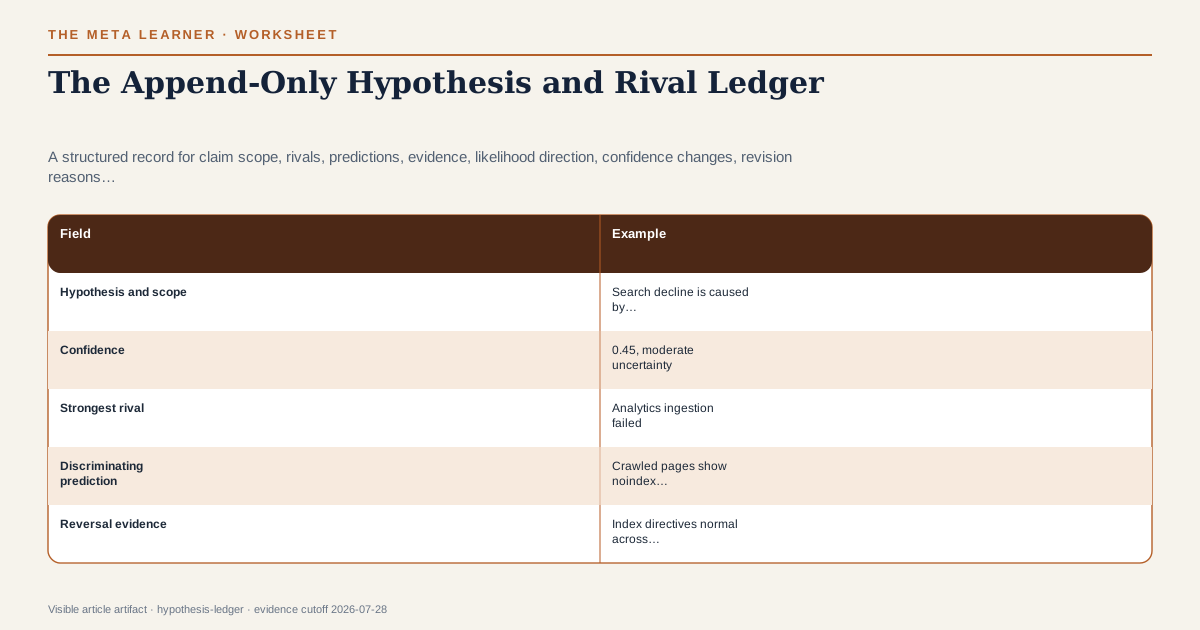
Create an append-only record for each material hypothesis: exact scope, current confidence, strongest rival, observations each predicts, evidence that would change confidence, and a decision relevance. Register it before targeted searching. Add dated evidence with source and quality, update confidence with reasons, and preserve every prior version. Registration can freeze a poor model, confidence updates remain judgmental, and an exhaustive hypothesis set is impossible.
Use this when evidence will arrive in pieces
Use this method for an uncertain causal explanation, product thesis, research question, diagnosis, forecast, or strategic belief that will receive observations over time. It is especially useful when multiple people search, incentives favor one answer, or the conclusion may change a decision.
Do not use it to turn settled facts into endless “hypotheses,” expose confidential or personal information without authority, or perform pseudo-Bayesian arithmetic with invented precision. When urgent protection is justified, act while continuing to update the explanation.
Preregistration scholarship argues for distinguishing confirmatory predictions and analysis from exploratory work rather than banning exploration. prereg, manifesto Reproducible-science proposals emphasize transparency, methods, and incentives across a research system. manifesto A practical ledger borrows this temporal discipline without pretending every inquiry is a formal study.
Failure modes that preserve a belief at any cost
- Writing the rival after seeing the result.
- Creating a rival too weak to matter.
- Recording only supportive evidence.
- Counting duplicated reports as independent observations.
- Updating confidence from source prestige without claim fit.
- Changing scope silently after disconfirmation.
- Using precise probabilities without calibration.
- Leaving a dead hypothesis “open” forever.
If no possible observation changes the claim, it is not functioning as a hypothesis.
The append-only record
| Field | Example | |---|---| | Hypothesis and scope | Search decline is caused by accidental noindex on route group A | | Confidence | 0.45, moderate uncertainty | | Strongest rival | Analytics ingestion failed | | Discriminating prediction | Crawled pages show noindex while raw server traffic remains stable | | Reversal evidence | Index directives normal across affected URLs | | Evidence entry | Source, date, quality, direction, notes | | Revision | Confidence, reason, author, timestamp | | Decision link | Which action changes at what threshold |
The original entry never changes. Corrections append a new version.
Evidence for the diagnosis: the Append-Only Hypothesis and Rival Ledger
Register predict observe and revise
Step 1 — State a bounded claim. Include population, mechanism, outcome, time, and conditions.
Step 2 — Add a serious rival. A rival should explain the same observation through a different mechanism.
Step 3 — Write discriminating predictions. Specify observations more likely under one account than the other.
Step 4 — Set an update rule. Name evidence that raises, lowers, or retires the hypothesis and any action threshold.
Step 5 — Freeze the entry. Timestamp it before targeted evidence collection.
Step 6 — Add evidence atomically. Record source, access date, observation, quality, scope, and direction. Do not merge contrary evidence into prose.
Step 7 — Update with reasons. Append confidence and explain which prediction or assumption changed.
Step 8 — Retire or fork. Mark a failed claim; create a narrower successor without deleting the original.
Worked ledger: “AI feedback improves writing”
The broad claim is untestable. A bounded version says: “For developing second-language writers in this course, diagnosis-only AI feedback will improve independent revision on a new argumentative paragraph compared with self-review.”
The rival says additional time and attention, not AI diagnosis, drives improvement. A discriminating design equalizes time, preserves original drafts, uses a blinded human rubric, and tests a new prompt without AI. If only AI-assisted revision improves, the original transfer claim falls even if students produce better submitted drafts.
The ledger captures that narrowing as learning rather than failure.
Adaptations for different evidence systems
- Research: link protocol, measures, exclusions, and analysis plan.
- Strategy: use scenarios, signposts, and decision thresholds.
- Diagnosis: include harm-sensitive action that may precede causal certainty.
- Team inquiry: register individual estimates before discussion, then a group synthesis.
- Qualitative work: replace numeric confidence with ordered labels and explicit reasons, while preserving rivals.
Adaptation must keep chronology and revision visible.
Audit evidence independence
Several links can repeat one upstream claim. For every evidence entry, record the primary origin, funding or institutional relationship when material, data overlap, and whether another item is genuinely independent. Five articles summarizing the same study are one evidential lineage, not five replications.
Also separate measurement from interpretation. “The route returned a noindex directive at 10:32” is an observation; “the release caused the traffic decline” is an inference combining timing, mechanism, and exclusion of rivals. Update each hypothesis from the appropriate layer. When evidence fits both rivals, mark it non-discriminating rather than letting volume create false confidence. This audit often changes less glamorous entries—the source graph and scope note—before it changes the headline probability.
The transfer test for the Append-Only Hypothesis and Rival Ledger
Give the analyst a new uncertain claim and a mixed source packet. Without the form, they must bound the hypothesis, generate a rival, write a discriminating prediction and update rule before reading the results, add evidence with scope, and preserve a reasoned revision. Score chronology and discrimination, not whether the preferred claim wins.
Expose the assumption with The Ladder of Inference, attack both accounts through The Steelman–Red-Team Protocol, and connect the belief to action with The Decision Journal Method.
A ledger cannot make subjective updates objective
Evidence quality, likelihood, and confidence remain judgmental outside a formal model. Hypotheses are not exhaustive, observations may be dependent, and strategic actors can manipulate records. Registration can discourage useful exploration if treated rigidly. Keep exploratory ideas welcome, label them honestly, and use qualified methods for high-stakes causal claims.
The ledger protects intellectual history so that a changed mind can show exactly what evidence earned the change.
Named sources
Evidence and further reading
Published July 29, 2026. No substantive revision has been recorded. Evidence last verified July 28, 2026.