The Decision Journal Method: Calibrate Judgment Over Time
Record the decision state before outcomes arrive, then score predictions, separate process from luck, and update recurring judgment patterns.
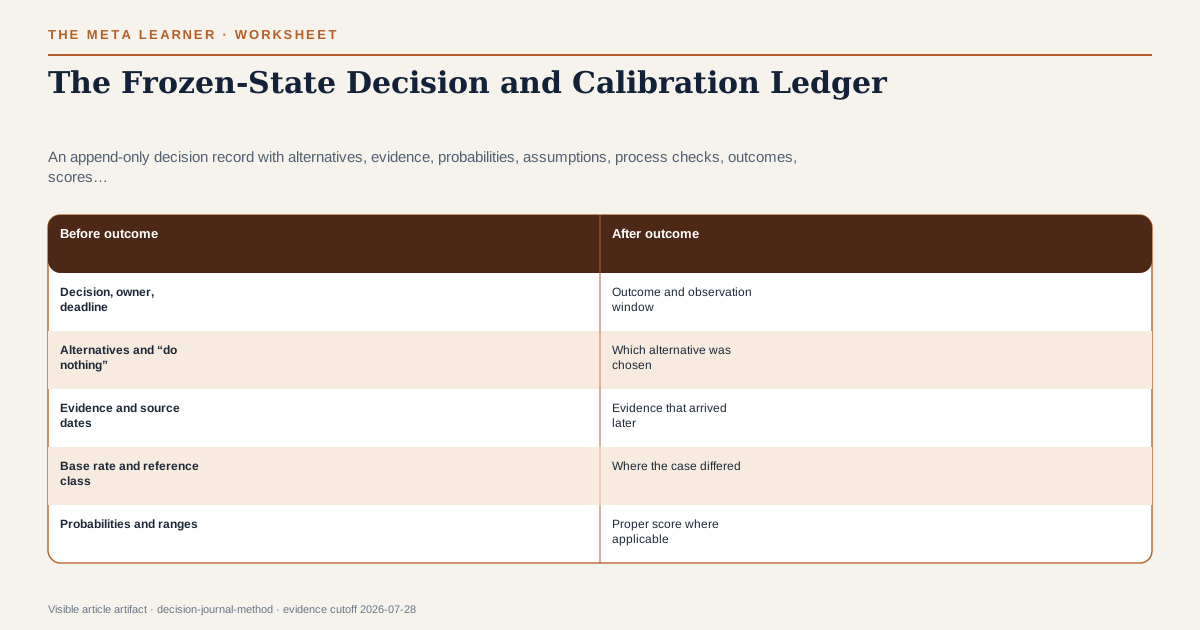
Before deciding, record the question, owner, deadline, alternatives, current evidence, base rate, key assumptions, probabilities, expected downside, reversibility, and what would change your mind. After the outcome, append what happened, score the predictions, judge process separately from result, and update only patterns supported by a comparable set of decisions. Journaling does not remove incentives, missing alternatives, correlated outcomes, or rare-event uncertainty, and small samples can mislead.
Use this for repeated consequential uncertainty
Use this method for hiring, product bets, forecasts, investments of time, experiments, negotiations, and other decisions in which uncertainty matters and similar choices recur. Its value comes from making the pre-outcome state inspectable.
Do not use it to manufacture false precision for a one-off moral judgment, record sensitive personal information without authority, or delay an urgent reversible choice. A journal is not a confession diary. It is a calibration dataset with a defined unit of decision.
Research on outcome bias shows that people can evaluate a decision differently after learning its result even when the decision information was the same. outcome, forecast Forecasting-tournament research documents practices associated with improved probabilistic judgment, while not proving that journaling alone causes performance. forecast
Freeze decide score and update
Step 1 — Bound the decision. State what is being chosen, by whom, by when, and what is outside scope.
Step 2 — Generate alternatives. Include the status quo and at least one materially different path.
Step 3 — Freeze evidence. Link sources, mark observations versus inference, and state what remains unknown.
Step 4 — Quantify uncertainty. Assign probabilities to mutually clear events where feasible. Use ranges and conditional statements when one number would mislead.
Step 5 — Name assumptions. For each decisive belief, record an observable sign that would weaken it.
Step 6 — Make the decision. State rationale, expected consequence, safeguards, and reversal plan.
Step 7 — Review blind. When possible, have a reviewer assess process from the left column before seeing the outcome.
Step 8 — Score and update. Append results, calculate forecast scores across a batch, and revise a recurring decision rule only when a pattern exists.
The frozen-state ledger
Each entry contains:
| Before outcome | After outcome | |---|---| | Decision, owner, deadline | Outcome and observation window | | Alternatives and “do nothing” | Which alternative was chosen | | Evidence and source dates | Evidence that arrived later | | Base rate and reference class | Where the case differed | | Probabilities and ranges | Proper score where applicable | | Assumptions and reversal evidence | Assumptions supported or broken | | Process blockers and dissent | Process quality, judged blind to result | | Expected upside, downside, reversibility | Actual consequence and recovery |
Never overwrite the left column. Append clarification with a timestamp.
Why the evidence supports the Frozen-State Decision and Calibration Ledger
Experimental evidence supports outcome bias, and forecasting research supports probabilistic practice, updating, and aggregation under defined conditions. The complete ledger is an editorial synthesis. Evidence does not show that private journaling alone eliminates bias or creates skill without feedback and repeated comparable cases.
outcome, forecastSeparate the four quadrants
| Process | Outcome | Interpretation | |---|---|---| | Strong | Good | Consistent with skill; not proof | | Strong | Bad | Possible bad luck or missing model | | Weak | Good | Luck may conceal a fragile process | | Weak | Bad | Repair the process before retaking risk |
The quadrant blocks the seductive inference that winning proves wisdom or losing proves stupidity.
Adaptations for different decision tempos
- Fast reversible choice: use a six-line entry and a one-week outcome window.
- Major commitment: add independent estimates, pre-mortem, legal or technical gates, and explicit dissent.
- Forecast portfolio: define resolvable events and score probabilities over many cases.
- Team decision: record each member’s estimate before discussion, then the aggregated estimate.
- Qualitative uncertainty: use ranked scenarios with observable signposts, but do not call them calibrated probabilities.
Adaptation changes detail, not the requirement to freeze the state before learning the outcome.
Review decisions as a cohort
After enough entries resolve, group them by decision type, horizon, and information environment. Compare stated confidence with outcome frequency, but also inspect false positives, false negatives, and cases that never resolved. A good overall score can hide systematic overconfidence in one high-consequence class.
Choose one pattern-level repair: widen the reference class, seek an independent estimate before discussion, lower an action threshold, or make a reversible pilot the default. Register the predicted effect of that repair before applying it to the next cohort. Do not rewrite old probabilities or remove awkward cases. The journal becomes a training system only when the changed rule is tested against later decisions.
Failure modes that turn the journal into memoir
- Writing the rationale after the result.
- Recording only successful or memorable decisions.
- Omitting the alternative that was rejected.
- Using vague outcomes that can never resolve.
- Giving 70 percent to everything and never scoring.
- Treating one surprise as a new universal rule.
- Evaluating process with outcome visible.
- Hiding political incentives and authority.
If entries are not comparable, analyze decision types separately rather than averaging them.
Verify the Frozen-State Decision and Calibration Ledger outside rehearsal
Give the decision owner a new case without the template. They must reconstruct the minimum fields, generate alternatives, state a base rate, quantify a resolvable uncertainty, name reversal evidence, and preserve the entry before acting. After resolution, a second reviewer checks whether the learner separates process from outcome and updates from a set rather than one story.
Surface failure hypotheses with The Pre-Mortem Method, maintain key beliefs in The Hypothesis Ledger, and turn a completed team event into action through The After-Action Review.
Calibration needs cases not confession
Small samples, selection effects, correlated events, changing environments, and ambiguous outcomes can make apparent calibration unstable. Probability scoring requires clearly defined events and resolution rules. A journal can also expose confidential reasoning or create surveillance risk. Use appropriate access control, retention, and aggregation, and do not infer moral worth or general intelligence from a decision score.
The journal becomes valuable when it changes a recurring decision rule with evidence, not when it proves that hindsight can tell a compelling story.
Named sources
Evidence and further reading
Published July 29, 2026. No substantive revision has been recorded. Evidence last verified July 28, 2026.