The After-Action Review: Turn Projects Into Institutional Learning
Compare intent with evidence, reconstruct why results diverged, preserve successes and negative findings, and assign a tested change to the next cycle.
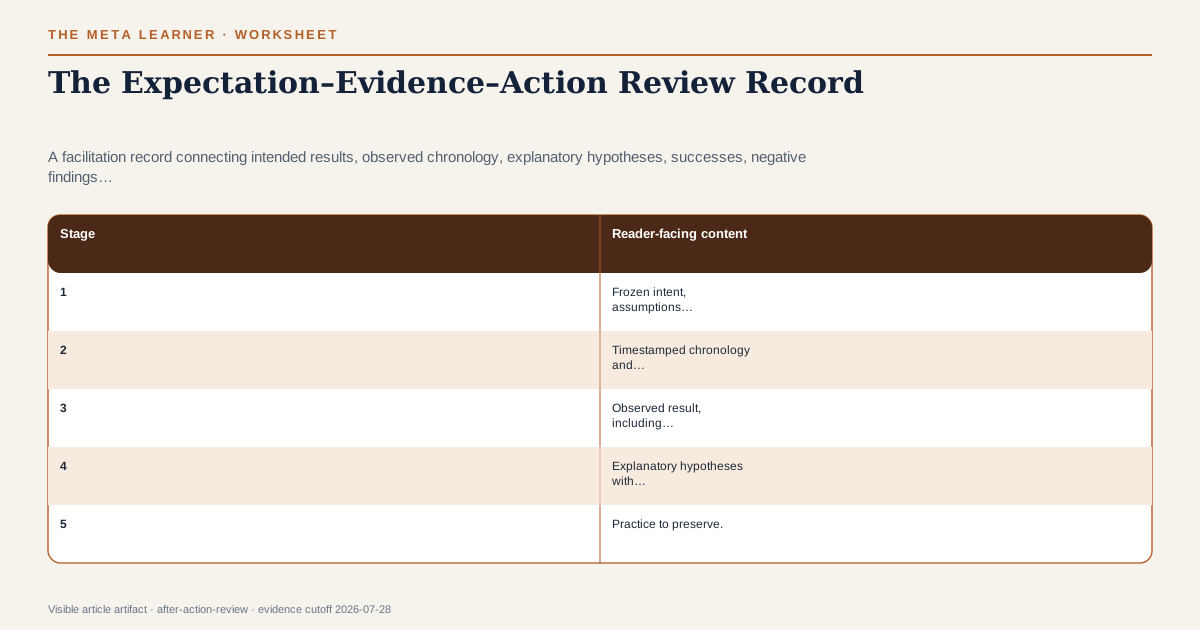
Run an after-action review soon after a bounded event. Restore the original intent and measures; reconstruct what occurred from records and participant perspectives; explain divergences without collapsing hypothesis into fact; identify what to preserve and change; then assign one observable action, owner, and retest in the next comparable cycle. Review effects depend on facilitation, evidence, candor, follow-through, power, and whether the next task is comparable.
Use this while the evidence is still recoverable
Use this after a project, exercise, release, incident, campaign, experiment, or operational period with a definable intention and participants who saw different parts of the work. Review successful performances as well as failures; success may depend on a fragile improvisation that the formal process never captured.
Do not use an AAR as a disciplinary hearing, performance ranking, public confession, or substitute for a protected incident investigation. Do not convene it while immediate safety and support needs remain unresolved. If participants face retaliation for candor, fix the authority and confidentiality design before expecting learning.
UK Health and Safety Executive guidance structures an after-action review around what was supposed to happen, what actually happened, why, lessons, and resulting actions. hse, ellis Research on after-event reviews examined learning from both successful and failed experience, supporting the value of structured reflection while leaving important contextual boundaries. ellis
Worked review: a delayed research release
Intent: release a source-verified report after three gates. Actual: the report was accurate but five days late. The easy story blames “scope creep.”
Chronology shows a late source-format change, one reviewer holding all claims, and a successful script written during the delay. The AAR preserves the script, tests two review lanes, and requires source-format freeze before the final gate. It does not declare parallel review successful until the next comparable release.
A negative finding remains: the new script caught formatting differences but did not reduce expert verification time. Preserving that result prevents automation mythology.
The review record
The original asset contains:
- Frozen intent, assumptions, and measures.
- Timestamped chronology and artifacts.
- Observed result, including unexpected positives.
- Explanatory hypotheses with evidence and dissent.
- Practice to preserve.
- Failure or near miss to address.
- One change, owner, due condition, and predicted signal.
- Next comparable event and retest result.
“Lesson learned” is not a status. The record stays open until the change is tested.
Evidence inside the case boundary: the Expectation–Evidence–Action Review Record
Facilitate the four-question evidence review
Step 1 — Rebuild the intention. Read the original goal, baseline, plan, measures, roles, and predictions. Do not reconstruct intent from the outcome.
Step 2 — Ask what occurred. Build a chronology from logs, outputs, observations, and participant accounts. Mark disagreement.
Step 3 — Ask why it differed. Generate multiple explanations. Separate controllable contributors, environmental change, luck, and still-unknown causes.
Step 4 — Ask what to preserve or change. Identify effective adaptation, failed assumption, and side effects.
Step 5 — Prioritize one or two actions. Each gets an owner, implementation condition, expected result, guardrail, and next test.
Step 6 — Publish to the right audience. Share sanitized lessons with people who can act, while protecting sensitive details.
Step 7 — Close on recurrence. At the next comparable event, test whether behavior and result changed.
Adaptations by event type
- Ten-minute hot review: intent, observation, one divergence, one owner; follow with evidence later.
- Project review: include timeline, decision journal, artifact links, and downstream stakeholders.
- Cross-team review: gather independent accounts before the meeting.
- Sensitive event: use an independent facilitator, protected channels, and clear separation from discipline.
- Solo review: freeze the original plan and wait before interpreting to reduce immediate self-justification.
Adaptation may reduce ceremony but not the link from intention to observation to tested action.
Design the room for evidence
Send the original plan and neutral chronology before the session. Ask participants to add missing observations independently, then let people closest to the work speak before senior sponsors. Display facts, interpretations, and proposed actions in separate columns. A facilitator should interrupt blame labels and ask for the observable event or governing condition underneath them.
Close by reading every owner, prediction, and retest aloud. If the owner lacks authority or resources, the action is not assigned. If the lesson cannot be retrieved when the next task begins, add a trigger to the relevant template, checklist, or kickoff rather than relying on organizational memory.
Failure modes that produce lessons nobody uses
- Starting with “what went wrong” and ignoring success.
- Letting the senior owner narrate first.
- Replacing chronology with memory and opinion.
- Calling a hypothesis a root cause.
- Producing twenty recommendations with no owner.
- Treating the meeting as completion.
- Hiding negative findings to protect the project.
- Reusing generic lessons that do not change a procedure.
If no next comparable task exists, store the lesson with explicit retrieval triggers rather than pretending transfer has occurred.
Test the Expectation–Evidence–Action Review Record beyond the original case
Give a facilitator a new completed event and its original plan. Without the worksheet, they must restore intent, build a multi-perspective chronology, separate observation from explanation, preserve one success and one negative finding, assign a change with a prediction, and name the next test. Participant safety and voice are part of fidelity.
Freeze the original decision through The Decision Journal Method, aggregate recurrence with The Error Taxonomy Method, and question a governing rule through Double-Loop Learning.
A review cannot manufacture candor or recurrence
Memory, hierarchy, fear, documentation gaps, and outcome bias affect review. A team may not receive another comparable task soon enough to test the change. Findings from one event do not establish general causality. Serious incidents require qualified, protected, and sometimes legally governed investigation beyond this method.
An AAR becomes institutional learning when the next team can see what changed, why it changed, and whether it worked.
Named sources
Evidence and further reading
Published July 29, 2026. No substantive revision has been recorded. Evidence last verified July 28, 2026.