Double-Loop Learning: Fix the Rule, Not Only the Error
Correct immediate performance, then test the governing assumption, metric, incentive, or policy that keeps reproducing the same class of error.
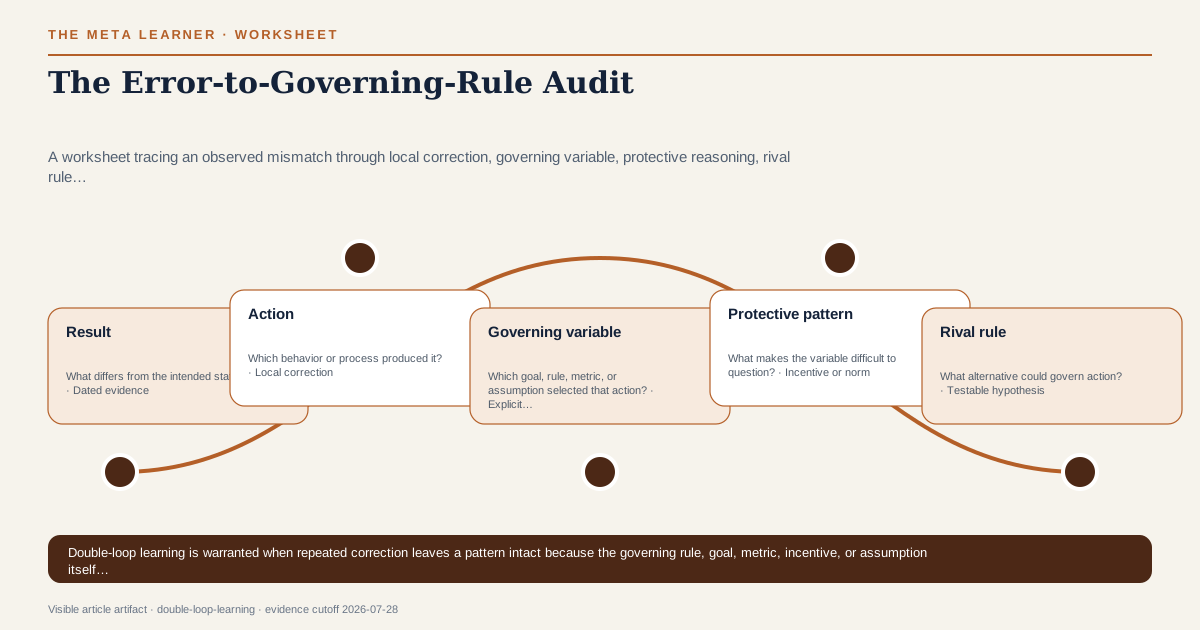
Use double-loop learning by first correcting the immediate mismatch, then tracing which goal, metric, assumption, incentive, policy, or norm made that response seem right. State a rival governing rule, predict its benefits and side effects, test it within a safe boundary, and update the rule only from observed results. Preserve both loops.
Use this when competent correction keeps failing
Use this method when a problem recurs despite capable people, local fixes, and feedback: the team improves forecast accuracy but keeps rewarding optimistic deadlines; customer support corrects bad replies while a throughput metric continues to punish investigation; a learner studies harder under a plan that measures completion rather than transfer.
Do not use double-loop language to skip disciplined execution, attack every standard, or announce “culture” when one tool is broken. When the governing rule is legally binding, safety-critical, or outside the team’s authority, escalation and qualified review come before experimentation. First establish that the pattern is real and that reasonable single-loop correction has been attempted.
Argyris distinguished models that correct action within existing governing variables from those that question the variables themselves. argyris, hbr His organizational account emphasized how defensive reasoning can prevent people from examining the assumptions that shape action. hbr
What survives the comparison: the Error-to-Governing-Rule Audit
Foundational organizational-learning work provides the distinction between correction within governing variables and inquiry into those variables. It does not establish that every recurring problem requires a second loop or validate this audit as a universal instrument. The method is best treated as a structured hypothesis test.
argyris, hbrThe two-loop audit
| Layer | Question | Artifact | |---|---|---| | Result | What differs from the intended state? | Dated evidence | | Action | Which behavior or process produced it? | Local correction | | Governing variable | Which goal, rule, metric, or assumption selected that action? | Explicit proposition | | Protective pattern | What makes the variable difficult to question? | Incentive or norm | | Rival rule | What alternative could govern action? | Testable hypothesis | | Safe experiment | What limited change can discriminate? | Prediction and guardrail |
The asset prevents “think deeper” from becoming an unbounded discussion.
Trace the error through two loops
Step 1 — Establish the recurrence. Collect comparable incidents, not one frustrating story. Define the expected and observed state.
Step 2 — Complete the first loop. Repair the immediate issue and document whether the correction works under the current rule.
Step 3 — Reconstruct selection. Ask what a reasonable actor was optimizing, protecting, assuming, or avoiding when choosing the action.
Step 4 — State the governing proposition. Write it in falsifiable form: “We reward rapid closure because faster closure is assumed to increase customer value.”
Step 5 — Find protective reasoning. Note status, identity, metric ownership, fear, or missing data that makes the proposition difficult to inspect.
Step 6 — Generate a rival rule. “We reward verified resolution, with speed as a constraint rather than the primary target.”
Step 7 — Model side effects. Identify what the old rule protected and what the rival may damage.
Step 8 — Run a bounded test. Change one team, queue, or decision class; define guardrails and an owner.
Step 9 — Update explicitly. Retain, revise, or replace the rule from evidence, then check whether behavior and results move.
Worked example: the deadline that always slips
A team repeatedly adds buffers to project estimates. The immediate fix is a larger buffer; the next launch still slips. The audit finds that people are rewarded for presenting an attractive date, while dependencies are recorded only after public commitment.
The governing rule is not “estimate accurately” but “win approval with an early date, then manage the variance.” A rival rule requires an evidence range, dependency confidence, and separate commitment date. The safe test applies this to one project family and predicts fewer emergency scope cuts without unacceptable decision delay.
If the test fails because upstream priorities remain unstable, the next loop must address portfolio governance rather than individual estimation.
Adaptations to authority and consequence
- Individual learning: test a personal success metric such as hours versus delayed performance.
- Team process: use anonymous evidence collection before examining a leader-owned rule.
- Regulated setting: keep mandatory constraints fixed and question implementation assumptions around them.
- High consequence: model side effects and obtain independent approval before changing control.
- AI workflow: distinguish a prompt correction from a rule about which tasks, data, or decisions may be delegated.
Adaptation should narrow the experiment, not weaken the inquiry.
Failure modes that confuse depth with disruption
- Calling the first explanation a root cause.
- Assuming recurrence proves the policy is wrong.
- Changing a rule before measuring local execution.
- Using “mindset” to blame people who lack resources.
- Ignoring the useful function served by the old rule.
- Challenging norms without psychological or organizational safety.
- Running a pilot with no predicted result or guardrail.
- celebrating candor without changing authority or incentives.
When the rule cannot be changed, document the constraint and redesign within it rather than pretending inquiry created control.
Where the Error-to-Governing-Rule Audit travels—and where it does not
Present a new recurring problem from another workflow. Without the worksheet, the practitioner must separate observed result, immediate correction, governing proposition, protective pattern, rival rule, side effects, and bounded test. A reviewer rejects answers that jump directly to “culture” or cannot name evidence that would preserve the current rule.
Start from an observed mismatch with The After-Action Review, map downstream effects through Systems Thinking, and freeze the rival rule and prediction in The Decision Journal Method.
Not every recurrence indicts the governing rule
Patterns can arise from noise, insufficient skill, scarce resources, conflicting authorities, or an unimplemented rule. Power can make honest inquiry unsafe, and a local experiment may miss system-wide effects. The method cannot determine legal authority or ethical legitimacy. Use representative evidence, protect dissent, and obtain qualified review before changing high-consequence controls.
Double-loop learning earns its name only when a governing proposition becomes visible, testable, and genuinely open to revision.
Named sources
Evidence and further reading
Published July 29, 2026. No substantive revision has been recorded. Evidence last verified July 28, 2026.