The Ladder of Inference: Slow Down Fast Conclusions
Trace a conclusion back through selected data, meaning, assumptions, and beliefs, then seek missing observations and test a rival interpretation.
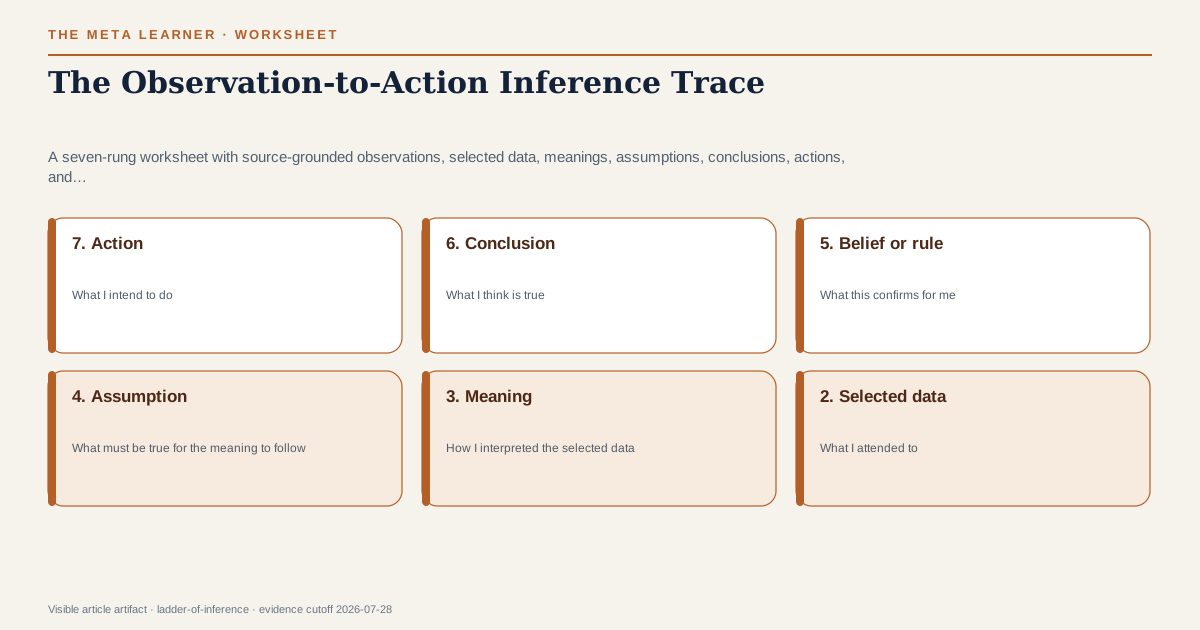
Write the conclusion or intended action, then trace downward: what belief supports it, which assumption gives the data meaning, which data you selected, and what was directly observable. Add omitted observations and construct a plausible rival ladder from the same base. Choose the smallest respectful test that can distinguish the interpretations.
Use this when a conclusion arrives before its trace
Use this method when a team is stuck in disagreement, an interpersonal story is hardening, or an analysis jumps from a small observation to a consequential action. It is most useful when the observation can still be checked and the next move is reversible.
Do not use it to demand that someone justify every intuition in real time, delay an emergency response, or invalidate lived experience. Do not use it when evidence of harm is already sufficient for a protective action. The method slows a selected inference; it is not a universal requirement to suspend judgment.
Argyris’s work on organizational learning examined how governing variables and reasoning can remain unavailable for scrutiny. argyris, opposite Research on considering an opposite provides narrower experimental support for generating alternative explanations as a corrective strategy. opposite The popular rung sequence is best treated as a practical representation, not a literal scan of cognition.
Walk down then climb a rival ladder
Step 1 — Capture the top. Write the exact conclusion and intended action without softening it.
Step 2 — Descend one rung at a time. For every statement, ask what assumption or selected observation makes it follow.
Step 3 — Clean the bottom. Rewrite observations without motive words, diagnosis, or evaluation. Link documents, timestamps, or quotations where available.
Step 4 — Expand the field. Ask what occurred before and after, what a different observer noticed, and what expected signal is absent.
Step 5 — Build a rival. Using the same observations, create the strongest plausible alternative meaning and conclusion.
Step 6 — Design a discriminating move. Ask a question, inspect a record, or run a reversible test whose result differs under the rivals.
Step 7 — Update the top. Change confidence, action, or scope and preserve the earlier trace.
The observation-to-action trace
| Rung | Entry | |---|---| | 7. Action | What I intend to do | | 6. Conclusion | What I think is true | | 5. Belief or rule | What this confirms for me | | 4. Assumption | What must be true for the meaning to follow | | 3. Meaning | How I interpreted the selected data | | 2. Selected data | What I attended to | | 1. Observable field | What a recorder or source could show |
Add two columns: “omitted data” and “rival ladder.” Those additions make the asset a test rather than a confession.
Why the evidence supports the Observation-to-Action Inference Trace
Organizational-learning theory and alternative-explanation research support making assumptions discussable and considering rival accounts. Evidence does not validate a fixed seven-step cognitive sequence or prove that completing a worksheet improves every decision. The trace is an editorial protocol.
argyris, oppositeWorked trace: “the analyst is disengaged”
Top: remove the analyst from a project. Selected data: two silent meetings and a late draft. Meaning: low commitment. Assumption: engaged people speak frequently and meet the first deadline. Observable field: the analyst spoke once, asked three questions in the document, and delivered eighteen hours after the provisional date.
Omitted data includes meeting airtime, timezone, unclear ownership, and whether the date was confirmed. A rival ladder says the analyst is cautious in groups and believed the date was tentative. The discriminating action is a private conversation using observations and a clarified next deliverable—not a public accusation or immediate removal.
The rival may be wrong. Its function is to make the first story testable.
Adaptations without demanding false neutrality
- Interpersonal: ask permission, state observations, and invite the other person’s ladder.
- Research claim: replace “observable field” with primary data and source text.
- Fast operation: use four lines—observation, inference, rival, next test.
- Team review: let people build ladders independently before discussion.
- Power-sensitive setting: use a facilitator and never force a less powerful person to disclose beliefs.
Adaptation must preserve the distinction between observation and interpretation.
Failure modes that turn the ladder into bureaucracy
- Calling an interpretation “raw data.”
- Moving downward only until evidence supports the preferred story.
- Generating a ridiculous rival.
- Treating every conclusion as equally uncertain.
- Using the worksheet to cross-examine rather than inquire.
- Ignoring emotion, incentives, and power.
- Asking questions when immediate protective action is warranted.
- Completing the trace without changing the next test.
If the conclusion rests on verified repeated evidence, the method can confirm rather than indefinitely reopen it.
Verify the Observation-to-Action Inference Trace outside rehearsal
Present a new ambiguous note, chart, or interaction. Without rung labels, the learner must separate observation, selection, meaning, assumption, conclusion, and action; identify omitted data; build a credible rival; and choose a respectful discriminating test. Score the quality of the rival and evidence, not the number of boxes.
Ground the bottom rung with Facts, Inferences, and Judgments, escalate a consequential claim into The Steelman–Red-Team Protocol, and preserve rivals in The Hypothesis Ledger.
The ladder is a conversation aid not a mind scanner
Human inference is not necessarily conscious, linear, or recoverable as seven stages. Observations are theory-laden, memory is fallible, and a rival explanation can create false balance. The method must not override credible safety evidence or compel disclosure. Use primary records, qualified expertise, and appropriate protective action when consequences are high.
The ladder works when it turns “obvious” into an inspectable path and that path produces a better next question.
Named sources
Evidence and further reading
Published July 29, 2026. No substantive revision has been recorded. Evidence last verified July 28, 2026.