The Scaffolding-Fade Protocol: Use AI Support, Then Remove It
Define the unsupported target, log every aid, fade one support at a time from performance evidence, restore help when needed, and test unaided transfer.
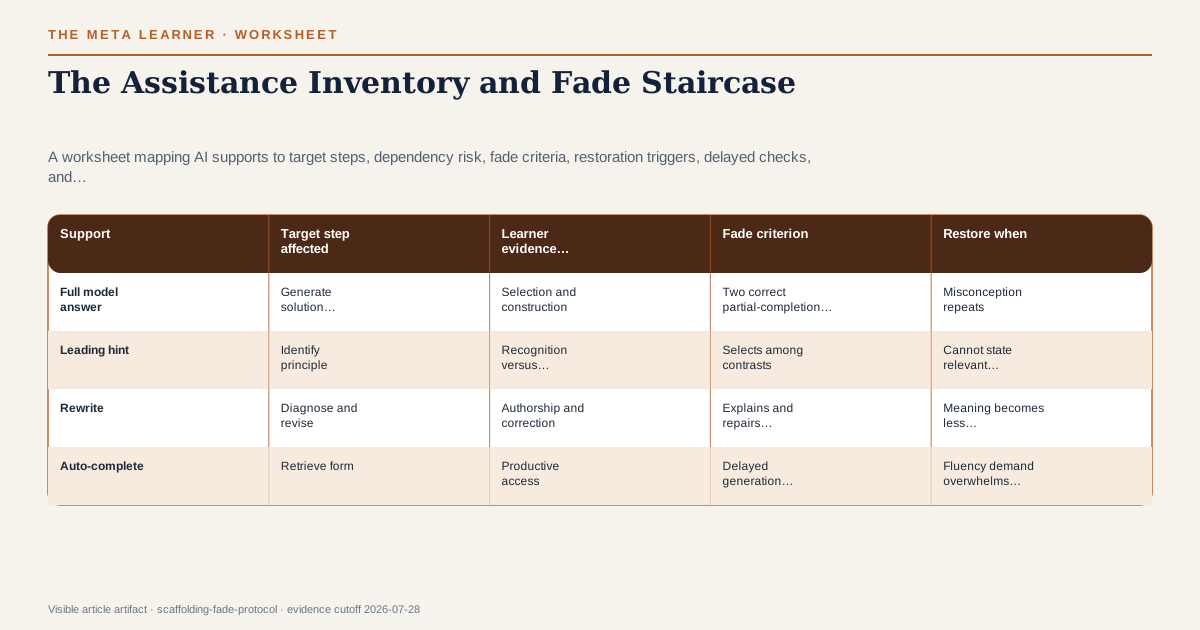
Define the task the learner must eventually perform without AI, inventory every support the system provides, and mark which target step each support replaces. Establish a baseline, fade one aid at a time after successful varied performance, restore the minimum help when errors show a prerequisite gap, and finish with a delayed unaided transfer test.
Use this when AI helps a step the learner must later own
Use this protocol when AI supplies hints, examples, planning, sentence completion, feedback, explanations, code, or revision during learning, but the learner must later select and perform the target step independently.
Do not remove accessibility tools, approved workplace tools, or supports that legitimately belong in the target environment. Do not fade assistance during unsafe clinical, legal, industrial, or public action merely to test independence. If the authentic capability is “work effectively with AI under review,” the transfer test should preserve AI and change the human-control demand.
Classic scaffolding work describes tutoring functions that recruit, simplify, direct, and control frustration relative to the learner’s current capacity. scaffold, fading, unesco Worked-example research has tested fading completed steps alongside self-explanation. fading UNESCO guidance adds agency, human capacity, and governance concerns for generative AI in education. unesco
Worked staircase: research-claim evaluation
Baseline: the learner accepts a causal headline from a correlational study. Full support would let AI write the critique. Instead, the system first asks the learner to identify the study design. If needed, it offers two contrasting definitions. Later it names only the rubric category, then supplies no hint.
The learner must open the source, identify design, reconstruct the claim, and write a bounded conclusion. Two days later, a study from another domain appears with no cue that causality is the issue. Success there supports fading; a polished AI-assisted critique does not.
The assistance inventory
| Support | Target step affected | Learner evidence hidden | Fade criterion | Restore when | |---|---|---|---|---| | Full model answer | Generate solution path | Selection and construction | Two correct partial-completion tasks | Misconception repeats | | Leading hint | Identify principle | Recognition versus selection | Selects among contrasts | Cannot state relevant features | | Rewrite | Diagnose and revise | Authorship and correction | Explains and repairs own draft | Meaning becomes less accurate | | Auto-complete | Retrieve form | Productive access | Delayed generation succeeds | Fluency demand overwhelms target |
The original asset also records date, task variant, support level, outcome, and next step.
Evidence inside the case boundary: the Assistance Inventory and Fade Staircase
Research supports contingent instructional support and studied transitions from worked examples toward independent problem solving. Official guidance supports protecting human agency around generative AI. Direct evidence for this exact AI fade staircase across domains is limited; it is an evidence-informed synthesis.
scaffold, fading, unescoInventory support and descend the staircase
Step 1 — Define unsupported performance. State task, conditions, quality standard, delay, and any legitimate tools.
Step 2 — Record an unaided baseline. Preserve the attempt and classify the bottleneck.
Step 3 — Inventory assistance. For every AI behavior, state which cognitive or procedural step it performs or reveals.
Step 4 — Set the support ceiling. Give only enough help to restart productive work. Prefer a question before a hint, a hint before a partial example, and a partial example before a full solution when appropriate.
Step 5 — Require learner action. The learner explains, selects, repairs, or generates after each support.
Step 6 — Fade one dimension. Remove answer visibility, reduce hint specificity, delay feedback, or change from rewrite to diagnosis.
Step 7 — Vary the task. Do not interpret memorized success as readiness to fade.
Step 8 — Restore contingently. If errors reveal a missing prerequisite, step up temporarily and record why.
Step 9 — Delay and transfer. Test a new case without unavailable support and compare with baseline.
Adaptations that respect the real target
- Novice: fade worked steps gradually and keep authoritative references.
- Advanced: fade diagnosis and require method selection among rivals.
- Language learning: preserve captions if the target includes supported media; remove them for independent listening only after audio QA.
- Coding: retain documentation and tests that professionals use; remove generated solution code when construction is the target.
- Neurodiversity or disability: never classify required accommodations as dependency; consult the learner and accessibility expertise.
Adaptation follows function, not an aesthetic of struggle.
Failure modes that disguise substitution as support
- Defining the goal after observing assisted performance.
- Letting AI perform the exact step later assessed.
- Fading several supports at once.
- Removing references experts normally use.
- Increasing novelty and time pressure simultaneously.
- Treating frustration as productive evidence.
- Restoring the full answer after any error.
- Asking the same model to certify independence.
If support never fades, rename the capability honestly as AI-assisted performance and evaluate the joint system.
Test the Assistance Inventory and Fade Staircase beyond the original case
After a delay, present a task with changed surface features and no prompt naming the principle. Remove only assistance unavailable in the target context. Score noticing, selection, execution, explanation, error recovery, and confidence. A human reviewer uses an independent key or rubric. Compare both the baseline and the last assisted result.
Design the tutor boundary through How to Use AI as a Tutor, replace generated exposition with Self-Explanation, and measure increasing distance through The Retrieval-to-Transfer Protocol.
Removing help is not the same as creating independence
Support withdrawal can reduce performance without diagnosing why, and a successful delayed task may not generalize. Human-tutoring and worked-example evidence does not automatically validate generative-AI tutoring. Models can give wrong feedback, leak answers through hints, and vary across runs. High-stakes learning requires qualified assessment, privacy controls, and accountable human oversight.
The staircase succeeds when the record shows not only that help decreased, but that independent capability survived the descent.
Named sources
Evidence and further reading
Published July 29, 2026. No substantive revision has been recorded. Evidence last verified July 28, 2026.