The OODA Loop for Knowledge Work: Observe, Orient, Decide, Act
Use OODA as a learning cycle for changing environments by separating signals, orientation, decision, action, feedback, and tempo from mere speed.
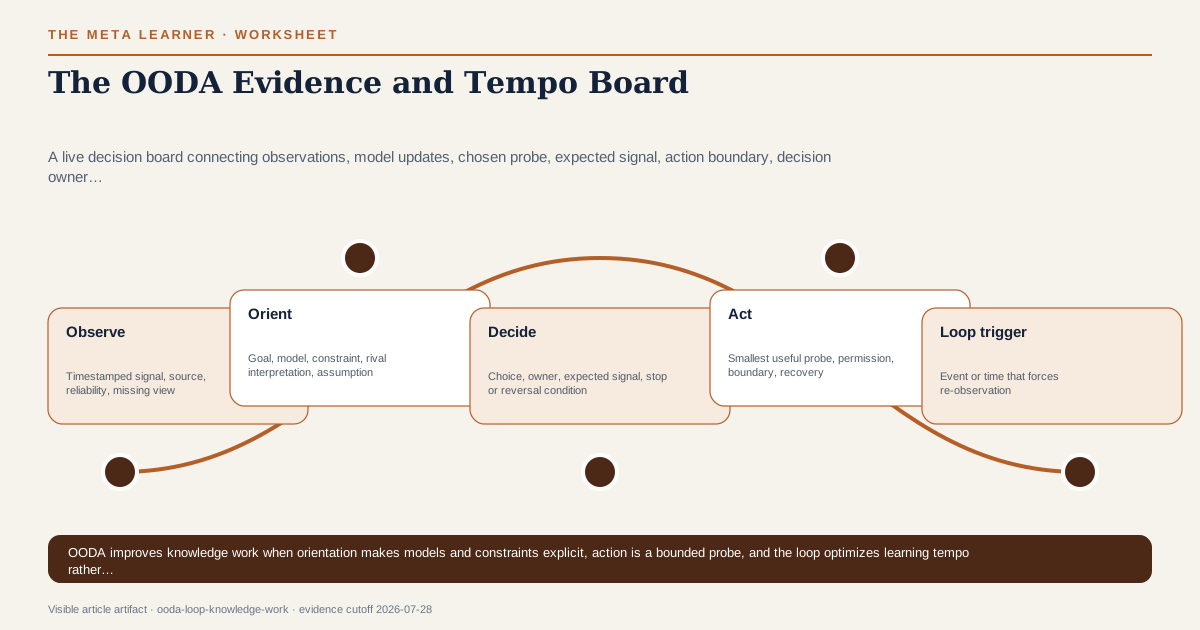
Use OODA in knowledge work by collecting decision-relevant observations, explicitly orienting them through goals, models, constraints, and rival interpretations, choosing one bounded action, and defining the signal that will trigger the next loop. Optimize time to reliable learning, not time to action; some loops should slow down. Military theory and naturalistic-decision research do not automatically validate OODA for every organizational or personal task.
Use this when reality can answer a bounded action
Use this method when the environment is changing, information is incomplete, and a reversible action can generate evidence: incident triage, research exploration, product experiments, negotiations, operational queues, or a fast-moving project.
Do not use it to bypass mandatory analysis, democratic process, medical or legal authority, or safety controls. It is a poor fit when action is irreversible and no pilot exists, when observation will not arrive before commitment, or when a stable procedure already performs reliably. “Act” must not become permission to externalize risk.
Boyd’s published discourse presents orientation as a rich process shaped by experience, analysis, synthesis, culture, and new information—not a simple second box. boyd, ndm Naturalistic-decision research studies how experienced people decide in demanding real settings, but expertise can also be absent or misapplied. ndm
Worked cycle: a sudden search-traffic decline
Observation: traffic fell 35 percent after a release. The first orientation—“the algorithm penalized us”—is only one story. Rivals include broken analytics, accidental noindex, route failures, seasonality, and changed rankings.
The team checks telemetry and crawl state before editing content. A bounded action restores one misconfigured route group and defines a two-hour signal. The decision owner can roll back. The next observation distinguishes technical recovery from a wider search change.
Moving quickly meant testing the cheapest discriminating explanation, not publishing twenty speculative rewrites.
The evidence and tempo board
| OODA field | Entry | |---|---| | Observe | Timestamped signal, source, reliability, missing view | | Orient | Goal, model, constraint, rival interpretation, assumption | | Decide | Choice, owner, expected signal, stop or reversal condition | | Act | Smallest useful probe, permission, boundary, recovery | | Loop trigger | Event or time that forces re-observation |
The asset keeps orientation and feedback visible. Without them, the loop is task management with military vocabulary.
Evidence inside the case boundary: the OODA Evidence and Tempo Board
Primary OODA material and naturalistic-decision research support attention to evolving orientation, expertise, feedback, and real-world context. They do not establish a universally superior four-step business method. The evidence-and-tempo board is an editorial adaptation for reversible knowledge work.
boyd, ndmRun an evidence-bearing OODA cycle
Step 1 — Observe selectively. State the decision and collect signals that could change it. Preserve source, time, uncertainty, and what the current sensor cannot see.
Step 2 — Orient explicitly. Write the working model, reference class, incentives, constraints, stakeholder perspectives, and at least one rival interpretation. Orientation is where most intellectual work occurs.
Step 3 — Choose the decision tempo. Ask whether waiting buys decisive information or only comfort. Slow down when authority, consequence, or ambiguity rises.
Step 4 — Decide one probe. Name the decision owner, expected observation, resource budget, stop condition, and what remains prohibited.
Step 5 — Act within a boundary. Execute the smallest move that changes reality enough to test the orientation.
Step 6 — Close the sensor loop. Capture outcome and side effects immediately. Trigger the next observation rather than defending the previous decision.
Adaptations by tempo
- Minute loop: incident triage with fixed permissions and a live status board.
- Day loop: research with one evidence-gathering action and a documented rival.
- Week loop: product discovery with a bounded user test and outcome measure.
- Team loop: separate observers report before the group orientation meeting.
- AI-assisted loop: AI may surface hypotheses or prepare a probe, but a human owns orientation, permission, and external action.
Adaptation must preserve an observable loop trigger and recovery path.
Pay down orientation debt
Rapid cycles can accumulate hidden assumptions: the dashboard definition changed, the customer segment drifted, a temporary workaround became policy, or the team stopped testing a rival because the current story kept producing acceptable actions. Schedule an orientation reset based on evidence, not a recurring calendar. Trigger it when observations repeatedly surprise the model, exceptions consume a defined share of work, or a decision crosses a consequence boundary.
During the reset, reconstruct the environment from primary records, invite an independent perspective, and retire obsolete constraints. Then compare the new orientation with the old one before acting. This prevents tempo from becoming path dependence and preserves the method’s synthesis function.
Failure modes that turn OODA into acceleration
- Treating the first dashboard metric as reality.
- Skipping orientation because it feels slow.
- Mistaking senior confidence for expertise.
- Acting without an expected signal.
- Optimizing cycle count rather than information gained.
- Removing dissent to achieve “tempo.”
- Running simultaneous changes that destroy attribution.
- Continuing after the stop condition.
When signals are delayed, replace rapid cycles with scenario signposts and explicit waiting criteria.
Test the OODA Evidence and Tempo Board beyond the original case
Give the practitioner a new ambiguous event and no OODA labels. They must separate observation from interpretation, generate a rival, identify missing sensors, choose a reversible probe, name the decision owner and stop condition, and state what signal begins the next cycle. The method transfers when the structure appears without jargon.
Track orientation in The Hypothesis Ledger, freeze the choice in The Decision Journal Method, and learn across completed cycles with The After-Action Review.
Tempo does not excuse weak authority or evidence
OODA emerged from military theory and is often simplified in management writing. Its application to knowledge work is analogical. Fast feedback can be noisy, local optimization can harm other stakeholders, and experienced intuition can fail outside familiar patterns. Irreversible, regulated, or high-consequence action requires stronger evidence, legitimate authority, and independent review.
The useful loop is not observe–react–repeat. It is observe, revise the model, choose a bounded test, and let reality challenge the orientation.
Named sources
Evidence and further reading
Published July 29, 2026. No substantive revision has been recorded. Evidence last verified July 28, 2026.