The One-Person Research System: Compete on Insight, Not Output
Build a solo research system around bounded questions, live source maps, claim ledgers, adversarial synthesis, decision artifacts, and transparent limits.
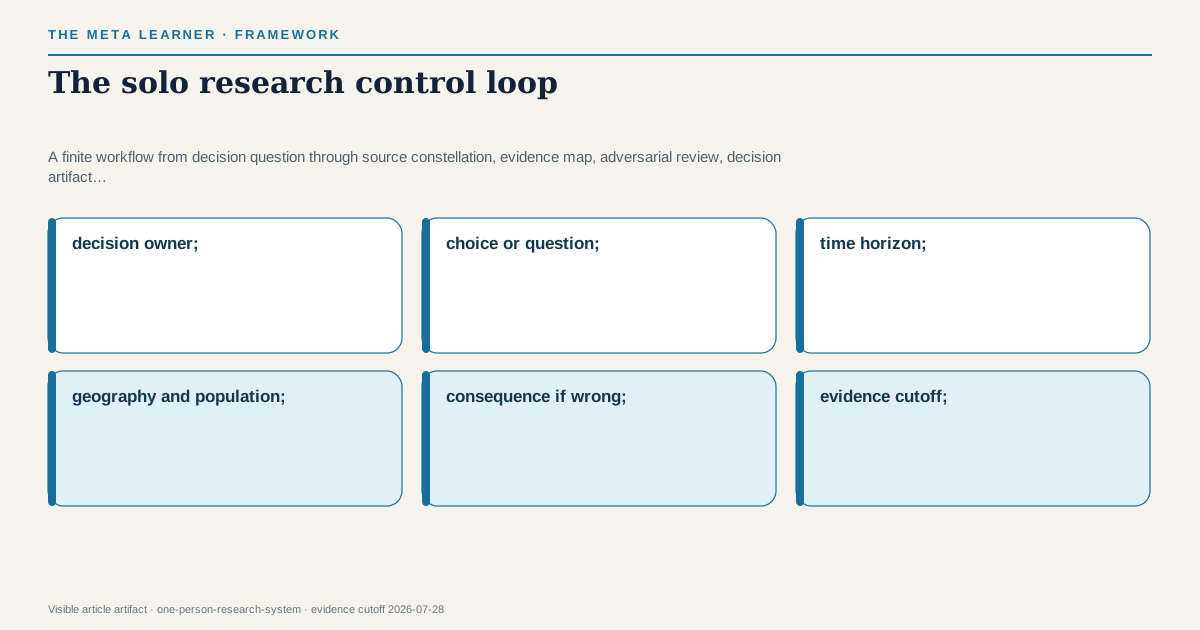
A one-person research system should compete on a smaller, better-framed question and a more inspectable answer. Define the decision, map authoritative and dissenting sources, maintain a claim-level ledger, use AI only for reversible transformations, red-team the synthesis, and ship a decision artifact with evidence, uncertainty, and correction paths. Do not imitate a large research team by generating more pages.
Solo leverage begins with constraint
One person cannot search every database, read every language, duplicate every judgment, interview every stakeholder, and monitor every change. AI can expand throughput but cannot remove those epistemic limits.
The solo advantage is coherence: one person can preserve the question, source trail, model, and editorial judgment end to end. To use that advantage, scope must be aggressive.
GOV.UK’s discovery guidance begins with understanding the problem, users, context, constraints, and opportunities before building a service.gov-discovery, cochrane-search, cochrane-synthesis, nber-genai-work A solo research project should likewise begin with a decision, not a predetermined report.
Scenario: the solo research control loop under organizational constraints
A solo analyst researches whether small exporters should use machine translation for support content.
The scope is one language pair, non-contractual help articles, and a six-month pilot decision. The analyst maps translation research, official data rules, language-professional guidance, tool documentation, and user-access needs. AI aligns terminology and creates a comparison table; bilingual reviewers judge representative samples.
The deliverable recommends a restricted pilot with human review and excludes legal, safety, and high-emotion communication. It does not claim “AI translation is ready for business.”
Define the decision unit
Write:
- decision owner;
- choice or question;
- time horizon;
- geography and population;
- consequence if wrong;
- evidence cutoff;
- exclusions;
- deliverable;
- stop condition.
“The future of AI” is not a solo research unit. “Which evidence would justify a controlled AI source-triage pilot for our six-person research team?” is.
The solo research control loop
- Frame: decision, boundaries, reversal conditions.
- Discover: source constellation and query log.
- Extract: claim, method, scope, and limitation.
- Map: evidence, assumptions, counterevidence, gaps.
- Synthesize: established, conditional, contested, unknown.
- Challenge: rival model and strongest objection.
- Decide: recommendation, threshold, monitor.
- Release: inspectable artifact and correction route.
Each stage produces a small artifact. If the final conclusion cannot be reconstructed from them, the chain is broken.
Formal review guidance demonstrates why question definition, search coverage, selection, structured comparison, and transparent synthesis matter. Service discovery emphasizes problem and user context before building. A solo adaptation must be represented as bounded research, not a systematic review.
Claim sources: cochrane-search, cochrane-synthesis, gov-discovery, nber-genai-work
Use AI at reversible boundaries
Good roles:
- query expansion;
- metadata normalization;
- comparison-table formatting;
- translation assistance with source retained;
- contradiction prompts;
- draft structure from verified claims;
- quality-control checklists.
Human-owned roles:
- source inclusion;
- claim interpretation;
- evidence appraisal;
- conflict resolution;
- recommendation;
- correction.
Preserve inputs and verify transformations. Never let AI-generated references enter the ledger unopened.
Build quality controls around likely failure
Without a second researcher, add:
- frozen inclusion criteria;
- random recheck of excluded sources;
- study-family IDs;
- adversarial search;
- claim-source audit;
- arithmetic reproduction;
- blind rereading after a delay;
- external review of load-bearing claims;
- public limitation statement.
Cochrane search guidance shows how database coverage, language, unpublished results, multiple reports, and retractions affect evidence visibility.cochrane-search A solo project should state which of those controls it did not perform.
Synthesize without vote counting
Group sources by comparable claim and method. Explain heterogeneity and conflicting contexts. Cochrane warns against synthesis practices such as vote counting by statistical significance and stresses methods suited to available data.cochrane-synthesis
Write four layers:
- supported;
- conditional;
- contested;
- unknown.
Then label your judgment separately.
Run the solo research control loop
- Freeze one decision unit.
- create the source constellation.
- open and log sources.
- build the claim ledger.
- search for disconfirming evidence.
- write four synthesis layers.
- request bounded external challenge where material.
- publish or deliver the evidence boundary with the judgment.
Use Turn Book Notes Into Reusable Knowledge, coordinate active work in How to Build a Personal Learning System, and audit claims through Critical Thinking: A Practical System for Claims and Evidence.
Scale theater for one-person research
- Generating hundreds of sources no one opens.
- calling a broad web search comprehensive.
- simulating expert consensus with several AI personas.
- hiding language and database limits.
- using word count as evidence of depth.
- producing forecasts without signposts or revision rules.
- skipping external review because the workflow looks systematic.
Separate tool capability from research-system adoption. A model may summarize a clean document well, yet the deployed workflow can still fail through incomplete search, duplicate study families, inaccessible sources, context loss, or unreviewed inference. Define which tasks AI may perform, what evidence a human must inspect, and where the project stops when verification is unavailable. The NBER workplace study is itself a reminder that observed effects belong to a bounded deployment rather than to an abstract technology.nber-genai-work For a solo researcher, disciplined scope is the substitute for organizational redundancy: make omissions, escalation limits, and unresolved disagreements visible before the answer leaves the system.
One person cannot simulate a field
A solo system cannot reproduce specialist teams, duplicate screening, multilingual coverage, field access, stakeholder participation, or formal assurance. AI agents do not become independent experts because they run in parallel. Medical, legal, investment, safety, and other high-stakes work requires appropriate accountable professionals and methods.
The solo researcher wins no contest for maximum output. The valuable artifact is a bounded decision whose evidence and uncertainty another person can actually inspect.
Named sources
Evidence and further reading
Published July 29, 2026. No substantive revision has been recorded. Evidence last verified July 28, 2026.