Mental Models: When They Clarify—and When They Distort
Treat every mental model as a purpose-built compression: expose its entities, assumptions, omissions, scale, predictions, rivals, and failure boundary.
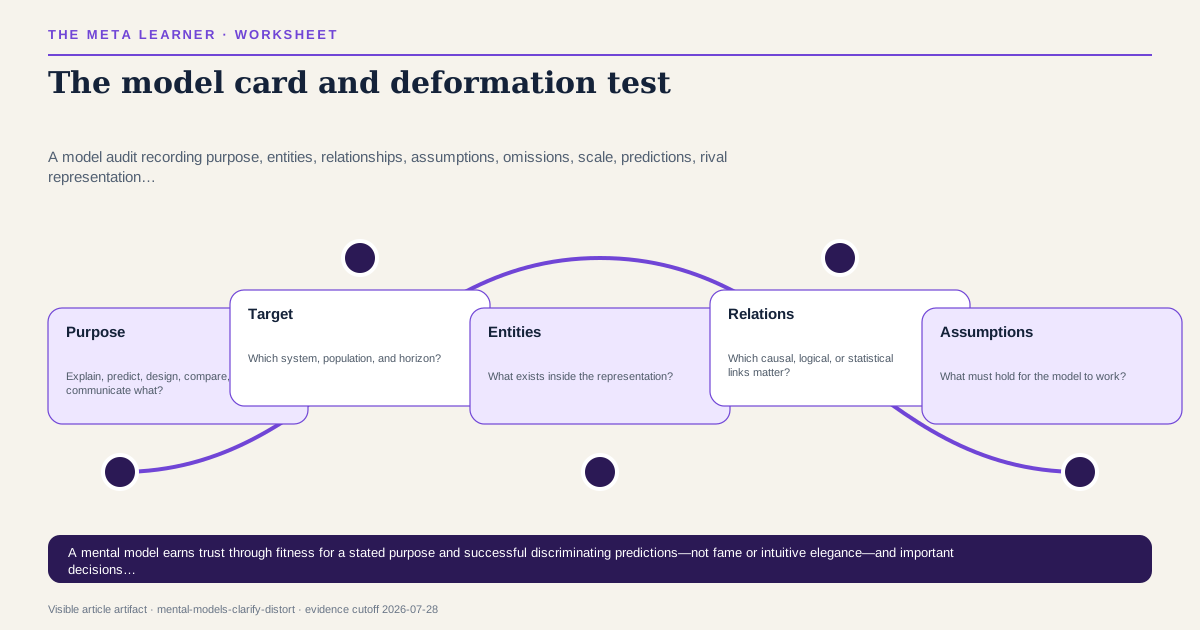
For each mental model, state the purpose it serves, what it includes, what it omits, the scale and conditions where it applies, and the observation it predicts better than a rival. Then apply a second model with different omissions. Keep the simpler model only while its compression preserves the features relevant to the decision.
A model is a selective instrument
“Incentives matter.” “Think in systems.” “Use supply and demand.” “Treat skills as a portfolio.” These models can direct attention productively. They can also become intellectual stamps placed on a situation after the outcome is known.
A model is not a miniature world containing every fact. It selects entities, relationships, scale, and purpose. Its omissions make it usable. The same omissions make it dangerous when the model travels to a question for which the removed features are decisive.
Evidence inside the case boundary: the model card and deformation test
Scholarship on scientific models emphasizes their variety: idealized, mathematical, physical, computational, and other representations can support explanation, prediction, exploration, and measurement. Models can function as mediators between theory and world rather than simple copies. Scientific pluralism examines why multiple approaches may be needed when aims and relevant features differ.
sep-models, sep-pluralism, morgan-morrisonClaim sources: sep-models, sep-pluralism, morgan-morrison
Write a model card
Before applying a favored model, complete:
| Field | Audit question | |---|---| | Purpose | Explain, predict, design, compare, or communicate what? | | Target | Which system, population, and horizon? | | Entities | What exists inside the representation? | | Relations | Which causal, logical, or statistical links matter? | | Assumptions | What must hold for the model to work? | | Omissions | What has been deliberately left out? | | Scale | At which level and time interval? | | Prediction | What should be observed if it is useful? | | Rival | Which model deforms the situation differently? | | Reversal | What would make you stop using it? |
If the model cannot produce a discriminating expectation, it may be a metaphor or organizing vocabulary rather than an explanatory model. That can still be useful, but it should not carry causal authority.
Run the deformation test
Every map stretches some distances and preserves others. Ask:
- Which feature becomes unusually visible?
- Which actor or value disappears?
- Which continuous process becomes a binary category?
- Which local variation becomes an average?
- Which feedback becomes a one-way arrow?
- Which horizon makes the model look successful?
- What intervention would the model recommend by default?
Then switch the deformation. If an incentive model highlights rewards, apply a capability model, a norms model, and a power model. The goal is not to collect more fashionable lenses. It is to discover whether the decision changes when previous omissions return.
A worked comparison
A company explains low knowledge sharing as an incentive problem. The model predicts that rewarding documented contributions will increase useful sharing.
A cognitive-load model predicts that employees lack time and a low-friction format. A power model predicts that knowledge creates status and job security, so public sharing can be individually costly. A network model predicts that people share within trusted groups but the organization measures only the central repository.
Each model suggests a different observation and intervention. Before adding a reward, the team samples work episodes, measures authoring cost, maps where questions are actually answered, and examines whether past documentation was used. The eventual design may combine protected time, retrieval improvements, and recognition. “Incentives matter” survives, but not as a complete diagnosis.
Models are not laws of universal transfer
A model learned in one domain may preserve the wrong structure elsewhere. Evolutionary metaphors can illuminate variation and selection but conceal intentional design. Market language can clarify exchange while erasing rights or public obligations. Engineering optimization can improve a measurable system while treating contested values as fixed constraints.
Cross-disciplinary transfer needs a mapping:
- What plays the role of each entity?
- Which relationship is literally shared?
- Which is only analogous?
- What evidence would distinguish successful transfer from a clever story?
The deeper the analogy drives action, the stronger this burden becomes.
The rival models
One simple model. This wins when the decision is routine, feedback is rapid, the omitted features are immaterial, and additional complexity would delay a reversible action.
A portfolio of models. This wins when stakes are high, causes operate at multiple levels, stakeholders contest the objective, or one representation has repeatedly produced residual anomalies.
Pluralism is not permission to keep contradictory models without choosing. Use each to generate evidence and options, then state which model governs which part of the decision.
When the reference class behind the model card and deformation test breaks
Continue using a model when it compresses without hiding decision-relevant variation, predicts new observations, supports useful intervention, and outperforms rivals within a stated boundary.
Retire, revise, or demote it when:
- anomalies accumulate exactly where its omissions lie;
- predictions succeed only after vague reinterpretation;
- it works at one scale but is exported to another;
- the recommended action repeatedly shifts costs to invisible actors;
- a rival model explains the same evidence with fewer unsupported assumptions;
- the environment changes the relationship the model relied on.
A failed prediction does not always destroy a model. Measurement can be wrong, or an auxiliary assumption can fail. Record which part is being protected and why, rather than silently moving the boundary.
Model-use failures
- Citing the name of a model instead of specifying it.
- Treating intuitive elegance as evidence.
- Applying an analogy without mapping relationships.
- Adding complexity that produces no different prediction.
- Using one model for explanation, prediction, and moral judgment.
- Averaging incompatible models into mush.
- Keeping only models an AI assistant already knows well.
- Changing assumptions after the result while claiming prior success.
The bounded verdict from the model card and deformation test
The model card is an epistemic aid, not a validation standard. Philosophy of scientific modeling does not make informal business or personal models scientific. Complex decisions may remain underdetermined even after comparison, and stakeholders can disagree about purpose and value. Formal technical models require domain-specific verification beyond this framework.
Test arrows with causal reasoning, use rival models to improve option generation, and protect diversity against AI-assisted epistemic monoculture.
Named sources
Evidence and further reading
Published July 29, 2026. No substantive revision has been recorded. Evidence last verified July 28, 2026.