Divergent vs Convergent Thinking: How Better Options Are Made
Separate option generation from evaluation without romanticizing creativity: use purposeful constraints, independent variation, criteria, tests, and reopening rules.
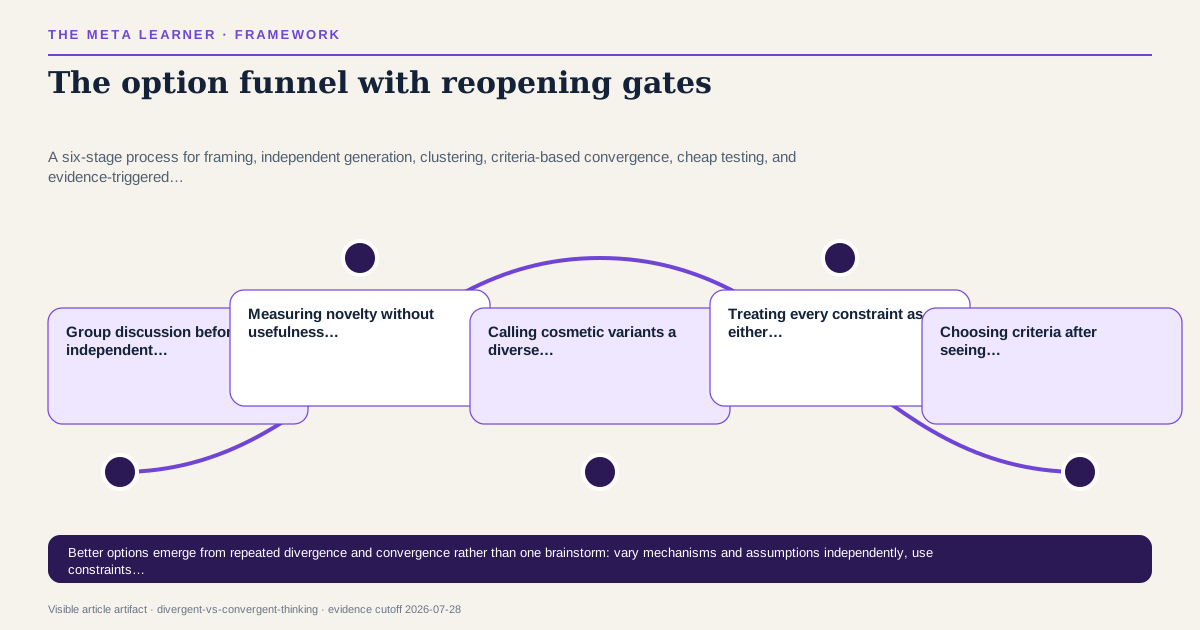
Frame the problem and constraints, generate options independently before group discussion, vary underlying mechanisms rather than surface features, and delay evaluation until a meaningful set exists. Then apply predeclared criteria, prototype the uncertain parts, and reopen divergence if every option fails the same assumption or new evidence changes the frame.
Creativity needs both variation and selection
Brainstorming is often treated as the creative stage and evaluation as the administrative stage that follows. The distinction is misleading. An idea is useful only when it can be developed, criticized, connected to constraints, and selected for a purpose. Convergence can be intellectually creative because it discovers which combination survives reality.
The opposite failure also occurs: evaluation begins with the first suggestion. Status, feasibility anxiety, and familiar criteria narrow the search before alternatives exist. The result is not efficiency but premature closure.
The rival models
Stay divergent longer. This wins when the current options share an assumption, the problem is novel, the cost of prototypes is low, or the first ideas reflect one discipline.
Converge early. This wins when the decision is reversible, feedback is fast, delay is costly, and real-world testing will produce more insight than another meeting.
The correct rhythm may be multiple short cycles. Diverge around the next uncertainty, converge on a test, learn, and diverge again.
What survives the comparison: the option funnel with reopening gates
Creative-cognition research treats novel ideas as emerging from ordinary generative and exploratory processes rather than inspiration alone. Cropley argues that effective creativity needs convergent judgment as well as divergent production. A review of organizational research finds that constraints have contingent relationships with creativity and innovation; their source, form, and intensity matter.
cropley-creativity, acar-constraints, finke-creative-cognitionClaim sources: cropley-creativity, acar-constraints, finke-creative-cognition
Run the option funnel
1. Frame
State the user, outcome, constraints, and decision owner. Write one rival frame before generating solutions.
2. Diverge independently
Give participants quiet time. Require variation across mechanism: remove a step, change an incentive, alter timing, substitute a resource, redesign the default, or change who acts. Twenty cosmetic versions of one idea are not twenty options.
3. Cluster without ranking
Group ideas by causal logic. Name what each assumes. Preserve outliers until the mechanisms are understood.
4. Converge against criteria
Freeze criteria before champions pitch. Include value, feasibility, recoverability, evidence, distribution of costs, and learning potential.
5. Test the pivotal uncertainty
Prototype the mechanism, not the decorative whole. A landing page tests a message, not necessarily durable demand; a mock workflow tests usability, not organizational adoption.
6. Reopen or commit
If evidence defeats the shared assumption, reopen divergence. If one option meets the threshold and delay is costly, commit with a review trigger—not an endless ideation loop.
Use constraints purposefully
“Think without constraints” can generate unusable fantasy. “Be realistic” can preserve the current system. Separate constraints into:
- non-negotiable: law, safety, rights, physical limits;
- resource: current time, money, staff, data;
- design: deliberately imposed to focus variation;
- assumed: inherited rules that may be challenged;
- preference: convenience presented as necessity.
Good design constraints reduce an unproductive search space while leaving more than one mechanism available. Severe time pressure, contradictory demands, or arbitrary rules can suppress exploration.
A worked option set
A publisher wants readers to finish more difficult essays. The first idea is a gamified streak. Independent divergence produces different mechanisms:
- reduce entry cost with argument maps;
- improve orientation through question-led summaries;
- increase commitment with a reading cohort;
- insert retrieval prompts between sections;
- let readers choose depth paths;
- improve selection so fewer unsuitable essays are started.
Convergence criteria include comprehension, completion, autonomy, development cost, and risk of replacing reading with summaries. A small test compares argument maps and question-led orientation, measuring both completion and an unaided reconstruction afterward. The streak is not rejected because games are bad; it simply does not target the pivotal mechanism supported by the current frame.
Protect evaluation from attachment
Ideas become identities. Reduce ownership effects by scoring anonymously where possible, requiring advocates to state failure conditions, and letting a different person articulate the strongest version. Use criteria ranges rather than a total score whose weights hide disagreement.
Do not eliminate qualitative judgment. A weighted matrix can give false precision when criteria interact or one constraint is a veto. Record both the score and the argument.
Evidence that would settle the contest around the option funnel with reopening gates
Return to divergence when:
- all leading options fail for the same reason;
- a stakeholder or constraint was omitted;
- the prototype tests the wrong mechanism;
- the selected idea only wins under one fragile criterion weight;
- new evidence changes the problem frame.
Converge when options represent genuinely different mechanisms, criteria are decision-relevant, one choice clears a threshold, and further ideation has lower value than feedback from action.
Cancel the process when no owner can act or no option can cross a binding constraint. More creativity cannot repair missing authority.
Creative-process failures
- Group discussion before independent generation.
- Measuring novelty without usefulness or ethical acceptability.
- Calling cosmetic variants a diverse option set.
- Treating every constraint as either sacred or oppressive.
- Choosing criteria after seeing the favored idea.
- Prototyping the whole product instead of the key uncertainty.
- Running workshops with no decision owner.
- Asking AI for many ideas and mistaking lexical variety for model diversity.
What the debate leaves decidable: the option funnel with reopening gates
The option funnel does not measure creativity directly or guarantee innovation. Power, expertise, culture, and resource access shape which ideas are voiced and tested. Independent generation can reduce social anchoring but also miss productive collaboration. High-stakes choices need substantive expert and stakeholder review beyond a generic creative process.
Begin by framing the right problem, vary mental models, and compare finalists through opportunity cost.
Named sources
Evidence and further reading
Published July 29, 2026. No substantive revision has been recorded. Evidence last verified July 28, 2026.