Epistemic Monoculture: What Happens When Everyone Thinks With the Same AI
Distinguish observed AI convergence from broader systemic risk, then preserve source, model, prompt, reviewer, and non-AI diversity at consequential bottlenecks.
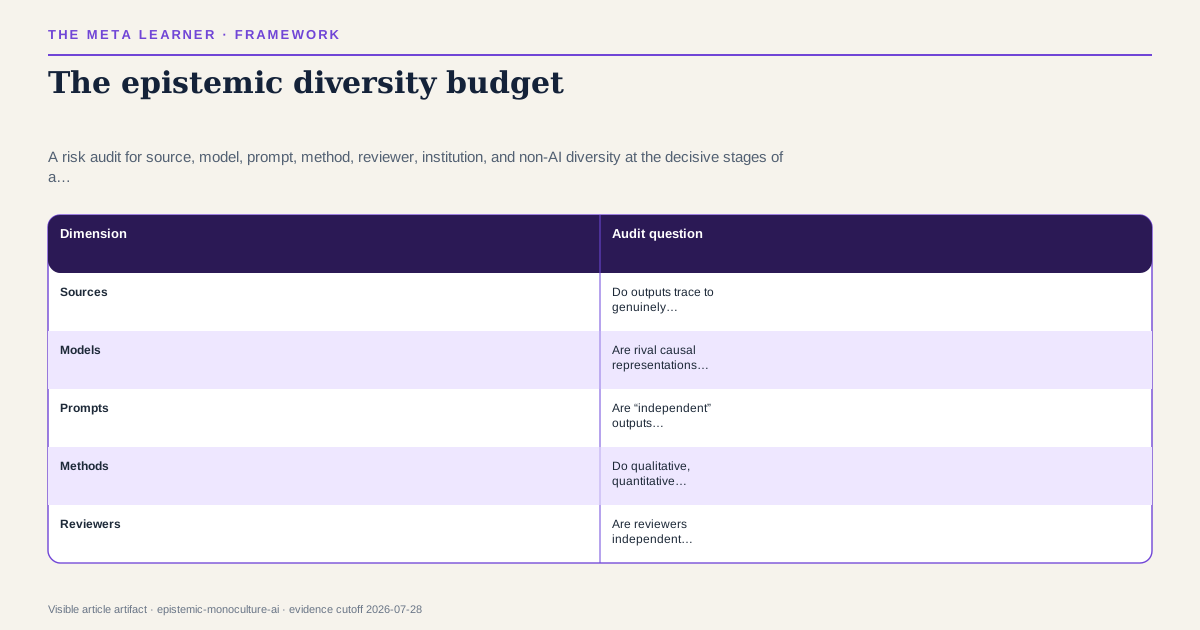
Epistemic monoculture is the risk that many people inherit correlated frames, omissions, sources, styles, or errors from shared AI systems. Audit where independent judgment actually enters the workflow. Preserve diversity in source selection, models, prompts, methods, reviewers, institutions, and non-AI baselines—especially where one common failure could affect many decisions. It does not establish that all AI-assisted knowledge work converges or that reduced output diversity is harmful in every domain.
A shared assistant can become shared infrastructure
When millions use a small number of general systems to search, summarize, brainstorm, code, and judge, their outputs need not be identical for dependency to become correlated. The same training regularities, safety policies, interface defaults, popular source patterns, and optimization targets can shape what appears salient and what disappears.
The concern is not that human thought becomes literally uniform. It is that apparent independence can conceal common upstream machinery. Ten polished memos may not constitute ten independent analyses if each began from variants of the same model-generated frame.
The epistemic diversity budget: evidence and boundary
One controlled experiment found that access to generative-AI ideas improved evaluated short-story outcomes while making AI-assisted stories more similar to one another.doshi-hauser Critical language-model scholarship documents risks rooted in training data, scale, and the appearance of understanding. Separate research shows model degradation when generative models are recursively trained on model-generated data. NIST frames AI risk management as contextual, life-cycle-based, documented, and accountable.bender-parrots, shumailov-collapse, nist-ai-rmf
Claim sources: doshi-hauser, bender-parrots, shumailov-collapse, nist-ai-rmf
Separate observation, inference, and scenario
Observed: In a particular creative-writing experiment, individual and collective outcomes moved differently.
Inference: Shared systems can correlate what users generate, omit, and trust, especially when the same model occupies multiple workflow stages.
Scenario: If institutions increasingly replace independent source discovery, drafting, review, and evaluation with the same few systems, correlated blind spots could become difficult to detect and self-reinforcing.
These layers should not be collapsed. The experiment is evidence for a mechanism worth monitoring, not proof that the scenario has already occurred. Likewise, recursive model collapse concerns model training distributions; it is not interchangeable with human cultural convergence.
Audit the epistemic diversity budget
Map the decisive workflow stages:
| Dimension | Audit question | |---|---| | Sources | Do outputs trace to genuinely different primary evidence? | | Models | Are rival causal representations considered? | | Prompts | Are “independent” outputs anchored by one shared frame? | | Methods | Do qualitative, quantitative, historical, and domain methods differ? | | Reviewers | Are reviewers independent of the generation path? | | Institutions | Do incentives and accountability differ? | | Non-AI baseline | Can a human or external procedure detect shared failure? |
Diversity is valuable where it creates differently caused errors or discriminating evidence. Ten models trained on overlapping data and prompted identically may add surface variety without epistemic independence.
A worked institutional risk
A publisher uses one model to suggest topics, outline articles, draft claims, recommend sources, check originality, and rank which pieces to feature. Human editors polish the prose, so every artifact looks individually reviewed.
The dependency graph shows one upstream system influences discovery, representation, evidence, expression, and quality control. A blind spot can pass through every gate. The intervention is not “use four chatbots.” It is to restore independent functions:
- editors build the query and evidence map from opened sources;
- a second method generates rival frames;
- claim verification occurs against primary material outside model prose;
- originality review compares structures, not only wording;
- a human owner can reject the system’s criteria;
- samples are tested against a no-AI or independently produced baseline.
The objective is meaningful error diversity, not decorative multiplicity.
Where standardization is good
Monoculture language can romanticize difference. Shared tools and standards can improve accessibility, reduce routine errors, enable collaboration, and diffuse expert practices. In aviation, medicine, security, and data exchange, some standardization is a safety feature.
The rival model wins when the procedure is validated, failures are observable, updates are governed, and consistency is the intended outcome. A standard calculation should not be made idiosyncratic merely to display creativity.
The risk rises when one system also defines the question, supplies the evidence, produces the answer, and judges its quality—particularly when outputs are hard to verify and failures are correlated.
Preserve disagreement, not noise
Epistemic diversity is not a requirement to platform unsupported claims. Give alternatives standing according to evidence and mechanism. Preserve:
- minority findings from credible methods;
- local knowledge missing from dominant datasets;
- competing models with different predictions;
- negative results and documented failure;
- disciplinary disagreement about measurement or value;
- people affected by a decision but absent from its data.
Do not equate random prompting, contrarian performance, or model temperature with intellectual pluralism.
Reversal and signpost conditions
Increase diversity controls when:
- outputs from nominally independent teams share unusual omissions or errors;
- citations converge on a narrow derivative source chain;
- one vendor occupies generation and evaluation;
- people lose the skill or access needed for independent checking;
- synthetic material increasingly feeds later training or retrieval;
- downstream decisions affect many people at once.
Reduce redundant diversity when independent validation shows a standardized process reliably improves the target outcome, exceptions are detected, and humans retain escalation paths.
Evidence that would weaken the broad risk thesis includes persistent cross-system variation grounded in independent sources, reliable detection of correlated failures, and institutions that preserve meaningful methodological plurality despite common tools.
Monoculture mistakes
- Claiming one writing experiment proves civilization-wide homogenization.
- Treating model collapse and human idea similarity as the same mechanism.
- Counting vendors instead of upstream data and method independence.
- Assuming every uncommon answer is valuable.
- Replacing expertise with random dissent.
- Using the same AI to generate and “independently” audit a claim.
- Demanding diversity without assigning accountability.
- Ignoring the coordination and accessibility benefits of standards.
The jurisdiction of the epistemic diversity budget
Evidence about population-level epistemic effects of generative AI remains limited and rapidly evolving. Product versions, training data, retrieval, prompts, tasks, institutions, and users differ. The diversity budget is a risk framework, not a measured universal threshold. Time-sensitive model and policy claims are bounded to evidence reviewed through July 28, 2026.
Separate observations from system inference, audit shared mental models, and verify individual outputs with the four-layer AI evaluation model.
Named sources
Evidence and further reading
Published July 29, 2026. No substantive revision has been recorded. Evidence last verified July 28, 2026.