How to Read Across Disciplines Without Flattening the Differences
Read across disciplines by translating problems, evidence, and standards explicitly while preserving the differences that make each field useful.
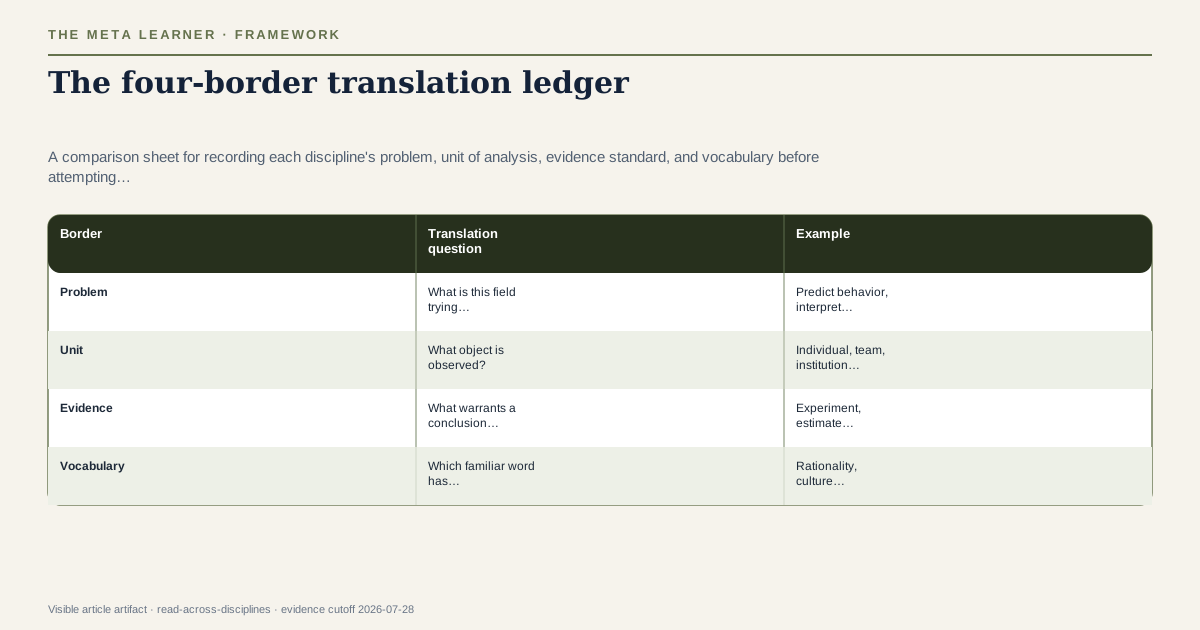
To read across disciplines without flattening them, compare four things before combining any conclusions: the problem each field is trying to solve, its unit of analysis, what it accepts as evidence, and how it uses key terms. Translate those differences explicitly. Synthesize at the level where claims are genuinely compatible, and preserve disagreements that arise from different questions rather than forcing a single verdict.
Where cross-disciplinary reading breaks
“What does the evidence say?” sounds singular. In practice, an economist may study incentives across populations, an anthropologist may examine meaning in a community, a psychologist may isolate a mechanism, and a historian may reconstruct a sequence that cannot be rerun. Their findings can illuminate the same phenomenon without being interchangeable.
This guide is for readers building a view that spans several fields. It does not teach those fields, and it does not award equal weight to every claim. Its purpose is to prevent two common failures: disciplinary tourism, in which exotic concepts are collected without their methods; and methodological imperialism, in which one field’s standards are imposed on every question.
The National Academies describes interdisciplinary research as integration of information, data, techniques, tools, perspectives, concepts, or theories from two or more bodies of specialized knowledge to advance understanding beyond one discipline’s scope.nasem-interdisciplinary, acrl-framework, cochrane-qualitative Integration is the achievement. Merely placing quotations next to one another is not.
Put the translation ledger to work
For every field or source family, complete one row:
| Border | Translation question | Example | |---|---|---| | Problem | What is this field trying to explain or change? | Predict behavior, interpret meaning, reconstruct history | | Unit | What object is observed? | Individual, team, institution, text, event, population | | Evidence | What warrants a conclusion here? | Experiment, estimate, archive, interview, formal proof | | Vocabulary | Which familiar word has a technical meaning? | Rationality, culture, learning, risk, agency |
Add two more columns during synthesis: scope and failure condition. A result about individuals may not scale to institutions. A population estimate may not explain a person’s motives. A vivid case can reveal a mechanism without estimating its frequency.
Ask whether the sources answer the same question
Apparent disagreement often dissolves when the questions are restated. Suppose organizational researchers find that psychological safety supports speaking up, while an ethnography shows that speaking up can still carry career risk in a particular hierarchy. One study may estimate a relationship across teams; the other may reveal how status and context shape the act. The second does not automatically refute the first, and the first does not erase the second.
Use a compatibility test:
- Are the outcomes defined in the same way?
- Are the populations and time scales comparable?
- Is one source describing frequency while another explains process?
- Does one claim causality while another offers interpretation?
- Would both conclusions fit inside a larger model?
Only combine claims after answering these questions.
Authoritative guidance converges on a demanding view of synthesis: knowledge is produced within disciplinary conversations, different evidence forms answer different questions, and integration requires methodological transparency. Qualitative and quantitative evidence may be complementary, but neither can be translated into the other by vocabulary alone.
Claim sources: nasem-interdisciplinary, acrl-framework, cochrane-qualitative
Preserve methods with the finding
Never move a conclusion into your notes without its method tag. Record “survey association,” “randomized comparison,” “historical reconstruction,” “ethnographic interpretation,” “simulation,” or another accurate descriptor beside the claim.
This practice matters because evidence changes meaning when detached from its production. An interview can identify concerns and mechanisms; it cannot by itself estimate prevalence. Administrative data can reveal patterns at scale; it may omit categories that matter to lived experience. A controlled experiment can isolate an effect under specified conditions; it may simplify the world that practitioners face.
The ACRL framework treats authority as constructed and contextual and scholarship as conversation.acrl-framework That does not mean truth is arbitrary. It means a source’s authority depends partly on the question and the practices through which its claims can be challenged.
Combine by function, not prestige
An interdisciplinary evidence stack can assign different jobs:
- Define: philosophy, law, or conceptual analysis clarifies what a term entails.
- Describe: statistics, surveys, or archives establish patterns.
- Explain: experiments, models, histories, and qualitative studies test mechanisms in different ways.
- Design: engineering, design research, and implementation studies explore workable interventions.
- Evaluate: trials, quasi-experiments, audits, or comparative cases examine outcomes and trade-offs.
The “highest ranked” method in one hierarchy is not automatically best for every job. Cochrane’s qualitative-evidence guidance, for example, treats searching and synthesis in ways suited to questions about experience and implementation rather than copying intervention-review procedures unchanged.cochrane-qualitative
A synthesis example
Imagine asking: “Does remote work improve knowledge work?” Labour economics may estimate productivity or employment patterns. Organizational psychology may study coordination, autonomy, and belonging. Information systems research may analyze tools and workflows. Sociology may examine household and inequality effects. Management cases may describe implementation.
A flattened synthesis averages this into “remote work works” or “remote work fails.” A translated synthesis says:
- output effects vary by task and measurement;
- coordination costs depend on interdependence and tool design;
- autonomy and isolation are different mechanisms;
- household effects are distributed unequally;
- organizational practices mediate outcomes.
It then identifies a decision: which tasks, for which team, under which coordination design, measured by which outcomes? The synthesis becomes more actionable because it is less falsely universal.
Build the translation ledger
Choose one question and three disciplines:
- Write one sentence defining the question in each field’s likely terms.
- Identify the unit of analysis and favored evidence form.
- Extract one claim with its method and scope intact.
- Mark terms that look identical but function differently.
- Sort the claims into define, describe, explain, design, or evaluate.
- Write one integrated model and one unresolved disagreement.
- Ask a specialist from the least familiar field to challenge your translation if the stakes justify it.
Use How to Read a Difficult Book to map each source, Systems Thinking to connect levels, and How to Make Decisions Under Uncertainty to retain the uncertainty your synthesis exposes.
Four kinds of intellectual flattening
- Vocabulary flattening: treating the same word as the same construct.
- Method flattening: asking every evidence form to perform the same inferential job.
- Scale flattening: moving freely from people to teams, firms, or societies.
- Value flattening: hiding normative choices inside apparently technical conclusions.
A fifth error is decorative interdisciplinarity: adding a famous idea from another field without allowing it to change the question, method, or conclusion.
Before accepting a cross-field conclusion, return to at least one original source in each discipline and reconstruct its argument as a short claim map: premises, evidence, warrant, conclusion, and scope. That check prevents a secondary label from becoming a false common language. If the premise changes meaning across fields, keep both meanings visible instead of forcing a verbal merger.
What translation cannot solve
The ledger cannot reconcile genuinely incompatible theories, repair weak studies, or substitute for years of disciplinary formation. Evidence hierarchies are purpose-specific, and some questions require technical appraisal that a generalist cannot perform. Cross-disciplinary synthesis also risks omitting non-English, indigenous, professional, or practice-based knowledge when the search privileges familiar academic databases.
The most sophisticated interdisciplinary reader is not the one who erases borders. It is the one who can cross them while remembering what changed at the crossing.
Named sources
Evidence and further reading
Published July 29, 2026. No substantive revision has been recorded. Evidence last verified July 28, 2026.