Primary, Secondary, and Tertiary Sources: Which Evidence Fits Which Claim?
Choose primary, secondary, or tertiary sources by the claim you need to support—not by a simplistic hierarchy that treats proximity as quality.
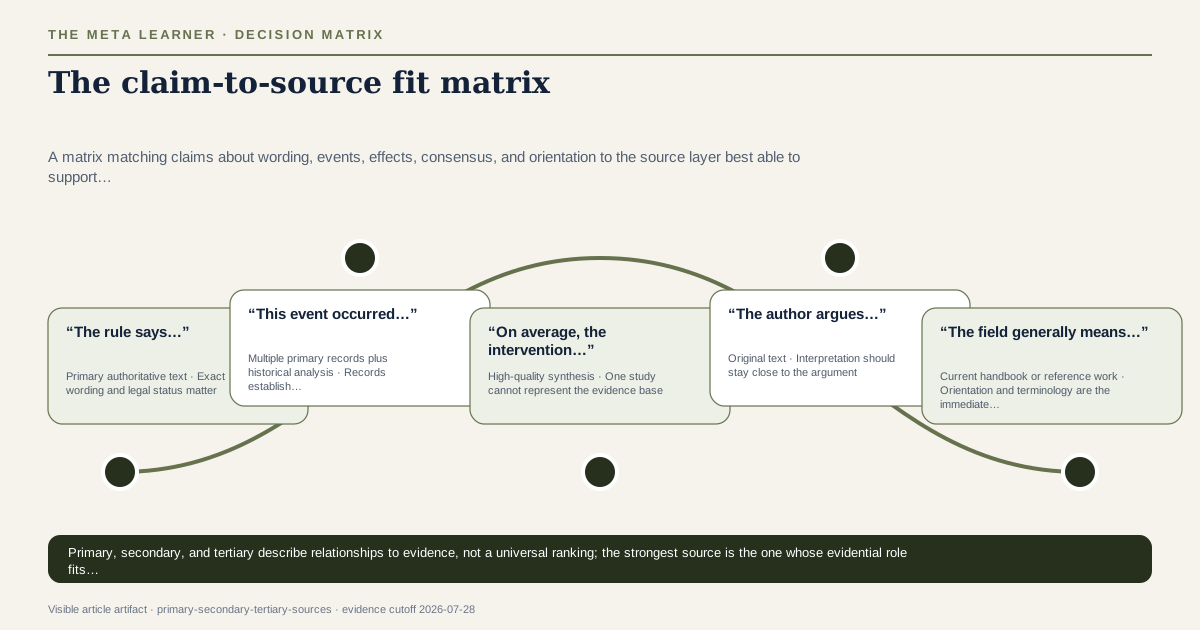
Use a primary source for direct evidence of an event, text, dataset, experiment, or artifact; a secondary source for analysis or synthesis of primary material; and a tertiary source for orientation and vocabulary. These are roles, not quality rankings. A strong systematic review may be better evidence for an overall effect than one primary study, while an enacted law is indispensable for its exact wording.
Why the three labels mislead
Students often learn a hierarchy: primary is best, secondary is acceptable, tertiary is weak. That rule is easy to remember and frequently wrong.
A randomized trial is primary research, but it may be biased or too narrow for your decision. A transparent systematic review is secondary, yet it may locate, appraise, and synthesize the relevant trials. An encyclopedia is tertiary, but it can supply the vocabulary needed to find both. The relevant question is not “Which layer is highest?” It is “Which source can legitimately support this sentence?”
The ACRL framework’s view of authority as constructed and contextual is useful here.acrl-framework, cochrane-studies, prisma-statement Authority does not evaporate into opinion; it is evaluated in relation to purpose, method, community, and challenge.
Define the roles relationally
Primary source: material closest to the phenomenon under study. Examples include interview transcripts, datasets, archival letters, statutes, court decisions, technical specifications, artworks, and reports of original studies.
Secondary source: analysis, interpretation, criticism, or synthesis of primary material. Examples include systematic reviews, histories, legal commentary, scholarly criticism, and evidence briefs.
Tertiary source: organized overview assembled from primary and secondary sources. Examples include dictionaries, encyclopedias, handbooks, indexes, and introductory explainers.
The same source can change roles. A newspaper story is secondary evidence about an event it describes, but primary evidence for a study of how newspapers framed that event. A systematic review is secondary for the intervention effects it synthesizes and primary for research on review methodology.
Audit five claims by source role
| Claim | Best starting role | Why | |---|---|---| | “The rule says…” | Primary authoritative text | Exact wording and legal status matter | | “This event occurred…” | Multiple primary records plus historical analysis | Records establish traces; analysis resolves context | | “On average, the intervention…” | High-quality synthesis | One study cannot represent the evidence base | | “The author argues…” | Original text | Interpretation should stay close to the argument | | “The field generally means…” | Current handbook or reference work | Orientation and terminology are the immediate job |
Follow the starting source outward. Exact statutory text may need guidance and case law. A review may need selected primary studies for a decisive subgroup. An original book may need critics and intellectual history.
Authoritative information-literacy and review guidance supports choosing sources by purpose, tracing reports to studies, and documenting how evidence was identified and selected. PRISMA improves transparency in reporting reviews; it is not itself a guarantee that a synthesis is rigorous.
Claim sources: acrl-framework, cochrane-studies, prisma-statement
Distinguish a study from its reports
One study may produce a protocol, conference abstract, journal article, supplementary appendix, dataset, correction, and follow-up. Cochrane explicitly treats the study—not each report—as the unit of interest and asks reviewers to link multiple reports rather than count them as independent evidence.cochrane-studies
This corrects a common research error. Ten documents do not necessarily mean ten studies. Conversely, the headline article may omit detail available in a protocol or regulatory report.
Create a study family:
- study identifier;
- protocol or registration;
- main report;
- secondary analyses;
- data or code;
- corrections or retractions;
- later replication.
Now the primary layer becomes a structured record rather than a single PDF.
Evaluate secondary sources by method
“Review” covers very different practices. Ask:
- Was the question specified?
- Were databases, dates, and queries reported?
- Were inclusion and exclusion decisions visible?
- Were studies appraised for bias?
- Were incompatible outcomes or populations combined?
- Were missing results and conflicts considered?
- Does the conclusion reflect uncertainty and heterogeneity?
PRISMA supplies reporting items and flow diagrams for systematic reviews.prisma-statement A review can report clearly and still contain questionable judgments, so use the checklist to expose the method, not to outsource appraisal.
A worked source decision
You need to write: “Active recall improves durable learning.”
A tertiary explainer gives the definition. A primary experiment demonstrates an effect under one set of conditions. A secondary review compares retrieval practice with other techniques across studies. The defensible evidence stack is:
- use the review for the general direction and boundaries;
- inspect representative primary studies for tasks, delay, and outcomes;
- use the explainer only for accessible orientation, not as the terminal evidence.
If your sentence instead says, “In this experiment, students who retrieved…” the primary paper becomes the direct source. Claim design changes source design.
Match five claim types to source roles
Take five material sentences from a draft:
- Label each sentence’s claim type.
- Identify the current source role.
- Ask whether that role can support the verb, scope, and number.
- Trace secondary claims to the underlying primary record.
- Search for synthesis when making a field-level claim.
- Add a tertiary source only where readers need orientation.
- Record source role in your notes.
Use Critical Thinking: A Practical System for Claims and Evidence to test warrant, How to Read a Difficult Book to reconstruct originals, and Turn Book Notes Into Reusable Knowledge to preserve provenance.
Category errors in evidence use
- Calling a source primary as a synonym for trustworthy.
- Citing a primary study for a claim about scientific consensus.
- Citing a review without examining its selection and appraisal method.
- Treating multiple reports of one study as independent confirmation.
- Using a textbook or AI answer for a contested current claim.
- Quoting a law from a commentator when exact legal text matters.
- Demanding randomized evidence for questions about meaning, history, or feasibility.
Where the labels stop helping
Disciplines classify sources differently, and digital artifacts blur familiar boundaries. The three labels do not assess bias, authenticity, completeness, relevance, legal force, or ethical legitimacy. High-stakes decisions require domain-specific evidence standards and current authoritative guidance, not only a correct source-layer label.
Source literacy is the ability to assign each claim an evidence carrier strong enough for its actual weight.
Named sources
Evidence and further reading
Published July 29, 2026. No substantive revision has been recorded. Evidence last verified July 28, 2026.