When to Read the Original, Use a Summary, or Ask AI: A Decision Framework
Decide when a source requires direct reading, when a trusted synthesis is sufficient, and when AI can safely help with navigation rather than authority.
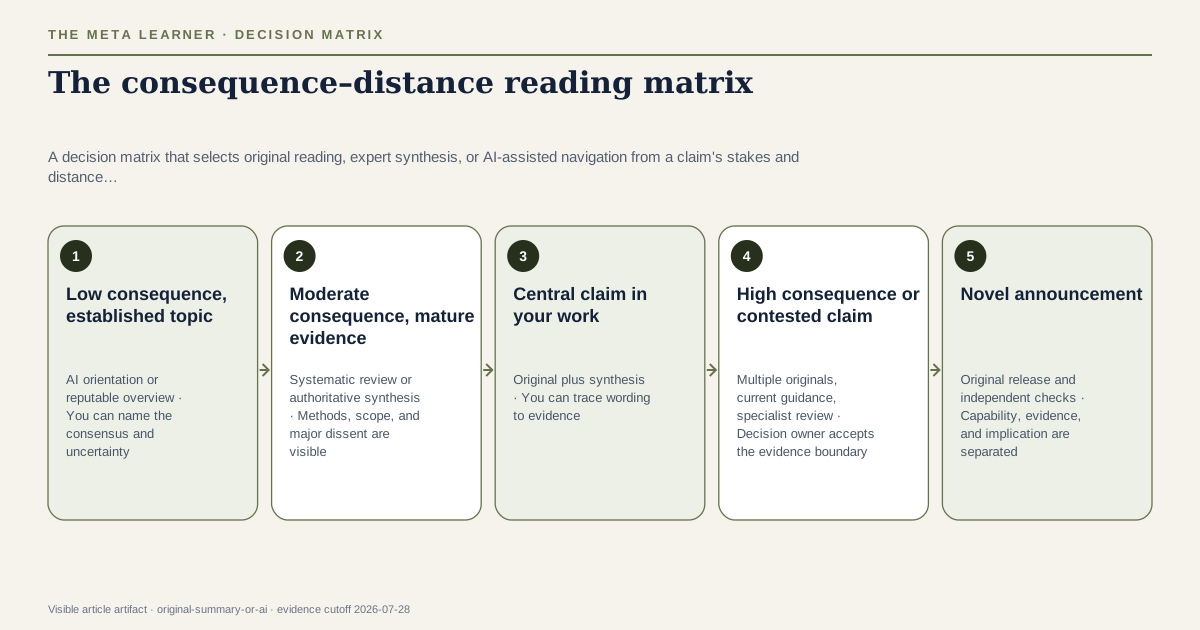
Read the original when the claim is consequential, disputed, novel, or central to your argument. Use a reputable synthesis when you need the state of a mature evidence base rather than one study. Ask AI to orient, compare terminology, or generate search leads—but verify its claims and citations in sources you can inspect. Convenience determines where you start; consequence determines where you stop.
The hidden cost of convenient answers
Modern readers can move from question to answer without encountering a source. Search snippets, newsletters, review articles, podcasts, and AI systems compress a chain of interpretation into a fluent conclusion. That compression is often useful. It can also hide population boundaries, rival findings, definitions, and uncertainty.
The real choice is not “originals good, summaries bad.” Primary evidence can be weak or unreadable in isolation. A careful systematic review may provide a more reliable account than one celebrated experiment. The decision is about evidential distance: how many interpretive steps separate you from the observation, argument, law, dataset, or artifact on which a claim depends?
Apply the matrix to a live claim
Score the claim on two axes:
- Consequence: What happens if this is wrong?
- Contestability: How plausible is informed disagreement?
Then choose the minimum defensible depth:
| Situation | Start with | Stop when | |---|---|---| | Low consequence, established topic | AI orientation or reputable overview | You can name the consensus and uncertainty | | Moderate consequence, mature evidence | Systematic review or authoritative synthesis | Methods, scope, and major dissent are visible | | Central claim in your work | Original plus synthesis | You can trace wording to evidence | | High consequence or contested claim | Multiple originals, current guidance, specialist review | Decision owner accepts the evidence boundary | | Novel announcement | Original release and independent checks | Capability, evidence, and implication are separated |
“Original” varies by question. For a statute, read the enacted text and authoritative guidance. For a historical quotation, inspect the primary document and context. For an intervention effect, one original trial is not the whole evidence base. For a model capability, examine the technical report, evaluation design, and independent replication.
Assign each layer a legitimate job
AI answer: vocabulary, possible subquestions, query expansion, comparison prompts, and navigation.
Popular summary: orientation, significance, narrative, and a doorway into the subject.
Expert synthesis: aggregation, methodological appraisal, disagreement, and a map of the evidence base.
Original source: exact wording, design, data, context, definitions, and provenance.
These layers are not a ladder of moral worth. They are tools with different failure modes. The ACRL framework treats authority as contextual and research as inquiry, which supports asking what kind of authority a particular question requires.acrl-authority, nist-genai, cochrane-synthesis
Information-literacy and evidence-synthesis guidance support matching sources to questions and preserving method and context. NIST identifies confabulation and information-integrity risks in generative AI. Together they support AI as a navigation and transformation layer, not an unverified evidential endpoint.
Claim sources: acrl-authority, nist-genai, cochrane-synthesis
The five reasons to open the original
Open the underlying source when:
- Wording carries authority. A legal rule, standard, policy, contract, or quotation depends on exact language.
- The claim anchors your conclusion. If removing it changes the argument, inspect it.
- A number is persuasive. Check its denominator, time period, population, and measure.
- The claim is surprising or polarizing. Strong emotional or social incentives reward distortion.
- The summary’s verbs outrun its design. “Causes,” “proves,” “eliminates,” and “will” deserve inspection.
If access is blocked, do not fill the gap by confidence. Label the source uninspected, find an accessible version, use a qualified synthesis, or narrow the claim.
When synthesis is superior
A disciplined synthesis can answer a question no single primary study can. It can locate studies systematically, appraise bias, compare populations, and examine heterogeneity. Cochrane warns, however, that non-meta-analytic synthesis methods vary in their ability to support conclusions and should be chosen and reported transparently.cochrane-synthesis
Prefer synthesis when asking:
- What is the overall direction and range of effects?
- Which conditions change the result?
- Where is the evidence missing?
- How stable is a finding across studies?
Still open selected originals when a particular method, subgroup, number, or quotation matters to your use.
A worked decision
You are designing a learning program and encounter the claim, “handwritten notes always produce better learning than laptop notes.”
An AI answer gives a confident mechanism and cites a famous study. A popular article repeats the conclusion. A later synthesis reveals variation in tasks, learner behavior, and outcomes. The original study clarifies its specific conditions.
The responsible conclusion becomes: device effects are entangled with how notes are taken, what is measured, and the learning context; design generative processing and retrieval rather than treating one medium as universally superior.
The convenient answer was not useless—it identified the debate. It was insufficient for the decision.
Use the consequence-distance matrix
For one claim in your current work:
- Write the consequence if it is wrong.
- Count the layers between your source and the underlying evidence.
- Mark whether the claim is disputed, novel, numeric, or authoritative.
- Select the depth from the matrix.
- Ask AI for search terms and rival interpretations, not final authority.
- Open the selected source and record the exact support and limitation.
- Rewrite your sentence so it cannot imply more than you verified.
Continue with Verify AI Explanations and Sources, then use How to Read a Difficult Book for close reading and AI Literacy for Adult Learners for broader capability boundaries.
Bad substitutions between source layers
- Using a search snippet as if it preserved the source’s qualification.
- Treating a systematic review as timeless or universally applicable.
- Citing the original study for a claim made only by a later commentator.
- Asking AI to “verify” the citation it generated without opening it.
- Reading every original indiscriminately and missing the evidence base.
- Confusing primary with reliable, or secondary with derivative.
NIST’s generative-AI profile is a risk-management document, not a claim that every AI answer is false. Its value here is the requirement to treat confabulation and information integrity as design concerns rather than surprises.nist-genai
Boundaries of the matrix
The matrix does not rate study quality, determine legal authority, or resolve specialist disputes. Access barriers, language, technical complexity, and publication bias can leave important evidence invisible. In medicine, law, finance, safety engineering, and other high-stakes domains, current professional guidance and accountable expertise are required even after careful source reading.
The disciplined reader does not worship originals or reject compression. The discipline is knowing which layer can legitimately carry which claim.
Named sources
Evidence and further reading
Published July 29, 2026. No substantive revision has been recorded. Evidence last verified July 28, 2026.