How to Evaluate a Research Study: A Non-Specialist’s Evidence Checklist
Evaluate a study through question fit, design, measurement, comparison, uncertainty, bias, transparency, and applicability before using its conclusion.
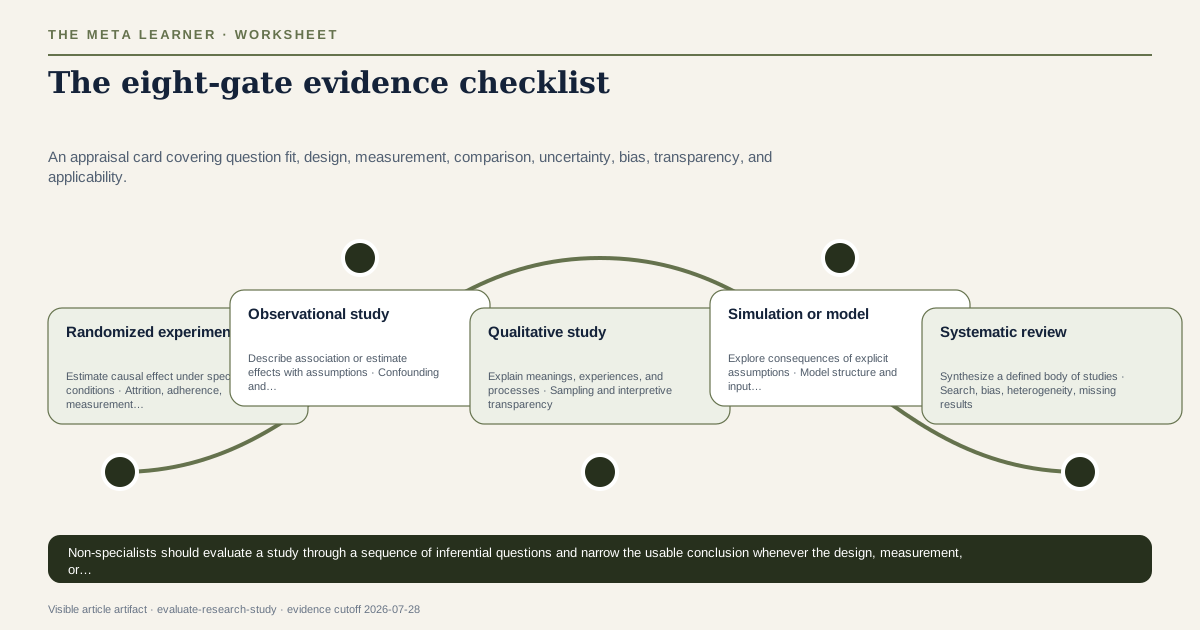
Evaluate a research study with eight gates: question fit, design, measurement, comparison, uncertainty, bias, transparency, and applicability. At each gate, ask whether the evidence supports the exact verb and scope of the conclusion. If not, narrow the conclusion. A checklist can organize judgment; it cannot turn a non-specialist into a statistician or domain expert.
What this checklist is for
This checklist is for readers who must decide whether a study can support a sentence, research brief, product decision, or learning choice. It is not a numerical score and not a substitute for the validated appraisal tools used in medicine, social science, engineering, or other disciplines.
The central principle is result-level judgment. A paper is not simply trustworthy or untrustworthy. One result may be well supported while another is exploratory, selectively reported, imprecise, or outside the design’s reach. Cochrane distinguishes risk of bias from imprecision and asks reviewers to justify domain judgments with source information.cochrane-bias, cochrane-rob, equator-reporting
Gate 1: question fit
Write your question and the study’s question side by side.
- Are the population, setting, intervention or exposure, comparison, outcome, and time horizon aligned?
- Is your desired outcome actually measured?
- Are you importing a policy, commercial, or ethical decision that the study did not ask?
A strong study can be irrelevant. Relevance is not a courtesy check; it determines whether the result enters your evidence base.
Gate 2: design
Identify what the design can, in principle, establish:
| Design | Strongest typical job | Central caution | |---|---|---| | Randomized experiment | Estimate causal effect under specified conditions | Attrition, adherence, measurement, generalization | | Observational study | Describe association or estimate effects with assumptions | Confounding and selection | | Qualitative study | Explain meanings, experiences, and processes | Sampling and interpretive transparency | | Simulation or model | Explore consequences of explicit assumptions | Model structure and input validity | | Systematic review | Synthesize a defined body of studies | Search, bias, heterogeneity, missing results |
Do not punish a qualitative study for lacking randomization when the question concerns experience. Do not use an observational association as if randomization occurred.
Gate 3: measurement
Ask what the variables mean in practice:
- Was the outcome direct or a proxy?
- Was the measure validated for this population and purpose?
- Was it selected before results were known?
- Was the assessor blinded where that matters?
- Is the timing long enough to represent the claim?
“Engagement,” “learning,” “productivity,” and “well-being” can be operationalized in incompatible ways. Read the instrument, task, coding scheme, or administrative definition.
Gate 4: comparison
An effect is always relative to something. Identify the counterfactual: usual practice, active alternative, placebo, wait list, historical baseline, or statistical model.
A weak comparator can make an intervention look useful without showing it is better than the realistic choice. Check whether groups differed before treatment and whether co-interventions or changing conditions could explain the result.
Risk-of-bias guidance supports domain-based, result-specific judgments with transparent reasons. Reporting guidelines identify information needed to understand and use studies, but EQUATOR explicitly defines them as reporting tools; complete reporting is not synonymous with valid design or unbiased results.
Claim sources: cochrane-bias, cochrane-rob, equator-reporting
Gate 5: uncertainty
Look beyond “statistically significant.”
- What is the effect magnitude?
- How wide is the interval estimate?
- Are there few events or many missing observations?
- Were numerous outcomes or subgroups tested?
- Does practical importance differ from statistical detectability?
Uncertainty can be random, structural, or contextual. A precise estimate of a poorly chosen measure is still limited.
Gate 6: bias
Bias is systematic deviation, not a synonym for disagreement. Examine:
- selection into the study and analysis;
- allocation and deviations from intended conditions;
- missing outcome data;
- measurement differences;
- selective analysis or reporting;
- conflicts that may influence design, conduct, or publication.
Cochrane’s tools are specific to designs and results; they are not meant to be replaced by a home-made total score.cochrane-rob Use the domains as questions, and seek the appropriate tool when the decision justifies it.
Gate 7: transparency
Look for registration, protocol, analysis plan, data and code where appropriate, appendices, funding, conflicts, corrections, and retractions. Compare planned outcomes with reported ones.
EQUATOR catalogs reporting guidelines for different study types, including CONSORT, STROBE, PRISMA, and qualitative standards.equator-reporting Their checklists help you find what should be visible. Missing reporting creates uncertainty; it does not prove misconduct.
Gate 8: applicability
Finally ask:
- Are participants meaningfully similar to the people in my decision?
- Can the intervention be delivered with comparable fidelity?
- Do baseline risks, incentives, institutions, or technology differ?
- What harms, costs, or distributional effects were not measured?
- Is the evidence still current for a changing system?
External validity is an argument, not an automatic property of sample size.
Apply the eight evidence gates
Choose one result and make a one-page record:
- Quote the authors’ claim.
- Write the narrowest result the data clearly show.
- Complete one sentence for each gate.
- Mark each gate clear, uncertain, or material concern.
- Rewrite your usable claim.
- State one decision this result can inform and one it cannot.
- Ask a specialist to review material concerns when stakes are high.
Then connect the appraisal to Critical Thinking: A Practical System for Claims and Evidence, calibrate action with How to Make Decisions Under Uncertainty, and use Verify AI Explanations and Sources when the study arrived through an AI system.
Shortcuts that produce false confidence
- Scoring the journal instead of the result.
- Treating peer review as replication.
- Equating a large sample with causal identification.
- Calling all limitations “bias.”
- Treating reporting compliance as methodological validity.
- Ignoring preregistration changes, missing outcomes, or study families.
- Using “more research is needed” without specifying which uncertainty matters.
- Applying a population average to an individual without context.
When the checklist is insufficient
This general checklist cannot evaluate specialized statistical models, diagnostic accuracy, toxicology, engineering safety, legal admissibility, clinical benefit, or other domain-specific standards. It also cannot detect fraud from a paper alone. Consequential decisions require the current validated appraisal tool, access to full records where possible, and review by accountable specialists.
Critical reading is not the performance of suspicion. It is the disciplined adjustment of a claim to the evidence that can actually carry it.
Named sources
Evidence and further reading
Published July 29, 2026. No substantive revision has been recorded. Evidence last verified July 28, 2026.