Why We Procrastinate on Important Learning: Emotion, Uncertainty, and Avoidance
Procrastination often regulates present emotion at a future cost. Reduce ambiguity, lower the emotional entry price, and make the next action concrete.
We often procrastinate on important learning because beginning evokes uncertainty, boredom, shame, threatened competence, or anticipated effort. Delay relieves that feeling now, which reinforces avoidance even when future costs are obvious. Make the first action concrete and small, reduce ambiguity, preserve agency, and reward starting with information—not self-punishment. Delay can be rational, and persistent avoidance may involve clinical, environmental, financial, or accessibility conditions beyond this framework.
The avoidance pattern this article explains
Procrastination is not simply doing something late. It is voluntarily delaying an intended action despite expecting the delay to make matters worse. That definition separates it from rational postponement: waiting for prerequisite data, recovering from illness, or declining a low-value course can be good judgment.
Learning is fertile ground for procrastination because its rewards are delayed and its first moments expose what we do not know. “Study statistics” contains no clear starting action, no finish line, and a possible verdict about intelligence. A tidy inbox offers immediate closure.
The emotional-entry protocol: evidence and boundary
Meta-analytic work characterizes procrastination as a consequential self-regulation failure associated with variables including task aversiveness, delay, impulsiveness, and self-efficacy. Emotion-regulation accounts explain delay as short-term mood repair whose costs fall on the future self. Research on implementation intentions indicates that specifying when, where, and how to act can help translate intentions into behavior, though it is not a universal cure.
steel-procrastination, sirois-mood, gollwitzer-intentionsClaim sources: steel-procrastination, sirois-mood, gollwitzer-intentions
The avoidance loop
- A task cue appears.
- The cue produces an aversive state: uncertainty, inadequacy, resentment, or boredom.
- A substitute activity offers fast relief.
- Relief reinforces the substitution.
- Time pressure and self-criticism make the original task more aversive.
The loop explains why reminders can worsen avoidance. A reminder repeats the threat without changing the entry conditions.
Diagnose the emotion before the calendar
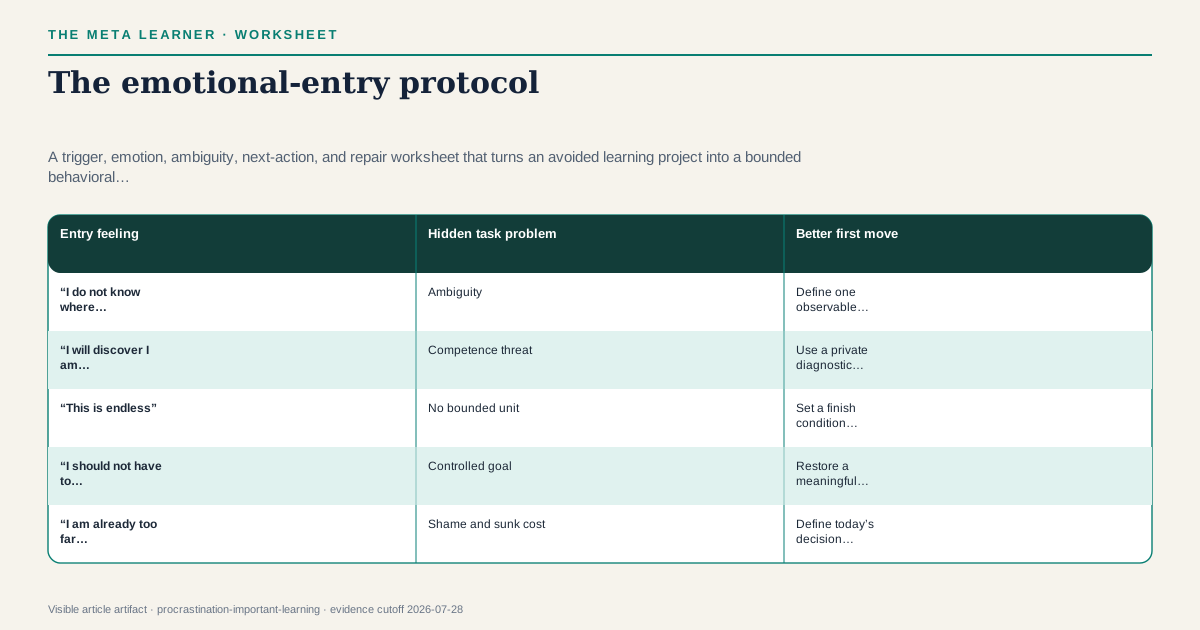
| Entry feeling | Hidden task problem | Better first move | |---|---|---| | “I do not know where to start” | Ambiguity | Define one observable action | | “I will discover I am bad at this” | Competence threat | Use a private diagnostic with correction | | “This is endless” | No bounded unit | Set a finish condition, not only a timer | | “I should not have to do this” | Controlled goal | Restore a meaningful choice or reject the goal | | “I am already too far behind” | Shame and sunk cost | Define today’s decision from current state |
The table does not diagnose a person. It generates a design hypothesis.
The emotional-entry protocol
Write five lines before changing tools:
- Trigger: What exact moment do I avoid?
- Emotion: What do I expect to feel in the first five minutes?
- Ambiguity: Which decision or instruction is undefined?
- Entry action: What physical action can finish in ten minutes?
- Useful residue: What evidence will that action leave for the next step?
“Open the paper” is physical but may leave no useful residue. “Extract the sample, comparator, and outcome into three cells” ends with evidence and a natural next question.
A case without heroics
A learner has avoided a machine-learning course for three weeks. The course is valuable, and time exists. The avoided moment is not watching the lecture; it is opening an assignment whose notation makes him feel fraudulent.
He changes the entry task: copy the problem statement, circle every symbol, and write which three are unknown. He sends that bounded artifact to a study partner with one question. The intervention does not make the assignment easy. It changes the first experience from undifferentiated threat to diagnosable uncertainty.
Run the emotional-entry protocol
For five avoided sessions:
- Name the emotion without arguing with it.
- Shrink the first action until its completion is unambiguous.
- Use an if-then cue: “If I close lunch, I will extract one claim at the desk.”
- Work only to the defined residue if needed.
- Record whether starting changed the predicted emotion.
- Increase scope only after the entry is reliable.
The aim is not to make every session tiny. It is to build a dependable door into larger work.
Repair the future-self bargain
Judge the intervention by more than starting. A five-minute entry ritual can improve immediate performance while leaving delayed retention and transfer unchanged. After the work episode, schedule an unaided retrieval or application test and compare it with the original learning goal. Novices may need a concrete first example and narrower task; learners with prior knowledge may need an authentic challenge rather than more scaffolding. Research synthesis on procrastination also spans different populations and measures, so a successful entry protocol is evidence about one avoidance loop, not a universal diagnosis.
Procrastination lets the present self consume relief while the future self pays interest. A decision record makes that exchange visible:
- relief obtained by delaying;
- future cost created;
- smallest cost-reducing action now;
- support the future self will inherit.
A restart note, prepared materials, and a specific question are gifts to the next session. They reduce the emotional price of re-entry.
Anti-procrastination traps
- Adding a more elaborate planning system to avoid the task.
- Publicly committing when social threat drives the avoidance.
- Making the first action so trivial that it never reaches the hard decision.
- Punishing delay and increasing shame.
- Prescribing discipline for a goal with no real value.
- Ignoring sleep, health, caregiving, disability, or unsafe conditions.
- Calling deliberate incubation or information gathering procrastination.
Evidence and care boundary
Procrastination research relies on varied definitions, self-report, student samples, and correlational as well as experimental designs. A lightweight protocol cannot diagnose ADHD, anxiety, depression, trauma, sleep disorders, or other conditions that may affect initiation and regulation. Persistent distress or impaired functioning deserves qualified support and appropriate accommodation.
The central move is compassionate precision: identify what delay accomplishes now, then redesign the first contact with the work.
Compare the wider motivation audit, place the entry cue in a personal learning system, and protect the resulting episode from attention residue.
Named sources
Evidence and further reading
Published July 29, 2026. No substantive revision has been recorded. Evidence last verified July 28, 2026.