Motivation Is Not Willpower: The Science of Value, Progress, and Agency
Motivation changes with value, expected progress, agency, belonging, and cost. Diagnose the system before demanding more discipline.
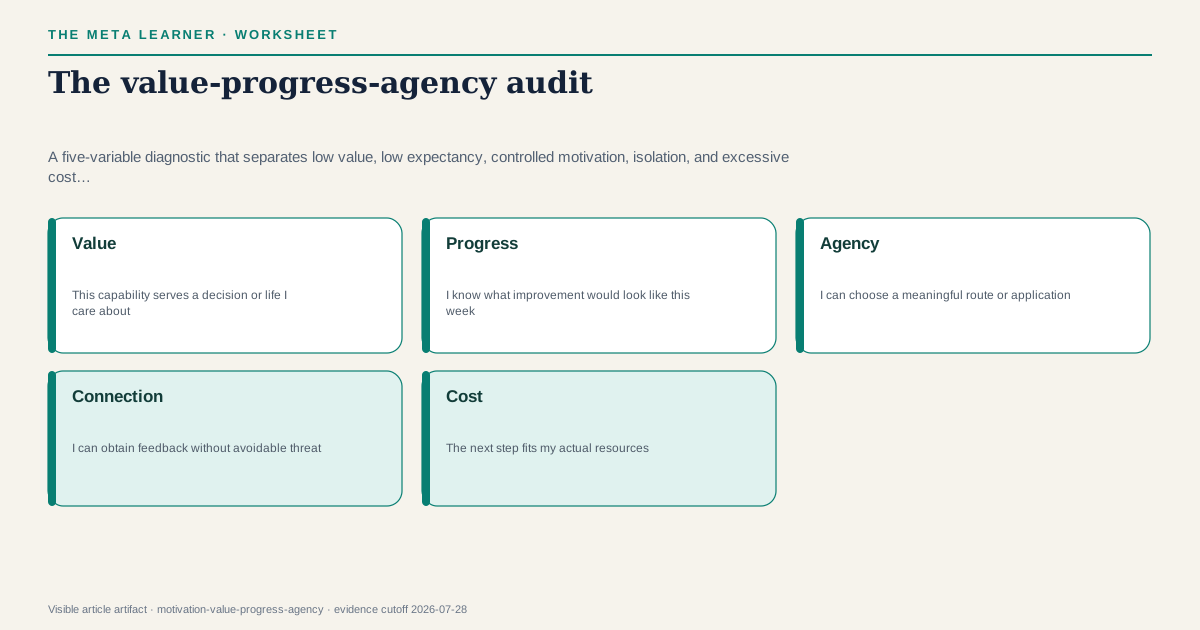
Do not treat motivation as a fuel tank filled by willpower. Diagnose whether the goal has personal or instrumental value, whether progress feels possible, whether the learner has meaningful choice, whether competence is visible, whether belonging is supported, and whether the cost is tolerable. Repair the weakest condition and make one next action produce evidence of progress.
The motivational problem to diagnose
When learning stalls, “be more disciplined” compresses many causes into a moral judgment. A person may not value the outcome, may value it but see no route to success, may feel controlled, may expect humiliation, or may face costs that no habit tracker can remove.
This article is for adults trying to restart a meaningful learning project. It does not promise permanent enthusiasm. It offers a diagnostic model for designing action when desire and obligation are mixed.
The value-progress-agency audit: evidence and boundary
Self-determination theory distinguishes more autonomous from more controlled forms of motivation and emphasizes competence, autonomy, and relatedness. Expectancy-value research models achievement choices through expectations of success, subjective value, and cost. The National Academies’ synthesis likewise describes motivation as shaped by goals, identity, belonging, self-efficacy, interest, and context across the life span. These frameworks overlap without being identical.
ryan-deci, wigfield-eccles, how-people-learnClaim sources: ryan-deci, wigfield-eccles, how-people-learn
Five variables behind “I do not feel like it”
Value: Is the outcome useful, interesting, identity-consistent, or important to someone the learner cares about?
Progress expectancy: Does the learner believe a specific action can improve performance?
Agency: Is the method or goal meaningfully chosen, or merely complied with?
Connection: Is there access to people, models, feedback, and belonging?
Cost: What time, effort, anxiety, money, status risk, or competing opportunity does the activity require?
A goal can score high on four and still fail on the fifth. A prestigious course with no visible progress may lose to a humble project that gives clean feedback.
The value-progress-agency audit
Rate each statement from 1 to 5 and write evidence:
| Variable | Diagnostic statement | Evidence, not aspiration | |---|---|---| | Value | This capability serves a decision or life I care about | | | Progress | I know what improvement would look like this week | | | Agency | I can choose a meaningful route or application | | | Connection | I can obtain feedback without avoidable threat | | | Cost | The next step fits my actual resources | |
Do not add the scores into a pseudo-scientific index. The lowest row generates a hypothesis to test.
Match the intervention to the deficit
If value is low, connect the skill to a real project—or honestly abandon it. If progress expectancy is low, shrink the target and provide a worked model. If agency is low, restore choice over topic, medium, sequence, or evidence. If connection is low, find a peer, expert example, or accountable reviewer. If cost is high, remove logistics, renegotiate scope, or choose a different season.
Rewards and deadlines can initiate action, but they do not all operate alike. External structures can support an endorsed goal; controlling pressure can also narrow agency or move attention toward merely clearing the requirement. Ask what relationship to the activity the incentive creates.
A nonheroic example
A manager says she wants to learn data analysis but repeatedly abandons online courses. The willpower story predicts more reminders. The audit reveals strong value, moderate agency, and almost no progress expectancy: lessons teach syntax without a work question she can answer.
She selects one recurring decision—whether customer response differs by channel—and learns only the operations needed to inspect it. A colleague reviews the analysis. The first chart is not proof of expertise, but it supplies credible progress and makes the next gap visible.
Make progress informational
Visible activity is not always visible competence. Streaks and hours can motivate while concealing whether capability changed. Prefer signals that both encourage and inform:
- a retrieval score after delay;
- an error category that disappears;
- a problem solved with less support;
- a clearer explanation to a skeptical reader;
- a transfer attempt in a new context.
Progress evidence should be frequent enough to guide action but not so easy that it becomes theatre.
Use the value-progress-agency audit
Apply the audit to one stalled project:
- Name the capability and the decision it serves.
- Score the five variables with one concrete observation each.
- Choose the weakest variable.
- Design the smallest change that could alter it.
- Define an observable result for the next seven days.
- Run the test without redesigning the entire system.
- Keep or reject the change from evidence.
If the project has no credible value after examination, stopping can be a rational decision rather than motivational failure.
Motivation advice that backfires
- Treating exhaustion or depression as a discipline problem.
- Adding public accountability when shame is already the barrier.
- Optimizing streaks instead of learning evidence.
- Using autonomy as an excuse to provide no structure.
- Assuming intrinsic interest must exist before beginning.
- Ignoring money, caregiving, language, disability, and institutional power.
- Interpreting one low-energy day as a stable identity.
Evidence boundary
Motivation constructs are measured in different ways and operate within social, cultural, material, and developmental contexts. A diagnostic worksheet cannot identify a clinical condition or remove structural constraints. Effects that hold on average do not dictate one person’s cause. When persistent low mood, anxiety, sleep disruption, or impaired functioning is present, appropriate professional support may matter more than learning design.
Motivation becomes tractable when it stops being a verdict. Ask what the current system makes valuable, possible, chosen, connected, and affordable.
Differentiate avoidance with why we procrastinate, measure episodes rather than myths about how long skill takes, and embed the result in a personal learning system.
Named sources
Evidence and further reading
Published July 29, 2026. No substantive revision has been recorded. Evidence last verified July 28, 2026.