How Long Does It Take to Learn a Skill? Why Hours Are the Wrong Unit
Skill time depends on the criterion, starting point, practice quality, feedback, spacing, and transfer. Track productive learning episodes, not folklore.
There is no evidence-based universal number of hours required to learn a skill. Time depends on what “learn” means, where you start, how the skill is structured, the quality and spacing of practice, feedback, health, opportunity, and the level of transfer required. Estimate a range from repeated, criterion-matched learning episodes and update it from observed progress.
The question hours cannot answer
“How long will Spanish take?” could mean ordering lunch, joining an unscripted professional meeting, reading a novel, or translating literature. “Learn Python” could mean editing a script or designing reliable distributed systems. Without a criterion, an hour estimate is decoration.
This article is for adults planning a serious capability without surrendering to the “ten-thousand-hour rule” or its opposite, the weekend-mastery promise.
The productive learning episode ledger: evidence and boundary
Foundational research on expert performance emphasizes extended, purposeful practice with tasks, feedback, and correction, not mere repetition. A later meta-analysis found that deliberate practice explained different proportions of performance variation across domains and far less than all of it. National Academies syntheses place learning within prior knowledge, context, culture, motivation, and opportunity. Hours matter, but they are not a universal dose or guarantee.
ericsson-practice, macnamara-meta, how-people-learnClaim sources: ericsson-practice, macnamara-meta, how-people-learn
Five variables inside every estimate
- Criterion: What observable performance counts?
- Starting state: Which prerequisites and related schemas already exist?
- Task structure: Is the domain stable, decomposable, and rich in valid feedback?
- Practice conversion: How much elapsed time contains targeted attempts and correction?
- Transfer distance: Must performance survive new settings, pressure, and ambiguous cases?
Two people can record one hundred hours while receiving different doses on all five.
The productive learning episode
Count an episode when it contains:
- a criterion-matched target;
- an attempt that exposes current performance;
- an identified bottleneck;
- feedback or an objective result;
- a corrected attempt;
- later evidence that the correction remained usable.
Reading and observation can be essential preparation, but do not automatically qualify. The ledger distinguishes inputs from capability change.
The productive learning episode ledger
| Date | Criterion | Bottleneck | Attempt | Feedback | Correction | Delayed result | |---|---|---|---|---|---|---| | | | | | | | |
After ten to twenty comparable episodes, inspect the rate at which bottlenecks change and independence increases. That personal evidence supports a better forecast than a famous number detached from your criterion.
Forecast a range, not a promise
Suppose a researcher wants to conduct a reproducible data analysis with documentation. A baseline reveals that data cleaning, not statistics, is the first bottleneck. She schedules six weeks of three project episodes, with code review every third episode.
Her forecast is conditional:
If I complete fifteen targeted episodes and pass two delayed, unseen data tasks, I expect to reach supervised competence in six to eight weeks.
This statement has an assumption, a criterion, and an update rule. “It takes 200 hours” has none.
Why early progress misleads
Beginners can improve rapidly on familiar examples, then slow when tasks become variable and judgment matters. Conversely, early setup costs can conceal later acceleration once a schema forms.
Do not extrapolate one week linearly. Track stage changes:
- orientation;
- reliable execution on standard cases;
- discrimination among cases;
- independent error correction;
- transfer and judgment.
Each stage changes the practice problem.
Estimate from productive episodes
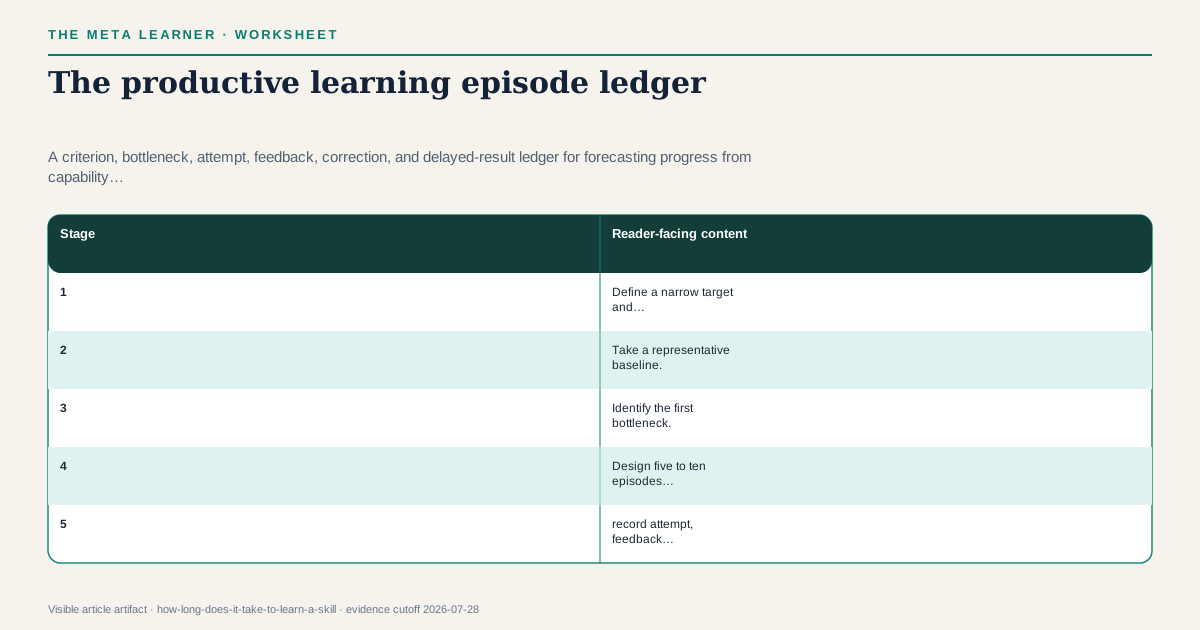
- Define a narrow target and success rubric.
- Take a representative baseline.
- Identify the first bottleneck.
- Design five to ten episodes around that bottleneck.
- record attempt, feedback, correction, and delayed result.
- estimate the conversion ratio between elapsed hours and complete episodes.
- project a range to the next criterion, not final mastery.
- update after each transfer test.
Include recovery and coordination time. A plan that counts only ideal practice is a fantasy schedule.
What deliberate practice does—and does not mean
That is why a forecast needs both a learner boundary and an outcome boundary. A novice acquiring basic vocabulary, a practitioner adapting adjacent prior knowledge, and an expert refining rare errors do not convert hours into progress at the same rate. Nor are course completion, immediate performance, delayed retention, unaided transfer, and professional reliability interchangeable targets. Review evidence can estimate broad relationships, but a local forecast should be updated from productive episodes and representative tests rather than from a universal hour count.
Use at least one delayed test and one changed-context task. If performance collapses without prompts, the ledger has counted supported activity rather than the capability promised.
Deliberate practice is not simply trying hard. Its classic formulation concerns activities designed to improve specific performance, requiring concentration and informative feedback. Such conditions are easier to build in mature domains with teachers, established tasks, and stable standards.
In new or ill-structured fields, exploration, projects, peer critique, and model-building may matter more than repeating decomposed drills. The ledger can still track learning episodes without pretending the domain has a settled curriculum.
Time myths
- A universal hour threshold guarantees expertise.
- Talent alone determines the curve.
- All practice minutes are equivalent.
- Early fluency predicts advanced judgment.
- Faster completion always means faster learning.
- Adults should compare their hours with full-time trainees.
- A precise estimate is more useful than an explicit range.
What cannot be forecast precisely
Skill trajectories are path-dependent and influenced by selection, prior experience, teachers, health, socioeconomic opportunity, motivation, and measurement. Retrospective hour estimates can be unreliable, and correlations between practice and performance do not isolate every cause. The ledger improves local planning; it does not calculate innate potential or guarantee expertise.
Time is a budget. Learning episodes are the investment decisions made inside it.
Design the episode with deliberate practice, adapt the path for adult expertise, and score the result with evidence of actual learning.
Named sources
Evidence and further reading
Published July 29, 2026. No substantive revision has been recorded. Evidence last verified July 28, 2026.