Can Adults Still Become Experts? What Changes With Age—and What Does Not
Adult cognition changes across the lifespan, but expertise is domain-specific and plastic. Design around prior knowledge, health, time, and real feedback.
Adults can still develop expertise, but neither age nor “brain plasticity” gives a simple yes-or-no prediction. Some speed, working-memory, sensory, and recovery constraints may change; accumulated knowledge, strategies, motivation, and context can be powerful assets. Define the domain and criterion, assess current constraints, then build sustained practice with feedback and real use.
The age question this article reframes
“Am I too old?” compares a birth date with an undefined destination. Becoming a competent data analyst, a concert soloist, a trusted interpreter, and a research-active mathematician have different entry conditions, bodily demands, selection effects, and standards.
This research map is for adults considering serious learning later than an imagined ideal. It rejects both decline fatalism and motivational claims that age never matters.
The adult expertise constraint map: evidence and boundary
Lifespan research finds that cognitive abilities follow different trajectories rather than one global decline curve. Some measures of processing and memory change across adulthood, while knowledge and expertise can remain robust. Reviews also find retained plasticity and potential benefit from cognitively, physically, and socially enriching activity, while cautioning that evidence for broad transfer and long-term causal effects is uneven. Context, culture, health, and prior knowledge remain integral to learning.
hertzog-enrichment, salthouse-aging, how-people-learnClaim sources: hertzog-enrichment, salthouse-aging, how-people-learn
Expertise is not raw cognitive speed
Experts recognize meaningful patterns, organize knowledge around deep relations, select relevant procedures, monitor error, and know the limits of their competence. Speed can matter, but it is one resource among many.
Accumulated domain knowledge reduces effective complexity. An experienced editor sees argument structure where a novice sees sentences. A senior engineer may take longer on a novel interface yet identify a failure mode faster because the situation maps onto organized experience.
This is also why expertise does not transfer automatically. Thirty years of clinical judgment do not make someone an expert investor. The advantage is structured knowledge in a domain, not a global rank.
What may change—and what may compensate
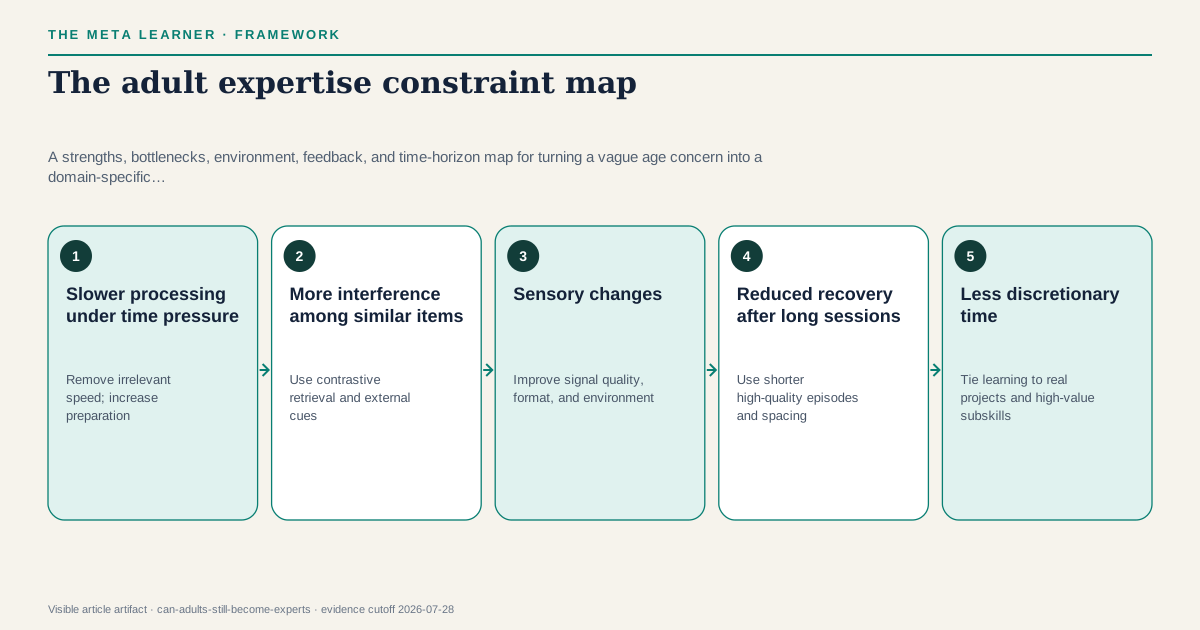
| Possible constraint | Compensating design | |---|---| | Slower processing under time pressure | Remove irrelevant speed; increase preparation | | More interference among similar items | Use contrastive retrieval and external cues | | Sensory changes | Improve signal quality, format, and environment | | Reduced recovery after long sessions | Use shorter high-quality episodes and spacing | | Less discretionary time | Tie learning to real projects and high-value subskills | | Anxiety about novice status | Use psychologically safe feedback and visible baselines |
Compensation is not concealment. If speed is a genuine criterion—emergency response, simultaneous interpreting, competitive sport—it must eventually be trained and tested. But do not import speed into a task where judgment is the real goal.
The adult expertise constraint map
Map five layers:
- Target: What performances define competence and advanced judgment?
- Assets: Which prior knowledge, relationships, and contexts accelerate learning?
- Bottlenecks: Which cognitive, sensory, physical, emotional, or logistical conditions constrain practice?
- Feedback ecology: Who or what can detect errors that self-study cannot?
- Time horizon: What sustained cadence fits the actual life?
The output should be a design, not an optimism score.
A realistic case
A 52-year-old policy professional wants to become technically fluent in machine learning. Competing with a full-time graduate student on mathematical speed is a poor initial frame. His goal is to interrogate models used in public decisions.
He maps the criterion: understand assumptions, reproduce a baseline analysis, detect leakage and distribution shift, and communicate limitations. Existing policy knowledge supplies meaningful cases. A statistician reviews monthly projects. Mathematics gaps become sequenced prerequisites rather than proof of a closed window.
This route may not create a frontier ML researcher, and it need not. It can create consequential domain expertise with a technical spine.
Design an adult expertise path
- Interview or observe credible practitioners to define performances.
- Record a baseline using a representative task.
- Decompose the domain into concepts, discriminations, procedures, and judgment.
- Identify prior knowledge that helps—and habits that interfere.
- Remove irrelevant time and interface demands.
- Schedule frequent retrieval and real projects with feedback.
- Increase complexity, variability, and consequence gradually.
- Reassess the target from demonstrated capability, not age stereotypes.
Track error patterns and independence, not only accumulated hours.
Health, sleep, and environment are part of the design
Learning does not occur in a brain detached from a body and social world. Hearing, vision, sleep, medication, stress, movement, and illness can alter performance. Addressing these factors is not “cheating.” It improves the conditions under which the intended capability can be expressed and developed.
Sudden or concerning cognitive changes are a health question. A learning plan should not normalize them as aging.
Myths at both extremes
- “Neuroplasticity means anyone can reach any level at any age.”
- “Processing-speed decline means complex expertise is closed.”
- “Ten thousand hours guarantees mastery.”
- “Prior experience always helps rather than interfering.”
- “Older adults need simplified content instead of meaningful challenge.”
- “A younger comparison group is the only relevant benchmark.”
- “Compensation makes the resulting expertise less real.”
Evidence and health boundary
Adult-learning and aging studies vary in design, duration, population, and outcome. Healthy-volunteer samples can underrepresent illness and disadvantage; training gains do not always transfer broadly. Elite expertise also reflects selection, opportunity, resources, and long histories. This article cannot predict individual potential or evaluate cognitive symptoms.
The honest answer is conditional but hopeful: age changes resources and constraints. Expertise grows from how those resources are organized around a real domain over time.
Compare expertise in the age of AI, replace the hour myth with criterion-based skill time, and build targeted practice with deliberate practice.
Named sources
Evidence and further reading
Published July 29, 2026. No substantive revision has been recorded. Evidence last verified July 28, 2026.