Expertise in the Age of AI: What Belongs in Your Head?
AI changes access to answers, not the need for organized knowledge. Keep the concepts, patterns, checks, and judgment that make tool output usable.
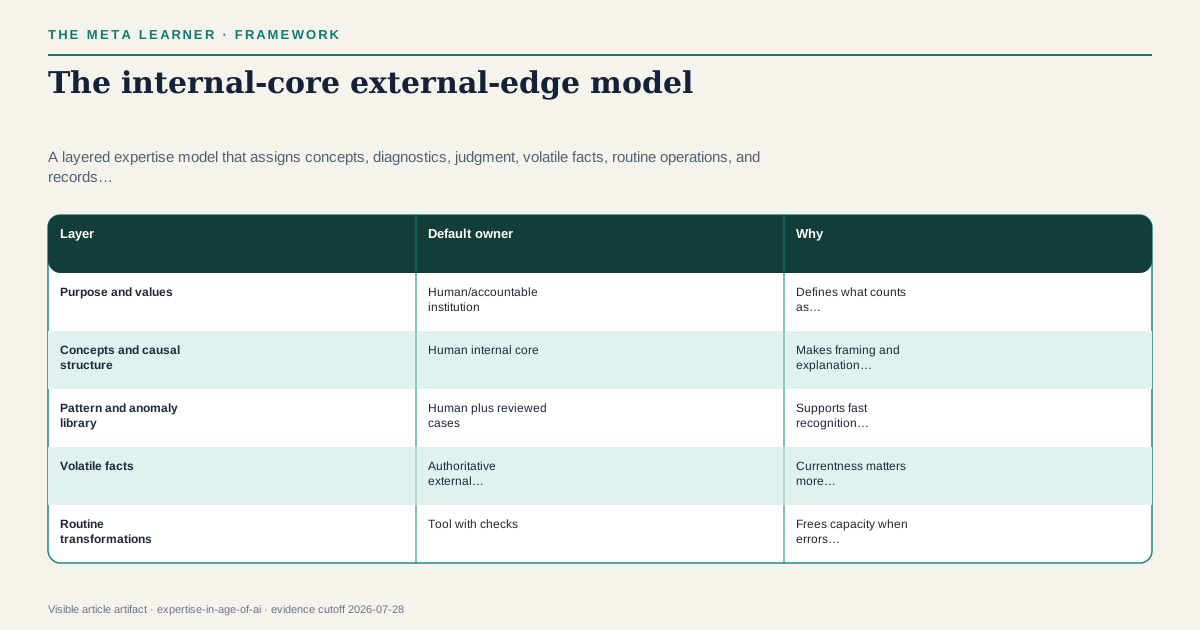
Keep in your head the conceptual structure that lets you frame a problem, recognize relevant patterns, ask discriminating questions, detect implausible output, and understand consequences. Delegate volatile facts, recoverable detail, and routine transformations when sources and checks are explicit. Do not delegate the criterion by which the answer is accepted.
The expertise boundary
If AI can explain, summarize, calculate, translate, and generate, what remains worth learning? The tempting answers are “everything—tools make us lazy” and “almost nothing—lookup is instant.” Both misunderstand expertise.
Expertise is not a warehouse of facts. It is organized knowledge that changes what a person notices, how a problem is represented, which analogy is relevant, what an answer should approximately look like, and which failure matters. Tools can extend this system, but they need not possess its goal or accountability.
Why the evidence supports the internal-core external-edge model
Research syntheses describe experts as organizing knowledge around meaningful relations and conditions of applicability rather than isolated facts. Cognitive-offloading research shows that external action and tools alter task demands and memory behavior. NIST’s risk framework calls for contextual knowledge, documented measurement, human oversight, and defined responsibilities. These foundations support a layered design, while direct evidence about long-term generative-AI use remains incomplete.
how-people-learn, risko-offloading, nist-ai-rmfClaim sources: how-people-learn, risko-offloading, nist-ai-rmf
The internal-core external-edge model
| Layer | Default owner | Why | |---|---|---| | Purpose and values | Human/accountable institution | Defines what counts as a good outcome | | Concepts and causal structure | Human internal core | Makes framing and explanation possible | | Pattern and anomaly library | Human plus reviewed cases | Supports fast recognition and skepticism | | Volatile facts | Authoritative external source | Currentness matters more than recitation | | Routine transformations | Tool with checks | Frees capacity when errors are detectable | | Decision record | Durable external system | Preserves evidence, ownership, and revision |
The borders move with consequence. A clinician, pilot, and casual hobbyist should not internalize the same emergency knowledge.
Knowledge is a search instrument
Without domain knowledge, a person cannot reliably formulate the query that would retrieve what they need. They also cannot distinguish an answer that is specific from one that is merely elaborate.
Internal knowledge supplies:
- vocabulary with precise distinctions;
- plausible ranges and invariants;
- causal mechanisms;
- common confounds and failure modes;
- boundary conditions;
- source hierarchies;
- questions whose answers would change the decision.
This is not an argument for memorizing every constant. It is an argument for building the model that makes constants interpretable.
A jagged delegation case
An experienced lawyer uses AI to compare contract clauses. The system can extract differences rapidly. It may still miss how a defined term changes liability elsewhere, invent a citation, or apply the wrong jurisdiction.
The lawyer’s internal core includes doctrine, document structure, materiality, and red flags. Official law and current precedents remain external sources. Extraction can be delegated; legal judgment and sign-off remain accountable. The useful boundary follows the operation, not the profession.
Learn the checks before the shortcuts
Automation can conceal the shape of a task. Before delegating, produce enough unassisted work to understand:
- inputs and their provenance;
- transformation and assumptions;
- expected output range;
- common failure patterns;
- independent verification;
- consequence and escalation.
Then automate where those checks remain viable. If no one can detect an error, speed is not augmentation; it is unmeasured dependence.
Build an internal expertise core
Choose one recurring professional decision.
- Draw the concepts and causal relations needed to frame it.
- List five anomalies an expert should notice.
- Identify volatile facts and their authoritative sources.
- Mark operations that are routine, reversible, and independently checkable.
- Assign each operation to human, tool, or shared control.
- Run a plausible-error drill.
- Run a tool-unavailable drill.
- Update the allocation from observed failures.
The goal is graceful degradation: when the tool falters, the person can narrow the task, find the source, and avoid catastrophic action.
What to practise with AI present
Use a delayed, unaided transfer test to locate that structure. Give the learner a new case, remove the assistant, and ask for a diagnosis, evidence request, and escalation decision. Immediate performance with AI may show workflow fluency; it does not by itself establish retention or independent competence. Novices need more internal vocabulary and worked cases before delegating. Experts can offload more routine production, but should be tested on the rare conditions where their model must override the tool. This expertise boundary should be defined task by task, not by job title.
Practise framing before prompting. Predict an answer range before generation. Ask for rival interpretations. Verify citations by opening them. Compare output with a criterion. Reconstruct the reasoning after closing the transcript. These actions use AI without making its fluent response the only model available.
For beginners, delay full delegation until a rudimentary schema exists. For experts, use the tool to widen hypotheses and inspect routine detail, but guard against automation bias and familiarity with polished language.
Two bad models of AI-era expertise
- The memorization bunker: retaining every fact while refusing tools, current evidence, or collaboration.
- The empty cockpit: keeping no internal model because an assistant is always available.
- Treating prompt skill as a substitute for domain knowledge.
- Measuring expertise by artifact polish when provenance is unclear.
- Assuming the same boundary fits low- and high-consequence work.
- Keeping no record of sources, system state, or human decision.
- Delegating monitoring to the same system whose error must be detected.
What the evidence supports
The internal-core model synthesizes established research on expertise, offloading, and risk governance; it is not a longitudinal trial of generative-AI use. Systems, interfaces, and access change, and tasks differ in auditability. Some disabilities are enabled by extensive offloading, while some regulated or safety-critical domains require specific competencies. Apply domain standards and qualified oversight.
The value of knowing shifts from owning every answer toward sustaining the structure that makes answers contestable, useful, and safe.
Design memory boundaries with cognitive offloading, ground the human path in adult expertise, and operationalize skepticism by verifying AI explanations and sources.
Named sources
Evidence and further reading
Published July 29, 2026. No substantive revision has been recorded. Evidence last verified July 28, 2026.