Cognitive Offloading: What Should You Remember When AI Can Remember for You?
External memory can extend thought or hollow out capability. Decide what to store, what to retrieve, and what must remain available for judgment.
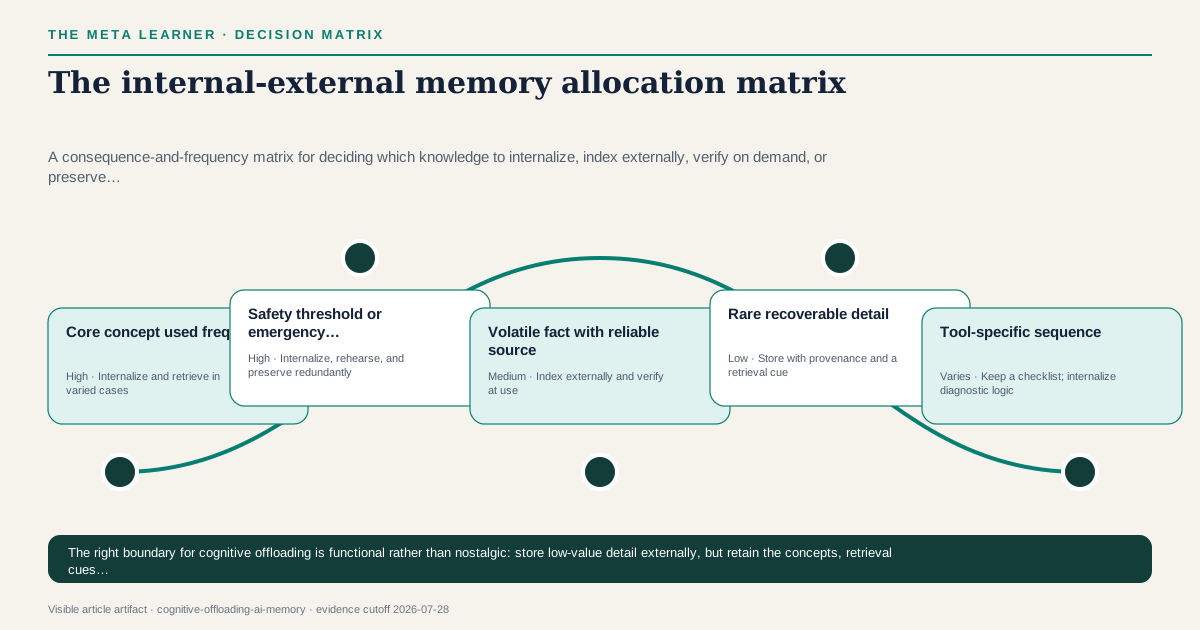
Remember what you need to frame the problem, notice an implausible answer, ask a discriminating question, and act safely when the tool is unavailable. Offload volatile detail, routine lookup, and recoverable records when doing so frees capacity for reasoning. Preserve sources, provenance, and a recovery path; AI output is not a trustworthy memory merely because it is fluent.
The memory-allocation problem
Writing, diagrams, calendars, libraries, calculators, search engines, and colleagues have always extended cognition. AI changes the speed and range of that extension, not the basic fact that minds work with external structures.
The serious question is therefore not “Should knowledge live in my head or in a tool?” It is: which internal knowledge makes external knowledge usable, auditable, and recoverable?
This guide is for adults designing that boundary. It rejects two symmetrical fantasies: that an educated person must memorize everything, and that ubiquitous retrieval makes internal knowledge obsolete.
Why the evidence supports the internal-external memory allocation matrix
Research defines cognitive offloading as action that changes a task’s information-processing demands and documents how reminders, external representations, and anticipated access influence memory behavior. Experiments associated with the “Google effect” found that expectations about later access can change what is remembered. NIST’s AI risk framework emphasizes documented context, human oversight, measurement, and accountability. These sources support deliberate allocation; they do not establish a universal list of facts to memorize.
risko-offloading, sparrow-google, nist-ai-rmfClaim sources: risko-offloading, sparrow-google, nist-ai-rmf
Four memory functions, not one
Working memory holds the relations being manipulated now. Semantic knowledge supplies concepts and patterns. Procedural knowledge makes actions executable. External memory preserves records and details beyond the present episode.
Offloading one function can strengthen another. A diagram can reduce transient load and permit deeper comparison. A calculator can free attention for model choice. Conversely, offloading can remove the practice that was meant to build a capability. An AI-generated synthesis may complete the deliverable while leaving the learner unable to evaluate its source selection.
The internal-external memory allocation matrix
| Knowledge type | Failure consequence | Best default | |---|---|---| | Core concept used frequently | High | Internalize and retrieve in varied cases | | Safety threshold or emergency procedure | High | Internalize, rehearse, and preserve redundantly | | Volatile fact with reliable source | Medium | Index externally and verify at use | | Rare recoverable detail | Low | Store with provenance and a retrieval cue | | Tool-specific sequence | Varies | Keep a checklist; internalize diagnostic logic | | Rationale for a consequential decision | High | Preserve an auditable external record and internal model |
“Internalize” does not mean recite every word. It means possess enough organized knowledge to recognize the situation, retrieve the governing relation, and detect when a candidate answer violates it.
AI is not merely a larger notebook
A notebook returns what was written. A generative model produces a new response conditioned on a prompt and system state. The answer may vary, omit provenance, or blend compatible-looking claims. Treating it as memory hides this difference.
For factual recall, prefer a stable source or retrieval system that exposes the record. Use generative AI to transform, compare, question, or simulate only with a verification route proportionate to the stakes. “The chatbot said it before” is not provenance.
A worked boundary
A product researcher follows changing accessibility standards. Memorizing every clause would be inefficient and may preserve obsolete text. She stores the current official standards, records version and jurisdiction, and verifies clauses before a release.
What stays internal is the conceptual map: perceivable, operable, understandable, robust; the difference between a legal requirement and design guidance; common failure patterns; and the trigger that tells her specialist review is needed. External detail remains useful because internal structure can question it.
Allocate memory by consequence
For one domain:
- List decisions you must make without delay.
- Name the concepts required to interpret evidence in those decisions.
- Identify facts that change often and their authoritative sources.
- Mark failure consequence and tool-availability assumptions.
- Choose one of four treatments: internalize, index, verify on demand, or preserve redundantly.
- Test a tool-failure scenario.
- Test an error scenario: could you notice a plausible but wrong answer?
If the answer to the final question is no, you have offloaded the evaluator along with the information.
Design retrieval cues, not digital attics
Test the boundary without the external aid. Immediate performance with a searchable notebook or AI assistant can exceed unaided performance while delayed retention and transfer remain weak. A novice may need more facts and worked examples internally before offloading; an expert can compress routine detail because prior knowledge supports verification. Review evidence on cognitive offloading establishes trade-offs, not a universal quota for how much belongs in memory.
External storage fails when capture is cheap and retrieval is undefined. Each record needs a decision it serves, a source, a date or version where relevant, and language you would actually search. A small, maintained index beats an unbounded archive whose contents cannot be trusted.
AI can help propose tags or summaries, but retain the original source and make machine-generated transformations visible. Compression is useful only when the path back to evidence survives.
Offloading failures
- Memorizing volatile details while neglecting durable concepts.
- Saving everything without a retrieval or deletion rule.
- Treating generated prose as a stable source record.
- Offloading the exact operation the learner intends to acquire.
- Assuming future access without testing permissions, connectivity, or format.
- Retaining no independent way to detect error.
- Equating “in my head” with accurate and “in a tool” with objective.
What remains uncertain
Research on reminders, search, and external representations predates many current generative-AI workflows. Evidence about long-term effects on adult expertise, memory, and institutional knowledge is still developing. Outcomes will depend on task design, tool reliability, user expertise, access, and verification. The matrix is a governance aid, not proof that one allocation is optimal for every person or domain.
The aim is neither memory maximalism nor cognitive surrender. It is a resilient division of labor in which the person can still understand what the system returns and recognize when it should not be trusted.
Continue with expertise in the age of AI, test unaided access with recognition is not recall, and apply the boundary when you use AI as a tutor.
Named sources
Evidence and further reading
Published July 29, 2026. No substantive revision has been recorded. Evidence last verified July 28, 2026.