Attention Residue: Why Task Switching Weakens Deep Learning
Switching away from unfinished work can leave attention behind. Use completion cues, restart notes, and protected episodes for demanding learning.
Attention residue is the continued cognitive pull of a previous task after you switch, especially when that task is unfinished or the transition is abrupt. It can weaken performance on the next demanding task. Reduce it by finishing a meaningful unit when possible or writing a concrete restart record before switching.
The hidden cost this article examines
This guide is for people whose study is threaded through messages, meetings, and several projects. Its subject is not a moral defense of monastic concentration. Many lives require switching. The practical question is how to prevent an interruption from becoming an ambiguous open loop that occupies the next learning episode.
The visible cost of a switch is the minute spent opening another window. The less visible costs include changing the active goal, reloading rules and context, and continuing to think about the unfinished task. “Attention residue” names that last persistence.
The closure-and-restart card: evidence and boundary
Controlled studies find measurable switch costs when people alternate tasks, with costs influenced by rule complexity and cues. Leroy’s experiments link unfinished-task transitions to attention remaining on the previous task and lower performance on the next. Separate experiments suggest that forming a specific plan can reduce intrusive cognitive effects of an unfulfilled goal. Together they support structured transitions, not a universal ban on switching.
leroy-residue, rubinstein-switching, masicampo-plansClaim sources: leroy-residue, rubinstein-switching, masicampo-plans
Residue is not the same as distraction
A notification can distract you while you remain on one task. A switch changes the task itself. Residue is what the prior task carries across the boundary. These can stack:
- a message captures attention;
- you switch to a client problem;
- the unsolved paragraph remains active;
- you return and must reconstruct both the paragraph and the client state.
The solution is therefore broader than silencing alerts. It includes deciding where tasks may be interrupted, what state must be preserved, and how re-entry will occur.
A small scene of cognitive fragmentation
A researcher is comparing two papers. Midway through identifying a measurement difference, she answers a project message. The answer triggers a budget check. Twenty minutes later she returns to the paper and rereads both abstracts.
The lost work was not just twenty minutes. Her unresolved inference—are the outcomes actually comparable?—was never externalized. The reading state existed only in working memory. A six-line restart record would have made the boundary visible.
The closure-and-restart card
Before a necessary switch, write:
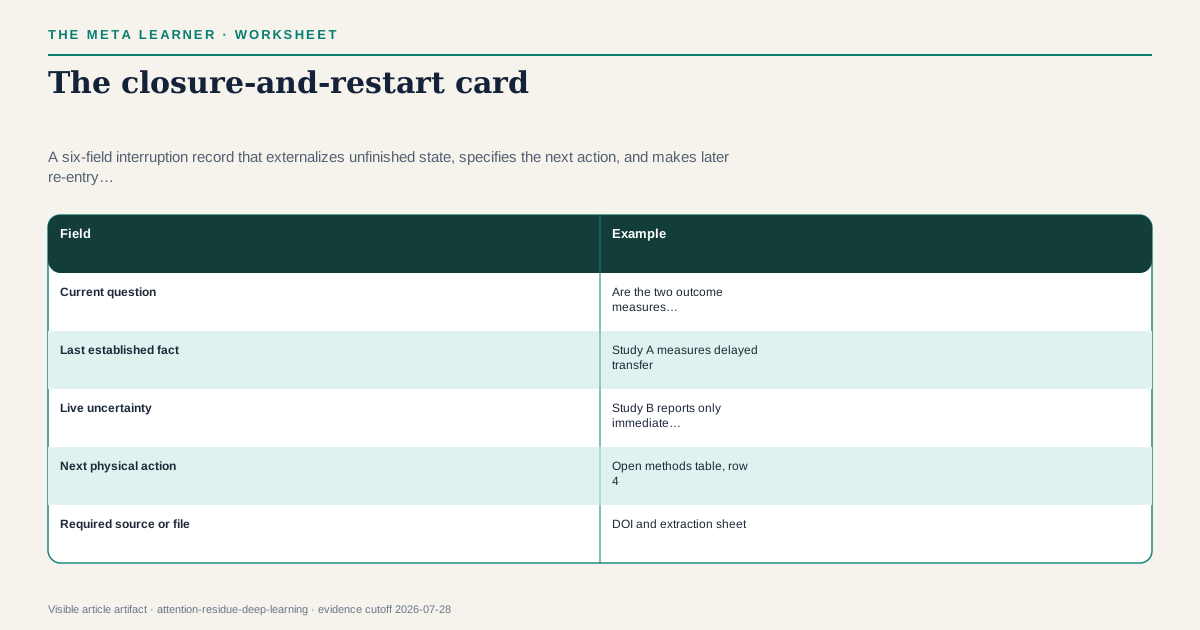
| Field | Example | |---|---| | Current question | Are the two outcome measures commensurable? | | Last established fact | Study A measures delayed transfer | | Live uncertainty | Study B reports only immediate accuracy | | Next physical action | Open methods table, row 4 | | Required source or file | DOI and extraction sheet | | Restart cue | “Compare delay, task, and scoring” |
This card does not “complete” the intellectual task. It completes the transition. The plan is concrete enough that the mind need not keep rehearsing a vague intention.
Choose natural boundaries
Deep learning rarely arrives in uniform twenty-five-minute parcels. A better boundary is a cognitively meaningful unit:
- one argument reconstructed;
- one proof attempt preserved;
- one pronunciation contrast recorded;
- one data transformation tested;
- one decision assumption made explicit.
Estimate enough time to reach such a unit, then protect it. If interruption is likely, begin with a smaller unit rather than opening the most entangled part of the task.
Use the closure-and-restart card
For one week, instrument—not optimize—your switching.
- Mark each switch during a demanding learning task.
- Note whether the previous unit was complete, deliberately parked, or simply abandoned.
- Use the six-field card for every unavoidable unfinished switch.
- On return, record time until the first substantive action.
- Compare re-entry after documented and undocumented switches.
- Keep the fields that predict faster, more accurate restart.
The measure is not hours of “focus.” It is the preservation of reasoning state: can you resume without reconstructing what you had already established?
Design three attention layers
The learner boundary changes the restart cost. A novice with fragile schemas may lose the governing structure after a switch, while an expert can reconstruct more from a compact cue; prior knowledge does not eliminate interference. Judge the design with both immediate performance and a delayed retention or transfer test. Research synthesis on attention and task switching supports protecting high-load work, but it does not supply one universal recovery interval.
Protected episodes hold work whose value depends on a coherent internal model. Responsive windows hold communication and shallow coordination. Transition buffers let you close, move, and reopen state. The proportions depend on role and life, but naming the layers prevents every minute from pretending to support every kind of work.
An on-call clinician, parent, or manager cannot guarantee isolation. Their protocol can still preserve next actions, make handoffs explicit, and reserve smaller units for interruption-prone periods. Attention design should adapt to constraints rather than blame the person living with them.
Attention design failures
- Treating all switches as equally damaging.
- Buying a focus tool without changing transition behavior.
- Leaving the next action as “continue working.”
- Measuring success by an unbroken timer rather than quality of thought.
- Scheduling deep work in a predictably interruptible window.
- Using closure notes so elaborate that they become a second project.
- Confusing a restorative break with a rule-heavy task switch.
What the evidence does not warrant
Attention-residue findings come from bounded experimental and organizational tasks. They do not establish that every unfinished goal intrudes, that one block length is optimal, or that uninterrupted work is always superior. Some switches are urgent, socially valuable, or restorative. Neurodiversity, caregiving, disability, job design, and task familiarity shape what is feasible. Test a lightweight transition protocol in the actual environment.
The aim is not a life without open loops. It is a practice that prevents an open loop from remaining the only place where your reasoning state exists.
Compare the broader multitasking evidence, review cognitive load, and connect attention to value, progress, and agency.
Named sources
Evidence and further reading
Published July 29, 2026. No substantive revision has been recorded. Evidence last verified July 28, 2026.