Does Multitasking Work? What the Evidence Says About Learning and Knowledge Work
Most apparent multitasking is rapid switching. Learn when tasks interfere, when pairing is tolerable, and how to protect the operation that matters.
Multitasking works poorly when both tasks require controlled attention, language comprehension, working memory, or response selection. What feels simultaneous is often rapid switching with reconfiguration costs and weaker encoding. Pairing can be tolerable when one activity is highly automated and neither error would be consequential, but the pair must be tested rather than assumed.
The question behind the productivity claim
“Can I multitask?” hides the variables that decide the answer. Walking while listening to familiar music, taking notes during a lecture, and answering messages while interpreting a statistical argument are three different dual tasks. A useful answer identifies the operations each demands and what failure would cost.
This article is for learners and knowledge workers deciding which activities may share time. It does not treat attention as a character virtue. It treats the problem as resource competition.
Three phenomena sold under one name
Concurrent performance means two streams truly overlap, as when driving while conversing. Task switching means goals and rules alternate, even if the alternation is fast. Background accompaniment means one stream is largely automated or not being processed deeply.
These categories blur in practice. A podcast begins as background, captures semantic attention, and becomes a competing task. A familiar route becomes hazardous and suddenly demands control. The classification must follow the moment-to-moment task, not the app label.
The two-task interference map: evidence and boundary
Experimental task-switching work identifies measurable costs associated with goal shifting and rule activation. Classroom experiments have found lower learning performance when participants engage in unrelated laptop multitasking, including effects on nearby peers. Research on habitual media multitasking reports associations with cognitive-control differences, but this literature contains contested findings and should not be read as a diagnosis of individuals.
rubinstein-switching, sana-laptops, ophir-mediaClaim sources: rubinstein-switching, sana-laptops, ophir-media
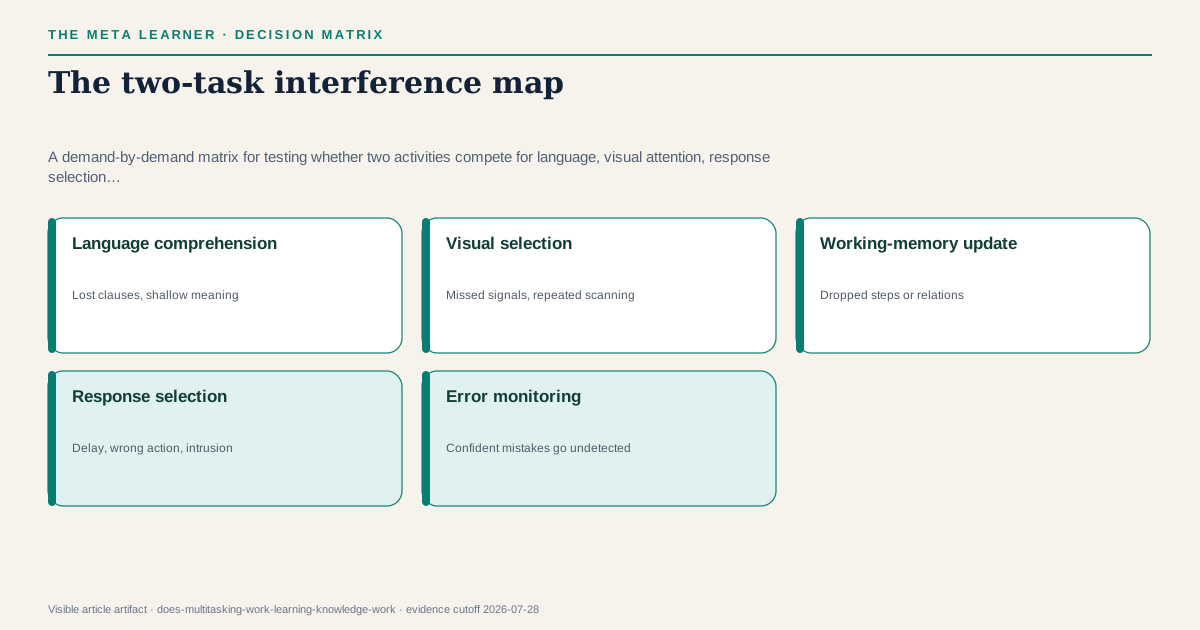
The two-task interference map
Score each task as low, medium, or high on the same demands.
| Controlled demand | Task A | Task B | What collision looks like | |---|---:|---:|---| | Language comprehension | | | Lost clauses, shallow meaning | | Visual selection | | | Missed signals, repeated scanning | | Working-memory update | | | Dropped steps or relations | | Response selection | | | Delay, wrong action, intrusion | | Error monitoring | | | Confident mistakes go undetected |
Two high scores in one row are a warning. Consequence then decides policy. A minor pause during laundry is different from a missed pedestrian, incorrect medication, or corrupted financial model.
Why learning is unusually vulnerable
Learning requires more than receiving a stream. The learner selects, organizes, relates, retrieves, checks, and integrates. A second semantic task competes with those operations even when the page remains open.
The harm can be invisible because immediate recognition survives. A learner may follow a video while answering messages and still recognize its examples. Later, the causal sequence or problem-solving condition is unavailable. The correct outcome is delayed recall or transfer, not the feeling that both streams were followed.
A bounded comparison
Imagine two sessions with the same technical paper.
In Session A, messages remain visible and receive quick replies. In Session B, the reader parks messages for thirty minutes, reconstructs the paper’s central claim, and then responds. Session A may produce more visible actions. To compare learning, test whether the reader can state the design, identify a confound, and apply the result to a changed case the next day.
This comparison does not assume Session B wins for every person. It defines an outcome capable of detecting the difference.
Audit a multitasking pair
Choose a pair you use frequently.
- State the primary task and the error that matters.
- List the controlled demands of both tasks.
- Run one normal paired session.
- Run one matched single-task session.
- Measure primary-task accuracy, completion time, restart time, and delayed recall—not only subjective effort.
- Keep the pairing only if the observed cost is acceptable for the stakes.
Use a realistic sample. One easy passage or quiet afternoon may conceal costs that appear with complexity and fatigue.
When pairing can be rational
The expertise boundary matters. An expert may execute a component with little conscious control that still overloads a novice. Yet automaticity is domain-specific: expertise in writing does not make driving while composing a message safe. Measure the intended learning outcome after a delay. Faster completion or a feeling of stimulation is immediate performance; unaided recall, retention, and transfer to a changed task are stronger tests. Research synthesis on task switching supports interference as a general risk, not one identical penalty for every person and pairing.
Pairing can make sense when the secondary activity is automated, interruptible, and low consequence; the primary activity is not acquiring new complex relations; and a quick test shows no meaningful degradation. A repetitive physical task with an undemanding audio review may qualify. Novel pronunciation discrimination while navigating traffic does not.
Some combinations also support the target. Sketching a mechanism while listening is not necessarily a separate task; it can be the generative activity through which the explanation is processed. The unit of analysis is functional competition, not the number of media.
Multitasking myths to retire
- “Digital natives” possess cost-free divided attention.
- Feeling stimulated proves that both tasks are being encoded.
- Fast switching is simultaneous processing.
- Music, speech, messaging, and visual alerts are equivalent.
- A preference for background media establishes better performance with it.
- Every switch is catastrophic.
- One laboratory effect dictates an identical workflow for everyone.
Evidence boundary
Dual-task and media-multitasking studies vary in task, population, duration, and measure. Some findings are correlational, and habitual media use is not a fixed trait or clinical category. Real work also includes collaboration, urgency, and accessibility needs that laboratory tasks omit. Evaluate a specific pairing against a specific outcome and consequence.
The practical rule is not “never do two things.” It is “never let the secondary task silently redefine what counts as success.”
Study attention residue for transition costs, cognitive load for capacity limits, and cognitive offloading for intentional use of external support.
Named sources
Evidence and further reading
Published July 29, 2026. No substantive revision has been recorded. Evidence last verified July 28, 2026.