Learning Styles: Why the Myth Persists and What the Evidence Supports Instead
Preferences and abilities are real, but matching instruction to a declared visual, auditory, or kinesthetic style lacks the required evidence.
People have preferences and meaningful individual differences, but evidence does not support assigning learners a visual, auditory, or kinesthetic type and matching instruction to that label to improve learning. Choose representation according to the knowledge, task, prior understanding, and accessibility needs; then test performance. The evidence does not imply that format never matters, that all learners should receive identical support, or that accessibility needs are optional.
The claim that needs testing
“I am a visual learner” can mean several things:
- I enjoy diagrams.
- I remember faces well.
- Speech is difficult for me to process.
- This concept is clearer when spatial relations are visible.
- A questionnaire classified me as visual.
- I will learn any content better when it is presented visually.
Only the last two form the classic prescriptive learning-styles claim. The others may describe real preference, ability, access, or content fit. Productive debate begins by separating them.
What evidence would the claim require?
Suppose a test classifies learners as visual or verbal. Researchers then randomly assign people in each group to visual or verbal instruction and use the same valid outcome. The meshing hypothesis predicts a crossover: visual learners do better with visual instruction and verbal learners do better with verbal instruction.
Finding that everyone learns a map better from a diagram does not support styles. Finding that visual learners prefer diagrams does not show better learning. Finding two teaching methods differ overall does not validate the classification.
What the evidence establishes for the learner-task representation matrix
Major reviews have articulated the required crossover design and found that the available evidence does not justify widespread use of learning-style assessments to prescribe instruction. Later reviews similarly identify weak or inconsistent support and methodological problems. The conclusion is narrower than “people are identical”: it rejects a particular matching inference.
pashler-styles, cuevas-review, rohrer-evidenceClaim sources: pashler-styles, cuevas-review, rohrer-evidence
Why the idea feels true
The theory is humane in intention. It acknowledges difference, offers an explanation for struggle, and gives teachers an actionable response. Labels are memorable and personally affirming. Preferences are also easy to observe, while delayed learning is harder to measure.
The myth persists partly because several valid ideas shelter beneath it:
- multiple representations can clarify complex relations;
- prior knowledge changes useful guidance;
- disability and language affect access;
- interest and autonomy affect engagement;
- abilities differ;
- content has a natural form.
None requires a fixed learning-style type.
The learner-task representation matrix
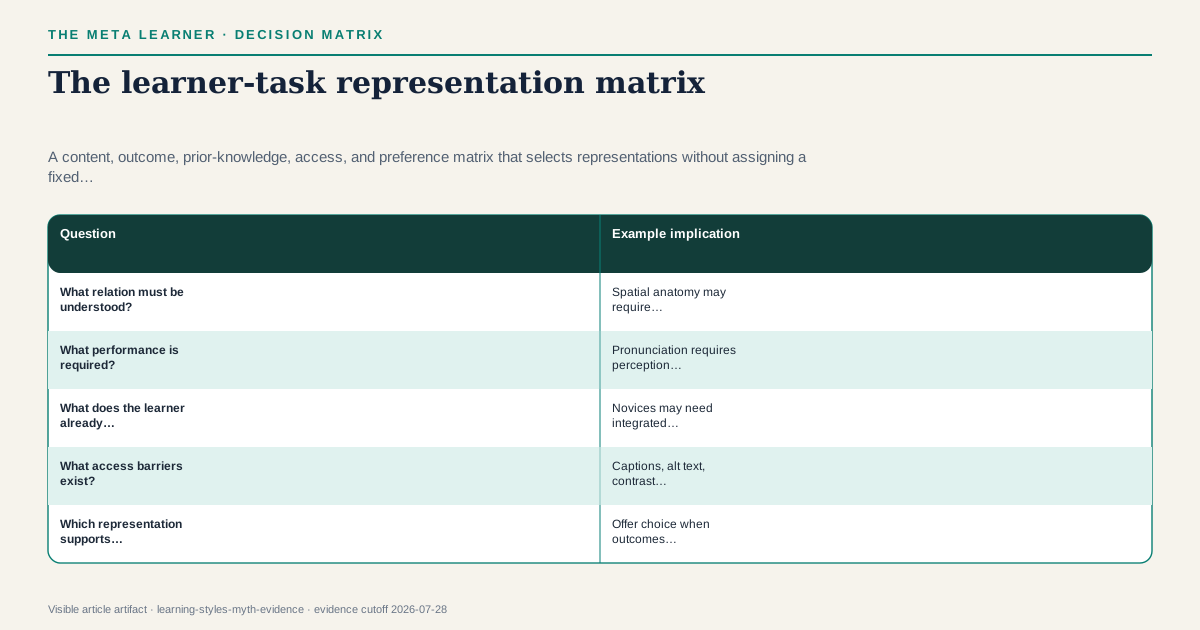
| Question | Example implication | |---|---| | What relation must be understood? | Spatial anatomy may require diagrams | | What performance is required? | Pronunciation requires perception and production | | What does the learner already know? | Novices may need integrated labels | | What access barriers exist? | Captions, alt text, contrast, or tactile form may be essential | | Which representation supports engagement? | Offer choice when outcomes remain equivalent | | How will learning be tested? | Compare delayed, criterion-matched performance |
The matrix allows differentiation without converting a preference into destiny.
A content-first example
To learn the shape of a coastline, a map is efficient because the relation is spatial. To learn an unfamiliar phonemic contrast, audio is indispensable. To learn a physical procedure, observation and action matter. These choices follow the object of learning.
Text can still explain a diagram; a transcript can support audio; demonstration can be segmented and verbally labeled. Multiple coordinated representations serve integration and access, not a presumed type.
Replace labels with a learner-task profile
For one lesson:
- Define the final performance.
- Identify the structure that the learner must represent.
- Assess relevant prior knowledge and abilities.
- identify access requirements and environmental constraints.
- Choose the representation that makes the structure inspectable.
- Offer preferences where they do not compromise the target.
- compare delayed performance, not enjoyment alone.
- revise support from observed error patterns.
Write “currently benefits from…” rather than “is a…” when describing the learner. The first stays open to evidence and development.
What to say to someone attached to the label
Do not answer personal experience with ridicule. Ask what “visual learner” means in practice. If diagrams help, use them. Then add a gentle distinction: the preference may be valuable without proving that matched instruction improves every outcome.
Invite a comparison on a real task. Respect for the learner and respect for evidence are compatible.
What debunking gets wrong
The relevant evidence boundary is not “all learners are the same.” It is that the instructional-matching claim needs an aptitude-by-treatment interaction: people classified one way should learn better from the matched mode, while people classified another way should show the opposite pattern, on an appropriate delayed outcome. Research syntheses and systematic reviews have not provided a sound basis for assigning instruction this way. Preference can still affect willingness to begin, but immediate enjoyment must be separated from retention and transfer.
An expert may use a diagram efficiently because prior knowledge makes its structure legible; a novice may need narration, labels, and a worked example. That is an expertise and representation effect, not proof of a fixed visual learner identity.
- Claiming format never affects learning.
- Treating preferences as imaginary.
- Ignoring disability and accessibility.
- Using “the science says” without explaining the crossover test.
- Replacing styles with another unsupported personality taxonomy.
- Assuming one method should therefore be used for everyone.
- Shaming teachers who adopted an intuitively humane idea.
The precise evidence boundary
“Learning styles” names many models, and studies vary in classification, instruction, and outcome. The strongest conclusion addresses prescriptive meshing claims, not every possible learner-treatment interaction. Research continues on prior knowledge, aptitude, motivation, accessibility, and multimedia design. A lack of support for styles does not authorize standardized instruction without accommodation.
The better alternative is richer and less marketable: understand the knowledge, the person’s current state, the environment, and the criterion—then test the design.
Contrast with cognitive load, evaluate the outcome with evidence of learning, and preserve choice through the motivation audit.
Named sources
Evidence and further reading
Published July 29, 2026. No substantive revision has been recorded. Evidence last verified July 28, 2026.