Automation Bias: Why Capable People Overtrust AI
Understand why skilled users accept automated advice, miss contradictory evidence, and need decision environments—not reminders—to calibrate trust.
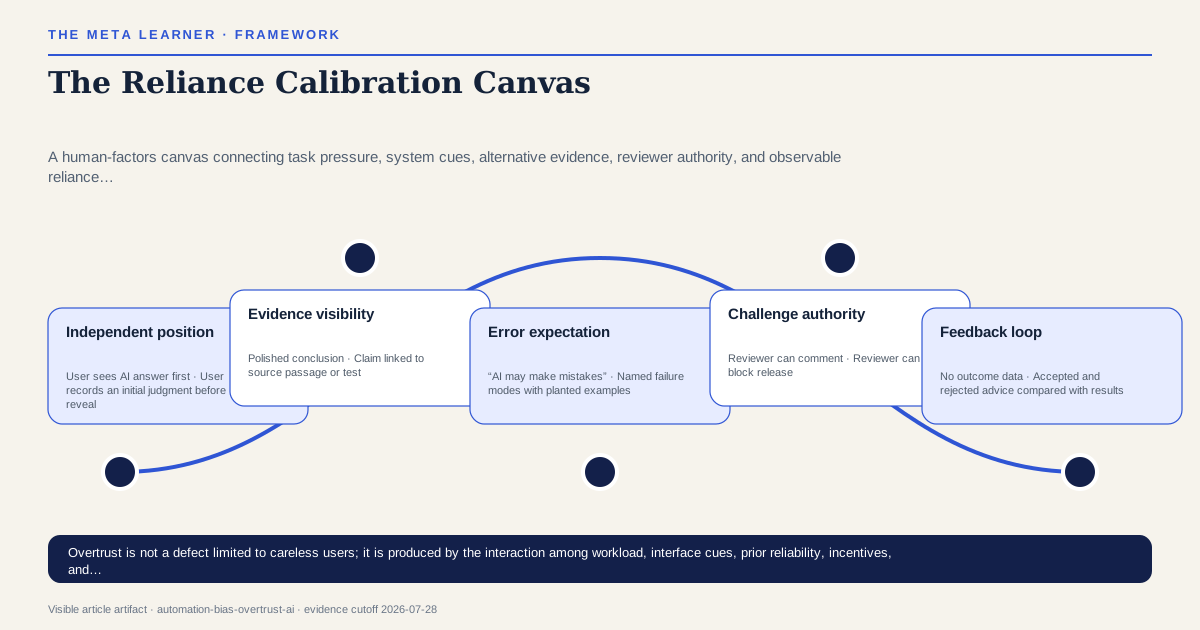
Capable people overtrust AI when accepting its output is fast, socially rewarded, and difficult to challenge—especially after many correct results. Automation bias is not cured by expertise or a warning banner. Calibrated reliance requires visible evidence, independent judgment before exposure, meaningful alternatives, and reviewers who have time and authority to disagree.
Overtrust is rational more often than it looks
Imagine an analyst reviewing two hundred AI-classified records. The first fifty look correct. Deadlines tighten. Source fields are hidden behind another click. The analyst gradually verifies less. When the fifty-first record contains a subtle but consequential error, “be careful” has little operational force.
This is not a story about stupidity. Human-factors research distinguishes appropriate use, misuse through over-reliance, and disuse through under-reliance. automation, trust, nist Trust is shaped by observed performance, purpose, process, context, and interface—not only by a person's stated attitude. trust
For generative AI, the problem is intensified by articulate language. The system can present a correct synthesis and a fabricated detail with the same typography and tone.
Commission errors and omission errors
Automation bias is often described through two patterns:
- Commission: following an incorrect recommendation.
- Omission: failing to notice a problem because the system did not flag it.
Generative systems add a third practical pattern: framing capture. The user keeps the model's initial categories, assumptions, or option set even while editing individual sentences. The answer may be factually repaired while the wrong frame survives.
Expertise helps only when it can be applied. A qualified reviewer may still over-rely if the interface withholds provenance, the workload is impossible, disagreement is punished, or responsibility is ambiguous.
The five conditions of calibrated reliance
| Condition | Weak design | Stronger design | |---|---|---| | Independent position | User sees AI answer first | User records an initial judgment before reveal | | Evidence visibility | Polished conclusion | Claim linked to source passage or test | | Error expectation | “AI may make mistakes” | Named failure modes with planted examples | | Challenge authority | Reviewer can comment | Reviewer can block release | | Feedback loop | No outcome data | Accepted and rejected advice compared with results |
The aim is not minimum trust. Chronic under-use wastes a genuinely useful system. The aim is appropriate reliance: acceptance when the system has earned it for this case, and investigation when evidence or context is weak.
Why the evidence supports the Reliance Calibration Canvas
Decades of human-automation research show that use and reliance are shaped by reliability, task demands, user understanding, and design. NIST explicitly calls for defined human roles and attention to limitations of human-AI interaction. Applying those findings to generative AI is justified at the level of reliance design, while precise effect sizes remain context-specific.
automation, trust, nistClaim sources: automation, trust, nist
Why explanation can increase the wrong kind of trust
An explanation may reveal evidence and uncertainty, but it can also function as persuasion. More words, a chain of reasoning, or a confidence number are not automatically diagnostic. Ask whether the explanation helps a reviewer distinguish correct from incorrect cases.
Test this empirically. Give reviewers a mixed set with known failures under three conditions: output alone, output plus explanation, and output plus inspectable evidence. Measure detection, correction time, and false rejection. If explanation raises acceptance without improving discrimination, it is a trust amplifier rather than a control.
The reliance calibration canvas
Map one decision across six fields:
- Decision: What exactly may the user accept or reject?
- Consequence: Who bears the cost of a false acceptance and false rejection?
- AI cue: What makes the output appear trustworthy?
- Counterevidence: What can contradict it, and how visible is that evidence?
- Reviewer reality: How much time, expertise, and authority exist?
- Observed behavior: When do users accept, edit, investigate, or bypass?
Do not ask only, “Do users trust the tool?” Self-reported trust is not the same as reliance. Observe which outputs move decisions.
Add one silent control round in which reviewers do not see the AI recommendation. Compare which evidence they inspect, what alternatives they generate, and whether confidence shifts after the recommendation appears. The contrast is not a pure measure of automation bias, but it can reveal a workflow dependence worth testing on a larger representative set.
Audit reliance instead of asking about trust
Run a bounded test with representative users:
- Select twenty normal cases and five plausible failure cases.
- Ask users for a pre-AI judgment on half the cases.
- Reveal AI output with the evidence normally available.
- Record acceptance, correction, investigation, time, and confidence.
- Interview users about the cues they used.
- Redesign one condition—such as source visibility or a blocking threshold—and rerun.
Start with the four-layer quality model, place review authority using AI Workflow Design, and set delegation boundaries with the Human–AI Collaboration Ladder.
Anti-bias measures that become theatre
- A generic “AI can be wrong” disclaimer that users click past.
- Human review without access to the underlying evidence.
- Confidence scores that are neither calibrated nor explained.
- Requiring approval while rewarding speed and agreement.
- Training users once but never measuring actual reliance.
- Showing an explanation that cannot discriminate good from bad output.
- Treating every disagreement as human error because aggregate model accuracy is high.
What calibration cannot guarantee
Reliance research cannot supply one interface or review rate for every domain. Experiments may alter behavior temporarily, and known-answer test sets may not capture novel failures. Some uses should be prohibited or externally audited rather than made acceptable through better review. The framework also cannot resolve legal accountability or power imbalances by itself.
The mature design question is not whether people trust AI. It is whether the environment helps them rely on it in proportion to evidence.
Named sources
Evidence and further reading
Published July 29, 2026. No substantive revision has been recorded. Evidence last verified July 28, 2026.