The Human–AI Collaboration Ladder: From Tool Use to Accountable Delegation
Choose among assistance, recommendation, bounded execution, and delegation by matching AI autonomy to evidence, reversibility, authority, and consequence.
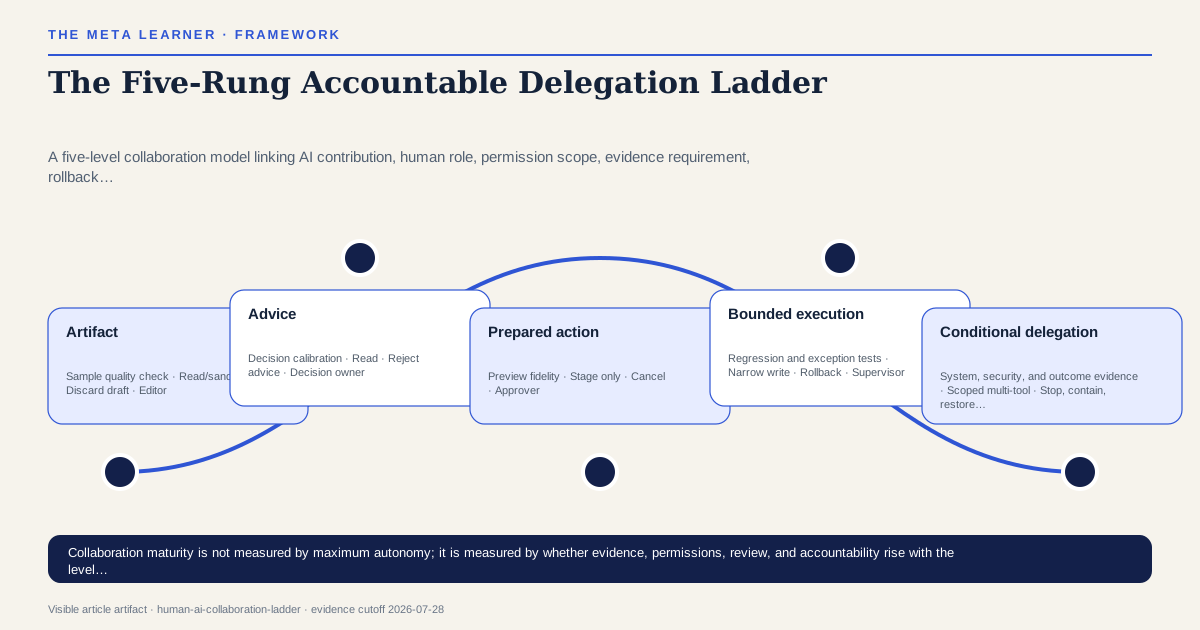
Delegate to AI in five increasing steps: produce an artifact, advise a human, prepare an action, execute within a bounded and reversible space, or operate under conditional delegation. Move upward only when the system has representative evidence, scoped permissions, visible actions, rollback, escalation, and an accountable human owner. The ladder is a governance heuristic rather than a validated universal taxonomy, and law or professional standards may restrict delegation.
Collaboration is an allocation of work and authority
“Human–AI collaboration” can mean spellcheck or an agent sending thousands of messages. The phrase becomes useful only when it identifies who produces, decides, acts, verifies, and bears the consequence.
Human-AI interaction research offers design guidance across initial use, ongoing interaction, correction, and failure. guidelines, automation, nist Human-factors research warns of misuse through over-reliance and disuse through under-reliance. automation NIST calls for defined roles, responsibilities, measurement, and management across AI systems. nist
The ladder below is a decision aid, not a claim that every task should climb.
The five rungs
Rung 1: Artifact
AI drafts, transforms, extracts, or generates options. A human inspects the artifact before it enters the workflow. Permissions are read-only or sandboxed.
Rung 2: Advice
AI ranks, recommends, flags, or predicts. A human makes the decision and can inspect evidence and alternatives. The key risk is that recommendation becomes default.
Rung 3: Prepared action
AI fills a form, composes a message, or assembles a change, but a human explicitly approves execution. The review packet must expose what will happen and to whom.
Rung 4: Bounded execution
AI acts automatically within a narrow, reversible domain: for example, labeling low-risk records or running tests in an isolated environment. Exceptions and uncertain cases escalate.
Rung 5: Conditional delegation
AI plans and acts across multiple steps under a mandate, budget, permissions, monitoring, and stop conditions. Humans govern the mandate and intervene at defined boundaries.
The control gradient
| Rung | Evidence | Permission | Recovery | Human role | |---|---|---|---|---| | Artifact | Sample quality check | Read/sandbox | Discard draft | Editor | | Advice | Decision calibration | Read | Reject advice | Decision owner | | Prepared action | Preview fidelity | Stage only | Cancel | Approver | | Bounded execution | Regression and exception tests | Narrow write | Rollback | Supervisor | | Conditional delegation | System, security, and outcome evidence | Scoped multi-tool | Stop, contain, restore | Governor |
As action increases, evidence and recovery must increase too. Autonomy without observability is not delegation; it is loss of control.
What survives the comparison: the Five-Rung Accountable Delegation Ladder
Research and guidance support transparent interaction, correction, calibrated reliance, defined roles, and risk-based controls. The five rungs are an original synthesis. Evidence does not establish that this number of levels is universally optimal or that higher levels create greater value.
guidelines, automation, nistClaim sources: guidelines, automation, nist
Two tests before moving up
Counterfactual test: If the AI vanished tomorrow, does the human or organization still understand the process, evidence, and recovery path?
Failure test: If the AI makes the most plausible serious error, which permission lets it create harm, who notices, and how is the state restored?
If neither question has a concrete answer, remain on the current rung.
A worked allocation
Consider customer-support replies. At rung one, AI drafts and an agent rewrites. At rung two, it recommends response categories. At rung three, it prepares the full message and recipient, but cannot send. At rung four, it may send only approved low-risk status updates with deterministic account checks and a recall path. Rung five would manage multi-step cases under policy.
The team need not pursue rung five. If rare exceptions and relationship judgment dominate, prepared action may be the mature endpoint.
Place one task on the ladder
- Name the exact artifact, decision, or external effect.
- Record the current rung rather than the marketed capability.
- Identify evidence that the next rung improves outcomes.
- Inventory new permissions and failure paths.
- Define escalation, rollback, and accountable ownership.
- Pilot with a limited population and explicit stop rule.
- Move, remain, or descend based on observed results.
Prove that the rung is reversible
Before moving upward, run a representative test set that includes permission errors, misleading evidence, tool failure, an unusual user, and an interrupted run. Evaluation must observe whether the human checkpoint sees the relevant state, whether the decision owner can stop the process, and whether recovery restores a trustworthy condition. A successful task completed under ideal conditions is not enough evidence for greater autonomy.
Also run a deskilling check. Ask the responsible team to explain the workflow, reproduce the critical judgment without AI, and execute the fallback. If knowledge exists only inside prompts or vendor configuration, the organization has moved authority without retaining control. The accountable choice may be to descend a rung, narrow the permission, or preserve periodic unaided rehearsal. Reversibility is both technical—rollback—and epistemic—the ability to understand and govern the work after the tool disappears.
Use Automation Bias to test reliance, preserve key decisions through AI Workflow Design, and inspect the machinery of higher rungs in What Is an AI Agent?.
Climbing for prestige instead of fit
- Calling a drafted artifact “delegation.”
- Making autonomy a roadmap goal without a user outcome.
- Granting broad permissions to avoid designing interfaces.
- Moving to automatic action before testing recommendation quality.
- Treating human approval as meaningful without evidence visibility.
- Measuring system activity rather than decision or service outcomes.
- Assuming a mature organization always belongs on a higher rung.
Delegation does not transfer responsibility
The ladder does not allocate legal liability, professional duty, or democratic legitimacy. A human owner can be nominal, under-resourced, or structurally unable to intervene. Some applications should remain prohibited rather than placed on a rung. Product capabilities and controls change, so time-sensitive details require verification immediately before use.
A good collaboration design gives AI enough scope to be useful and humans enough evidence and authority to remain genuinely responsible.
Named sources
Evidence and further reading
Published July 29, 2026. No substantive revision has been recorded. Evidence last verified July 28, 2026.