AI Workflow Design: Where Human Judgment Must Stay in the Loop
Place human judgment at framing, evidence, exception, value, and release boundaries—then give reviewers the information and authority to intervene.
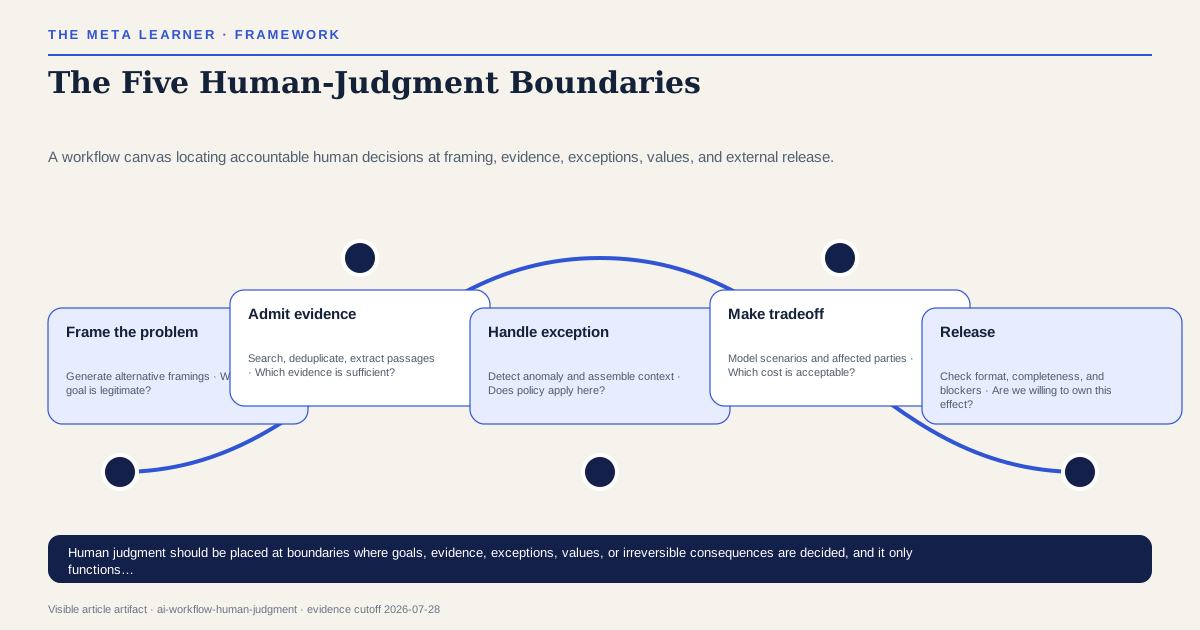
Keep human judgment where the workflow defines the problem, admits evidence, handles exceptions, makes value tradeoffs, or creates an irreversible external consequence. Automate preparation around those boundaries when useful. A human review box is not a control unless the reviewer can see the relevant evidence, has time and expertise, and can block the outcome.
Do not sprinkle humans over an automated pipeline
A workflow diagram often places one box labeled “human review” before release. That box may conceal ten different decisions: whether the question is valid, whether a source is authoritative, whether an exception matters, whose interests count, and whether the remaining uncertainty is acceptable.
NIST calls for organizations to define and differentiate roles and responsibilities in human-AI configurations. nist, interaction, automation Its human-interaction appendix notes that representations of complex human phenomena can strip away context relevant to risk. interaction Human-factors research also shows that automation can be misused or disused depending on design and reliance. automation
The design task is therefore not “add a person.” It is “name the judgment and enable it.”
Five boundaries that deserve human ownership
1. Framing
Who decides the question, target, and success condition? AI can help reveal ambiguity, but people accountable to affected stakeholders must decide what is optimized and what stays out of scope.
2. Evidence admission
Which sources, records, measurements, or testimony count? Retrieval can find material; a qualified human must determine authority, relevance, conflicts, and missing voices when those choices affect conclusions.
3. Exceptions
Rules and models handle regularity. Consequential work often turns on a rare case, new context, or conflicting obligation. Define which anomaly triggers escalation and where it goes.
4. Values and tradeoffs
Speed versus fairness, personalization versus privacy, consistency versus discretion: these are not facts the model discovers. Make the value choice explicit and assign it to a legitimate owner.
5. Release and effect
Who approves a message, recommendation, payment, deletion, denial, or public claim? The closer an output is to irreversible effect, the stronger the approval, evidence, and identity controls should be.
Evidence inside the case boundary: the Five Human-Judgment Boundaries
Authoritative risk guidance and human-factors research support explicit human roles, context-aware oversight, and attention to reliance. They do not show that any fixed number of review points is optimal. Judgment placement must follow the task and consequence.
nist, interaction, automationClaim sources: nist, interaction, automation
Separate preparation from judgment
AI can reduce the mechanical burden around a boundary:
| Human judgment | Useful AI preparation | Non-delegable question | |---|---|---| | Frame the problem | Generate alternative framings | Which goal is legitimate? | | Admit evidence | Search, deduplicate, extract passages | Which evidence is sufficient? | | Handle exception | Detect anomaly and assemble context | Does policy apply here? | | Make tradeoff | Model scenarios and affected parties | Which cost is acceptable? | | Release | Check format, completeness, and blockers | Are we willing to own this effect? |
The boundary is not based on whether AI can generate an answer. It is based on who can be accountable for the choice.
Design the review packet
A reviewer should receive:
- the decision and consequence;
- the AI output before hidden editorial cleanup;
- decision-relevant sources or source passages;
- unresolved uncertainty and known failure modes;
- the system's actions and permissions;
- the available alternatives;
- a clear approve, revise, reject, or escalate path.
Measure detection under real workload. If reviewers approve nearly everything in seconds, investigate whether the system is excellent or the review is ceremonial.
Draw the judgment-boundary map
Take one workflow from input to external effect:
- Draw every transformation, retrieval, decision, and action.
- Mark where a new claim or commitment enters.
- Identify the five boundary types.
- Assign one accountable role to each consequential boundary.
- Specify the evidence and authority that role needs.
- Add escalation for uncertainty, conflict, or missing evidence.
- Test whether a reviewer detects seeded failures.
- Remove approvals that add delay without changing decisions.
Test whether the checkpoint can actually catch failure
Construct a representative test set that includes a normal case, incomplete evidence, a misleading source, an exception, and an output that should be rejected. Give reviewers the same packet and time they would receive in real work. Evaluation should measure detection, correction, escalation, and decision quality—not simply whether the reviewer clicked approve.
If reviewers routinely miss the planted failure, change the boundary. Reduce output volume, expose source passages, move the checkpoint earlier, automate a deterministic check, or reserve the task for a qualified specialist. The accountable decision owner must have authority to stop release and a recovery path after an escaped error. Human judgment is a designed capacity with information and time constraints, not an unlimited safety resource.
Begin with Build Your First Useful AI Workflow, design against automation bias, and choose the appropriate delegation level with the Human–AI Collaboration Ladder.
Human oversight in name only
- The reviewer sees the recommendation but not its evidence.
- Approval is required, but disagreement harms performance metrics.
- One person reviews outside their domain expertise.
- The system acts before the review finishes.
- Exceptions have no destination, so reviewers force a binary choice.
- “Human judgment” means correcting grammar after the decision is fixed.
- Responsibility is diffuse: everyone is in the loop, but no one owns release.
Some boundaries cannot be generalized
This framework does not determine legal duties, professional scope, collective governance, or the rights of affected people. Human judgment can itself be biased, inconsistent, or corrupt; keeping a person involved does not automatically improve outcomes. Some low-risk tasks may need no review, while some high-risk uses may be inappropriate even with review. Domain authorities must set the actual boundary.
Good workflow design does not preserve human effort everywhere. It preserves human authority where the work becomes a claim, a value choice, or a consequence.
Named sources
Evidence and further reading
Published July 29, 2026. No substantive revision has been recorded. Evidence last verified July 28, 2026.