How Far Does a Transfer Test Travel? A 60-Protocol Benchmark
How do sixty test protocols distribute across near, moderate, and far transfer when four dimensions of task distance are declared explicitly? Executed on frozen inputs with inspect
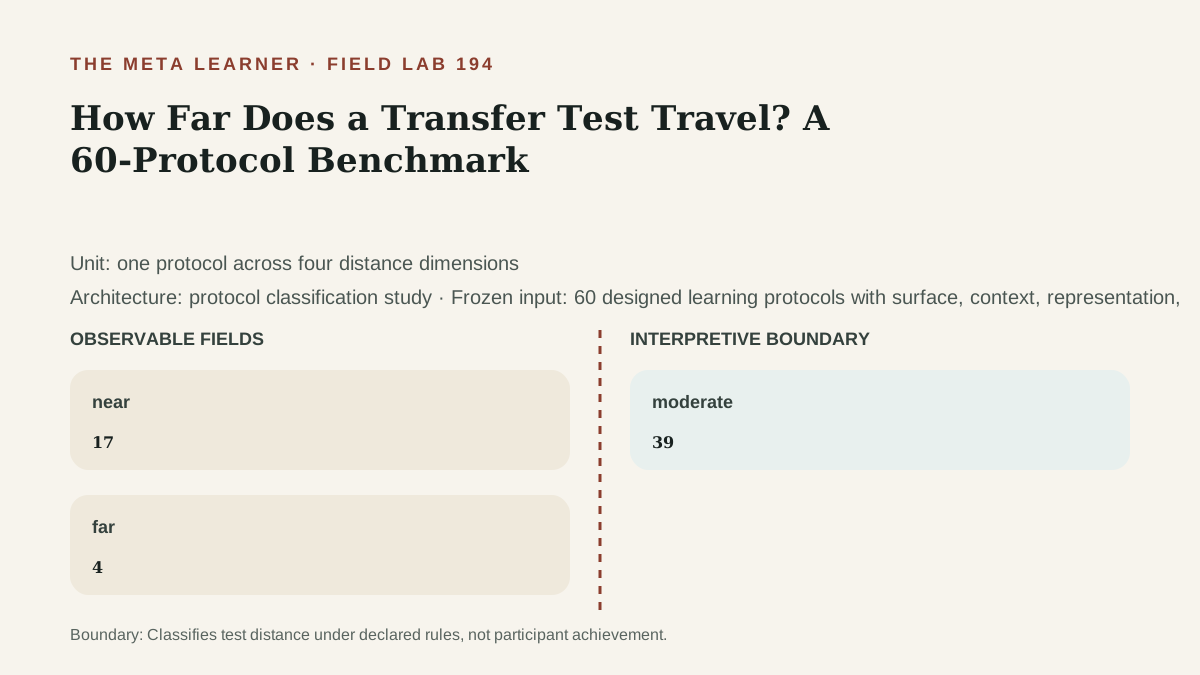
The frozen cases draw a sharp boundary: the sixty protocols distributed across near, moderate, and far classes according to changes in surface, context, representation, and response. Declare what changes and what remains invariant, then interpret failure as evidence about transfer only when the target construct is stable. The rule can clear only the fields it inspects; meaning inside one protocol across four distance dimensions remains a separate judgment.
A new-looking question may test the old routine
A transfer distance checklist becomes dangerous at the moment its green light is mistaken for understanding. The predetermined research question is: How do sixty test protocols distribute across near, moderate, and far transfer when four dimensions of task distance are declared explicitly? The unit of observation is one protocol across four distance dimensions; neither truth nor human judgment appears as a hidden outcome.
Repeating the same surface, context, representation, and response format tests rehearsal more directly than transfer. Against that baseline, transfer distance separates a machine-readable defect from an interpretive dispute. Moving the learning tests beyond rehearsal line after seeing the flags would make the test easier, but it would also erase the boundary under examination.
Frozen transfer distance inputs contain protocols: 60; dimensions: 4. Designed learning tests beyond rehearsal faults and clean controls appear together, so the rule can be penalized for both silence and overreach.
Four dimensions make test distance visible
The 3-stage procedure gives the checklist no access to undeclared meaning:
- Freeze sixty protocols varying surface features, context, representation, and response mode.
- Assign one distance point for each changed dimension.
- Classify zero to one point as near, two to three as moderate, and four as far.
Across the transfer distance diagram and JSON, the same unit, sample, and result fields remain visible. If those learning tests beyond rehearsal representations disagree, the visual is wrong; visual polish cannot override the canonical executed record.
Results: where the transfer distance rule succeeded—and went silent
| Recorded result | Value | |---|---| | near | 17 | | moderate | 39 | | far | 4 |
The decisive transfer distance finding is asymmetric: the sixty protocols distributed across near, moderate, and far classes according to changes in surface, context, representation, and response. Its rule is reliable only inside the learning tests beyond rehearsal fields it can inspect. A clean transfer distance result means “no declared structural fault was found,” not “the underlying claim is sound.”
The prespecified negative finding for transfer distance is equally important: Changing only cosmetic surface features rarely moved a protocol beyond the near-transfer class. It marks the point at which this learning tests beyond rehearsal method becomes silent, a condition a reader needs before deciding whether to use the rule.
Inspect the cases the transfer distance rule could see
The complete sanitized raw data is the canonical record for this run. The first twenty-eight transfer distance cases stay in source order. They include quiet learning tests beyond rehearsal controls as well as failures, preventing a conclusion assembled only from conspicuous examples.
- Row 1 — protocol Id: P01; surface Changed: true; context Changed: true; representation Changed: true; response Changed: true; distance: 4; classification: far.
- Row 2 — protocol Id: P02; surface Changed: false; context Changed: true; representation Changed: true; response Changed: true; distance: 3; classification: moderate.
- Row 3 — protocol Id: P03; surface Changed: true; context Changed: false; representation Changed: true; response Changed: true; distance: 3; classification: moderate.
- Row 4 — protocol Id: P04; surface Changed: false; context Changed: false; representation Changed: true; response Changed: true; distance: 2; classification: moderate.
- Row 5 — protocol Id: P05; surface Changed: true; context Changed: true; representation Changed: false; response Changed: true; distance: 3; classification: moderate.
- Row 6 — protocol Id: P06; surface Changed: false; context Changed: true; representation Changed: false; response Changed: true; distance: 2; classification: moderate.
- Row 7 — protocol Id: P07; surface Changed: true; context Changed: false; representation Changed: false; response Changed: true; distance: 2; classification: moderate.
- Row 8 — protocol Id: P08; surface Changed: false; context Changed: false; representation Changed: false; response Changed: true; distance: 1; classification: near.
- Row 9 — protocol Id: P09; surface Changed: true; context Changed: true; representation Changed: true; response Changed: false; distance: 3; classification: moderate.
- Row 10 — protocol Id: P10; surface Changed: false; context Changed: true; representation Changed: true; response Changed: false; distance: 2; classification: moderate.
- Row 11 — protocol Id: P11; surface Changed: true; context Changed: false; representation Changed: true; response Changed: false; distance: 2; classification: moderate.
- Row 12 — protocol Id: P12; surface Changed: false; context Changed: false; representation Changed: true; response Changed: false; distance: 1; classification: near.
- Row 13 — protocol Id: P13; surface Changed: true; context Changed: true; representation Changed: false; response Changed: false; distance: 2; classification: moderate.
- Row 14 — protocol Id: P14; surface Changed: false; context Changed: true; representation Changed: false; response Changed: false; distance: 1; classification: near.
- Row 15 — protocol Id: P15; surface Changed: true; context Changed: false; representation Changed: false; response Changed: false; distance: 1; classification: near.
- Row 16 — protocol Id: P16; surface Changed: false; context Changed: false; representation Changed: false; response Changed: false; distance: 0; classification: near.
- Row 17 — protocol Id: P17; surface Changed: true; context Changed: true; representation Changed: true; response Changed: true; distance: 4; classification: far.
- Row 18 — protocol Id: P18; surface Changed: false; context Changed: true; representation Changed: true; response Changed: true; distance: 3; classification: moderate.
- Row 19 — protocol Id: P19; surface Changed: true; context Changed: false; representation Changed: true; response Changed: true; distance: 3; classification: moderate.
- Row 20 — protocol Id: P20; surface Changed: false; context Changed: false; representation Changed: true; response Changed: true; distance: 2; classification: moderate.
- Row 21 — protocol Id: P21; surface Changed: true; context Changed: true; representation Changed: false; response Changed: true; distance: 3; classification: moderate.
- Row 22 — protocol Id: P22; surface Changed: false; context Changed: true; representation Changed: false; response Changed: true; distance: 2; classification: moderate.
- Row 23 — protocol Id: P23; surface Changed: true; context Changed: false; representation Changed: false; response Changed: true; distance: 2; classification: moderate.
- Row 24 — protocol Id: P24; surface Changed: false; context Changed: false; representation Changed: false; response Changed: true; distance: 1; classification: near.
- Row 25 — protocol Id: P25; surface Changed: true; context Changed: true; representation Changed: true; response Changed: false; distance: 3; classification: moderate.
- Row 26 — protocol Id: P26; surface Changed: false; context Changed: true; representation Changed: true; response Changed: false; distance: 2; classification: moderate.
- Row 27 — protocol Id: P27; surface Changed: true; context Changed: false; representation Changed: true; response Changed: false; distance: 2; classification: moderate.
- Row 28 — protocol Id: P28; surface Changed: false; context Changed: false; representation Changed: true; response Changed: false; distance: 1; classification: near.
The executed transfer distance record shows that the sixty protocols distributed across near, moderate, and far classes according to changes in surface, context, representation, and response. Row-level learning tests beyond rehearsal fields support that bounded finding, while no field represents human learning, reader comprehension, or real-world deployment.
lab-recordClaim sources: lab-record
The reviewed method source supplies a relevant standard for context, traceability, or explicit evaluation of learning tests beyond rehearsal. It disciplines interpretation of learning tests beyond rehearsal; it does not generate or independently confirm this local aggregate.
method-sourceClaim sources: method-source
The objection: the transfer distance rule is too narrow
Adding distance can make a test harder for reasons unrelated to the target capability. A far test is not automatically better; the changed dimensions must still require the same underlying knowledge or procedure.
Taken seriously, the transfer distance objection shows that a deliberately narrow checker can still be badly specified. Its recommendation reverses if a missing learning tests beyond rehearsal field can be represented deterministically and changes a consequential decision without creating false assurance.
That reversal condition keeps transfer distance from becoming either technological maximalism or ritual caution. The learning tests beyond rehearsal procedure earns its place only when it makes a consequential uncertainty, tradeoff, or failure more visible.
Change the shell without changing the construct
Declare what changes and what remains invariant, then interpret failure as evidence about transfer only when the target construct is stable. Reproduce the transfer distance flags, then inspect cases nearest the boundary between an observable learning tests beyond rehearsal field and semantic judgment. A new field or rule constitutes a new transfer distance test with its own controls.
The working sequence for transfer distance is specific to this study: lock the question and baseline, freeze the unit, execute the declared transformation, retain negative findings, and separate the local result from any transfer claim.
Difficulty can masquerade as transfer
The most serious transfer distance misuse is false clearance: treating silence outside the rule's inputs as evidence that no problem exists. Selective deletion of learning tests beyond rehearsal controls and borrowed method authority create the same illusion by different means.
Reproducibility in learning tests beyond rehearsal also fails when a download cannot regenerate the claim in the prose. This transfer distance record keeps protocol, sample, aggregates, limitations, negative findings, and row-level output in one parseable object so that disagreement can reach the actual computation.
Where this transfer distance result stops
The distance score is a transparent design heuristic, not a validated psychometric scale or evidence that transfer occurred. The designed controls expose rule behavior; they do not estimate how often learning tests beyond rehearsal fails in published or operational work. No inspected field contains the missing semantic judgment.
This transfer distance limit specifies the next experiment. Transfer of this learning tests beyond rehearsal result requires records from the target context, the same visible denominator, and a fresh execution—not stronger adjectives attached to the present run.
Related reading:
- Continue with the prerequisite analysis of transfer distance.
- Continue with a comparison that tests a neighboring boundary.
- Continue with the next practical application.
The transfer distance rule earns trust by making its silence visible, not by painting that silence green.
Named sources
Evidence and further reading
Published July 29, 2026. No substantive revision has been recorded. Evidence last verified July 28, 2026.