How Much Qualification Survives Compression? A 90-Summary Test
When thirty bounded source statements are truncated at three fixed word budgets, how often does the prespecified qualification remain visible? Executed on frozen inputs with inspec
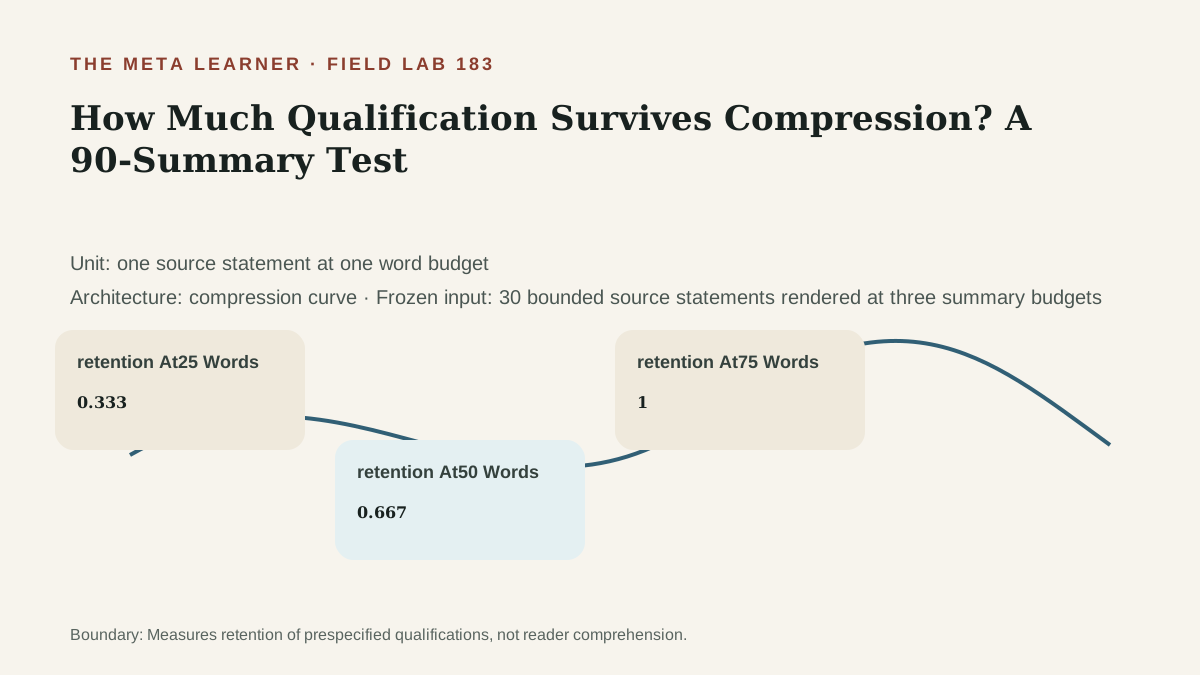
On the frozen records, qualification retention rose with the budget, yet boundaries placed beyond the cutoff remained absent regardless of how polished the surviving claim sounded. Budget the boundary before polishing the headline: preserve population, comparison, date, and uncertainty, then compress what remains. This is evidence about information retained or retrieved in one source statement at one word budget, not about comprehension, truth, or real-world prevalence.
Compression has an order of operations
qualification under compression rarely disappears all at once; it is more often lost one field, one cutoff, or one retrieval choice at a time. The predetermined research question is: When thirty bounded source statements are truncated at three fixed word budgets, how often does the prespecified qualification remain visible? By fixing one source statement at one word budget, the test can show the trade without pretending to measure what a reader later understands.
A claim-first truncation preserves the headline finding while silently dropping any boundary that occurs after the allotted words. Against that baseline, qualification under compression is intentionally plain enough to expose what the richer operation adds. A different claim-first summaries field, rule, or format would be a useful new comparison—not permission to rewrite this denominator retrospectively.
Frozen qualification under compression records fix source statements: 30; summary variants: 90; budgets: reported in the raw record. Because this claim-first summaries collection is constructed and labeled in advance, it offers an inspectable comparison rather than a universal performance estimate.
Results: the information trade exposed by qualification under compression
| Recorded result | Value | |---|---| | retention At25 Words | 0.333 | | retention At50 Words | 0.667 | | retention At75 Words | 1 |
In aggregate, qualification under compression reveals a trade rather than a winner: qualification retention rose with the budget, yet boundaries placed beyond the cutoff remained absent regardless of how polished the surviving claim sounded. Its strongest conclusion concerns one source statement at one word budget. A different study would be needed to establish comprehension, truth, or downstream usefulness of claim-first summaries.
The prespecified negative finding for qualification under compression is equally important: Increasing the word budget did not rescue qualifications positioned beyond that budget; placement mattered as much as nominal length. It marks the point at which this claim-first summaries method becomes silent, a condition a reader needs before deciding whether to use the rule.
A curve built from ninety summaries
The comparison changes only the declared information operation across 3 locked stages:
- Create thirty source statements with the decisive qualification placed early, in the middle, or late.
- Apply mechanical claim-first truncation at twenty-five, fifty, and seventy-five words.
- Count a qualification only when the complete seven-word boundary remains inside the summary.
Across the qualification under compression diagram and JSON, the same unit, sample, and result fields remain visible. If those claim-first summaries representations disagree, the visual is wrong; visual polish cannot override the canonical executed record.
Open the row-level evidence for qualification under compression
The complete sanitized raw data is the canonical record for this run. In the excerpt, qualification under compression is deliberately less polished than a chart. It preserves fields that claim-first summaries can remove and keeps uneventful rows available for challenge.
- Row 1 — statement Id: S01; boundary Position: early; word Budget: 25; boundary Start Word: 14; qualification Retained: true.
- Row 2 — statement Id: S01; boundary Position: early; word Budget: 50; boundary Start Word: 14; qualification Retained: true.
- Row 3 — statement Id: S01; boundary Position: early; word Budget: 75; boundary Start Word: 14; qualification Retained: true.
- Row 4 — statement Id: S02; boundary Position: middle; word Budget: 25; boundary Start Word: 38; qualification Retained: false.
- Row 5 — statement Id: S02; boundary Position: middle; word Budget: 50; boundary Start Word: 38; qualification Retained: true.
- Row 6 — statement Id: S02; boundary Position: middle; word Budget: 75; boundary Start Word: 38; qualification Retained: true.
- Row 7 — statement Id: S03; boundary Position: late; word Budget: 25; boundary Start Word: 64; qualification Retained: false.
- Row 8 — statement Id: S03; boundary Position: late; word Budget: 50; boundary Start Word: 64; qualification Retained: false.
- Row 9 — statement Id: S03; boundary Position: late; word Budget: 75; boundary Start Word: 64; qualification Retained: true.
- Row 10 — statement Id: S04; boundary Position: early; word Budget: 25; boundary Start Word: 14; qualification Retained: true.
- Row 11 — statement Id: S04; boundary Position: early; word Budget: 50; boundary Start Word: 14; qualification Retained: true.
- Row 12 — statement Id: S04; boundary Position: early; word Budget: 75; boundary Start Word: 14; qualification Retained: true.
- Row 13 — statement Id: S05; boundary Position: middle; word Budget: 25; boundary Start Word: 38; qualification Retained: false.
- Row 14 — statement Id: S05; boundary Position: middle; word Budget: 50; boundary Start Word: 38; qualification Retained: true.
- Row 15 — statement Id: S05; boundary Position: middle; word Budget: 75; boundary Start Word: 38; qualification Retained: true.
- Row 16 — statement Id: S06; boundary Position: late; word Budget: 25; boundary Start Word: 64; qualification Retained: false.
- Row 17 — statement Id: S06; boundary Position: late; word Budget: 50; boundary Start Word: 64; qualification Retained: false.
- Row 18 — statement Id: S06; boundary Position: late; word Budget: 75; boundary Start Word: 64; qualification Retained: true.
- Row 19 — statement Id: S07; boundary Position: early; word Budget: 25; boundary Start Word: 14; qualification Retained: true.
- Row 20 — statement Id: S07; boundary Position: early; word Budget: 50; boundary Start Word: 14; qualification Retained: true.
- Row 21 — statement Id: S07; boundary Position: early; word Budget: 75; boundary Start Word: 14; qualification Retained: true.
- Row 22 — statement Id: S08; boundary Position: middle; word Budget: 25; boundary Start Word: 38; qualification Retained: false.
- Row 23 — statement Id: S08; boundary Position: middle; word Budget: 50; boundary Start Word: 38; qualification Retained: true.
- Row 24 — statement Id: S08; boundary Position: middle; word Budget: 75; boundary Start Word: 38; qualification Retained: true.
- Row 25 — statement Id: S09; boundary Position: late; word Budget: 25; boundary Start Word: 64; qualification Retained: false.
- Row 26 — statement Id: S09; boundary Position: late; word Budget: 50; boundary Start Word: 64; qualification Retained: false.
- Row 27 — statement Id: S09; boundary Position: late; word Budget: 75; boundary Start Word: 64; qualification Retained: true.
- Row 28 — statement Id: S10; boundary Position: early; word Budget: 25; boundary Start Word: 14; qualification Retained: true.
The executed qualification under compression record shows that qualification retention rose with the budget, yet boundaries placed beyond the cutoff remained absent regardless of how polished the surviving claim sounded. Row-level claim-first summaries fields support that bounded finding, while no field represents human learning, reader comprehension, or real-world deployment.
lab-recordClaim sources: lab-record
The reviewed method source supplies a relevant standard for context, traceability, or explicit evaluation of claim-first summaries. It disciplines interpretation of claim-first summaries; it does not generate or independently confirm this local aggregate.
method-sourceClaim sources: method-source
The qualification under compression rival: more information is not always better
A skilled editor can rewrite rather than truncate, so this experiment is not an argument for long summaries. It isolates the default failure of a claim-first operation and shows what an editor must deliberately repair.
The rival view prevents qualification under compression from becoming a ritual. If an added claim-first summaries field, budget, or source role never changes retrieval or interpretation in the target context, the simpler operation deserves to win.
That reversal condition keeps qualification under compression from becoming either technological maximalism or ritual caution. The claim-first summaries procedure earns its place only when it makes a consequential uncertainty, tradeoff, or failure more visible.
Reserve words for the boundary first
Budget the boundary before polishing the headline: preserve population, comparison, date, and uncertainty, then compress what remains. Recalculate the qualification under compression aggregate from raw rows, then examine claim-first summaries losses by field rather than headline score. Changing the qualification under compression corpus, cutoff, mapping, or relevance judgment creates a new run.
The working sequence for qualification under compression is specific to this study: lock the question and baseline, freeze the unit, execute the declared transformation, retain negative findings, and separate the local result from any transfer claim.
Brevity becomes distortion when placement is ignored
A high qualification under compression aggregate can conceal the population, caveat, or record that matters. Decorative claim-first summaries provenance retains a link while discarding the field that explains why it supports the claim.
Reproducibility in claim-first summaries also fails when a download cannot regenerate the claim in the prose. This qualification under compression record keeps protocol, sample, aggregates, limitations, negative findings, and row-level output in one parseable object so that disagreement can reach the actual computation.
Where this qualification under compression result stops
Mechanical truncation is intentionally crude and does not measure what a skilled human editor or language model could preserve. The frozen qualification under compression collection enables a clean comparison at the cost of ecological variety. A claim-first summaries field can be present or retrievable without being noticed, understood, or used well.
This qualification under compression limit specifies the next experiment. Transfer of this claim-first summaries result requires records from the target context, the same visible denominator, and a fresh execution—not stronger adjectives attached to the present run.
Related reading:
- Continue with the prerequisite analysis of qualification under compression.
- Continue with a comparison that tests a neighboring boundary.
- Continue with the next practical application.
The qualification under compression result should be judged by what remains recoverable, not by how fluent the surviving output appears.
Named sources
Evidence and further reading
Published July 29, 2026. No substantive revision has been recorded. Evidence last verified July 28, 2026.