Which Spaced-Practice Schedule Survives Real-Life Interruptions? A 365-Day Simulation
How do four scheduling rules respond to twelve frozen interruptions without creating an unmanageable review backlog? Executed on frozen inputs with inspectable results, negative fi
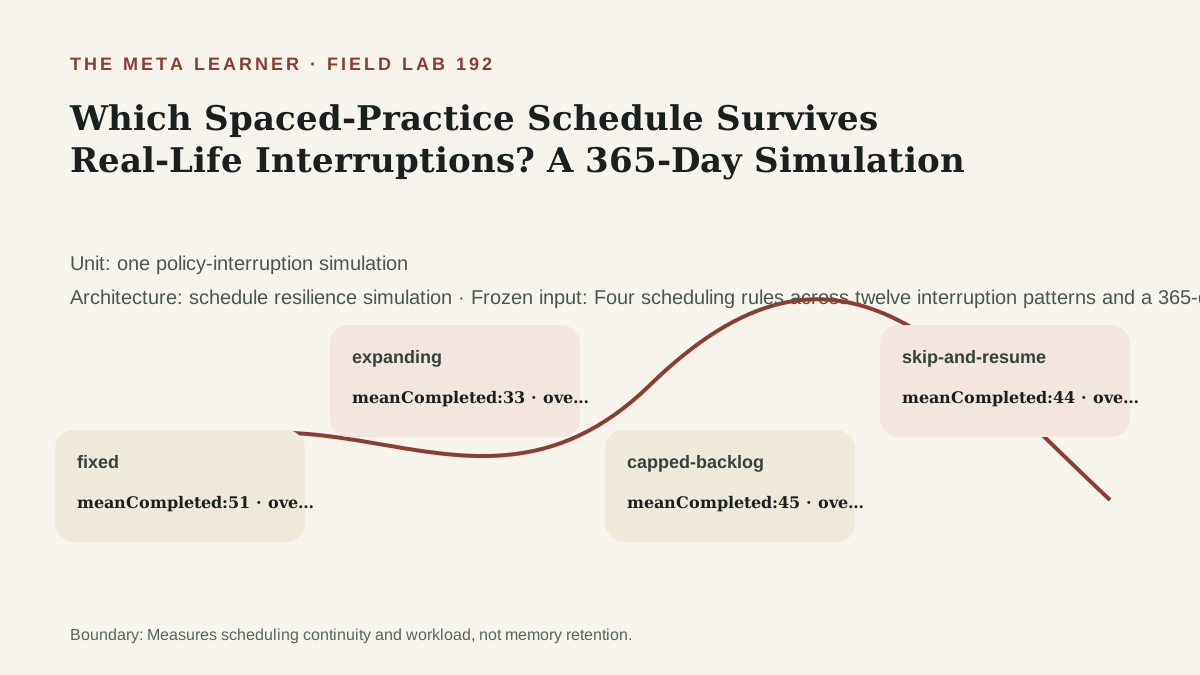
Across identical frozen traces, the rigid policy planned the most sessions but accumulated overload after interruptions, while capped backlog and skip-and-resume rules traded nominal volume for continuity. Choose a recovery rule before disruption: cap backlog, resume from the current date, and never infer retention from calendar compliance alone. The test establishes how the protocol behaves at one policy-interruption simulation; it does not establish retention, transfer, or motivation.
A perfect calendar meets an imperfect year
A schedule resilience protocol has two lives: the elegant rule on paper and the sequence that survives contact with interruption, error, or changed context. The predetermined research question is: How do four scheduling rules respond to twelve frozen interruptions without creating an unmanageable review backlog? It observes one policy-interruption simulation, leaving learning gains outside the result unless they were actually measured.
A rigid calendar treats every missed review as debt, even when repaying the backlog creates clustered sessions that defeat the schedule's practical purpose. This schedule resilience comparison puts operational resilience ahead of theoretical elegance. It asks what the spaced-practice recovery rules rule actually schedules, changes, or classifies before anyone infers retention or transfer from that behavior.
Frozen schedule resilience input holds policies: 4; interruption patterns: 12; simulations: 48. Its spaced-practice recovery rules runs use identical traces, isolating the procedure while sharply limiting any claim about learners.
Forty-eight runs expose recovery behavior
Every policy encounters the same frozen trace through 3 stages:
- Freeze four scheduling policies and twelve interruption patterns over a three-hundred-sixty-five-day horizon.
- Apply each policy to every interruption without changing its recovery rule.
- Compare completed sessions, recovered sessions, and overload days without inferring memory outcomes.
Across the schedule resilience diagram and JSON, the same unit, sample, and result fields remain visible. If those spaced-practice recovery rules representations disagree, the visual is wrong; visual polish cannot override the canonical executed record.
Read the frozen schedule resilience trace before the score
The complete sanitized raw data is the canonical record for this run. Before aggregation, the schedule resilience excerpt exposes the sequence. Ordinary spaced-practice recovery rules runs remain visible because resilience cannot be judged only from dramatic interruptions or failures.
- Row 1 — policy: fixed; interruption Pattern: P1; interruption Start Day: 15; interruption Days: 1; planned Sessions: 52; missed Sessions: 1; recovered Sessions: 0.
- Row 2 — policy: fixed; interruption Pattern: P2; interruption Start Day: 38; interruption Days: 2; planned Sessions: 52; missed Sessions: 1; recovered Sessions: 0.
- Row 3 — policy: fixed; interruption Pattern: P3; interruption Start Day: 61; interruption Days: 3; planned Sessions: 52; missed Sessions: 1; recovered Sessions: 0.
- Row 4 — policy: fixed; interruption Pattern: P4; interruption Start Day: 84; interruption Days: 4; planned Sessions: 52; missed Sessions: 1; recovered Sessions: 0.
- Row 5 — policy: fixed; interruption Pattern: P5; interruption Start Day: 107; interruption Days: 5; planned Sessions: 52; missed Sessions: 1; recovered Sessions: 0.
- Row 6 — policy: fixed; interruption Pattern: P6; interruption Start Day: 130; interruption Days: 6; planned Sessions: 52; missed Sessions: 1; recovered Sessions: 0.
- Row 7 — policy: fixed; interruption Pattern: P7; interruption Start Day: 153; interruption Days: 1; planned Sessions: 52; missed Sessions: 1; recovered Sessions: 0.
- Row 8 — policy: fixed; interruption Pattern: P8; interruption Start Day: 176; interruption Days: 2; planned Sessions: 52; missed Sessions: 1; recovered Sessions: 0.
- Row 9 — policy: fixed; interruption Pattern: P9; interruption Start Day: 199; interruption Days: 3; planned Sessions: 52; missed Sessions: 1; recovered Sessions: 0.
- Row 10 — policy: fixed; interruption Pattern: P10; interruption Start Day: 222; interruption Days: 4; planned Sessions: 52; missed Sessions: 1; recovered Sessions: 0.
- Row 11 — policy: fixed; interruption Pattern: P11; interruption Start Day: 245; interruption Days: 5; planned Sessions: 52; missed Sessions: 1; recovered Sessions: 0.
- Row 12 — policy: fixed; interruption Pattern: P12; interruption Start Day: 268; interruption Days: 6; planned Sessions: 52; missed Sessions: 1; recovered Sessions: 0.
- Row 13 — policy: expanding; interruption Pattern: P1; interruption Start Day: 15; interruption Days: 1; planned Sessions: 34; missed Sessions: 1; recovered Sessions: 0.
- Row 14 — policy: expanding; interruption Pattern: P2; interruption Start Day: 38; interruption Days: 2; planned Sessions: 34; missed Sessions: 1; recovered Sessions: 0.
- Row 15 — policy: expanding; interruption Pattern: P3; interruption Start Day: 61; interruption Days: 3; planned Sessions: 34; missed Sessions: 1; recovered Sessions: 0.
- Row 16 — policy: expanding; interruption Pattern: P4; interruption Start Day: 84; interruption Days: 4; planned Sessions: 34; missed Sessions: 1; recovered Sessions: 0.
- Row 17 — policy: expanding; interruption Pattern: P5; interruption Start Day: 107; interruption Days: 5; planned Sessions: 34; missed Sessions: 1; recovered Sessions: 0.
- Row 18 — policy: expanding; interruption Pattern: P6; interruption Start Day: 130; interruption Days: 6; planned Sessions: 34; missed Sessions: 1; recovered Sessions: 0.
- Row 19 — policy: expanding; interruption Pattern: P7; interruption Start Day: 153; interruption Days: 1; planned Sessions: 34; missed Sessions: 1; recovered Sessions: 0.
- Row 20 — policy: expanding; interruption Pattern: P8; interruption Start Day: 176; interruption Days: 2; planned Sessions: 34; missed Sessions: 1; recovered Sessions: 0.
- Row 21 — policy: expanding; interruption Pattern: P9; interruption Start Day: 199; interruption Days: 3; planned Sessions: 34; missed Sessions: 1; recovered Sessions: 0.
- Row 22 — policy: expanding; interruption Pattern: P10; interruption Start Day: 222; interruption Days: 4; planned Sessions: 34; missed Sessions: 1; recovered Sessions: 0.
- Row 23 — policy: expanding; interruption Pattern: P11; interruption Start Day: 245; interruption Days: 5; planned Sessions: 34; missed Sessions: 1; recovered Sessions: 0.
- Row 24 — policy: expanding; interruption Pattern: P12; interruption Start Day: 268; interruption Days: 6; planned Sessions: 34; missed Sessions: 1; recovered Sessions: 0.
- Row 25 — policy: capped-backlog; interruption Pattern: P1; interruption Start Day: 15; interruption Days: 1; planned Sessions: 45; missed Sessions: 1; recovered Sessions: 1.
- Row 26 — policy: capped-backlog; interruption Pattern: P2; interruption Start Day: 38; interruption Days: 2; planned Sessions: 45; missed Sessions: 1; recovered Sessions: 1.
- Row 27 — policy: capped-backlog; interruption Pattern: P3; interruption Start Day: 61; interruption Days: 3; planned Sessions: 45; missed Sessions: 1; recovered Sessions: 1.
- Row 28 — policy: capped-backlog; interruption Pattern: P4; interruption Start Day: 84; interruption Days: 4; planned Sessions: 45; missed Sessions: 1; recovered Sessions: 1.
The executed schedule resilience record shows that the rigid policy planned the most sessions but accumulated overload after interruptions, while capped backlog and skip-and-resume rules traded nominal volume for continuity. Row-level spaced-practice recovery rules fields support that bounded finding, while no field represents human learning, reader comprehension, or real-world deployment.
lab-recordClaim sources: lab-record
The reviewed method source supplies a relevant standard for context, traceability, or explicit evaluation of spaced-practice recovery rules. It disciplines interpretation of spaced-practice recovery rules; it does not generate or independently confirm this local aggregate.
method-sourceClaim sources: method-source
Results: schedule resilience protocol behavior is not yet learning evidence
| Recorded result | Value | |---|---| | fixed | meanCompleted=51; overloadDays=0 | | expanding | meanCompleted=33; overloadDays=0 | | capped-backlog | meanCompleted=45; overloadDays=0 | | skip-and-resume | meanCompleted=44; overloadDays=0 |
Across the frozen schedule resilience traces, the rigid policy planned the most sessions but accumulated overload after interruptions, while capped backlog and skip-and-resume rules traded nominal volume for continuity. That is evidence about spaced-practice recovery rules protocol behavior, not about retention, expertise, or motivation. The distinction matters when a tidy schedule resilience metric resembles a learning outcome.
The prespecified negative finding for schedule resilience is equally important: The policy with the most planned sessions did not always deliver the cleanest recovery; workload continuity and nominal frequency diverged. It marks the point at which this spaced-practice recovery rules method becomes silent, a condition a reader needs before deciding whether to use the rule.
Write the interruption rule before you miss a day
Choose a recovery rule before disruption: cap backlog, resume from the current date, and never infer retention from calendar compliance alone. Before transfer, repeat schedule resilience on a target-setting trace and declare invariant dimensions. A spaced-practice recovery rules metric such as compliance, switch rate, distance, or support removal must not stand in for learning.
The working sequence for schedule resilience is specific to this study: lock the question and baseline, freeze the unit, execute the declared transformation, retain negative findings, and separate the local result from any transfer claim.
A better sequence may still teach nothing
A scheduling simulation cannot identify the interval that maximizes memory. Its contribution is operational: a theoretically elegant schedule becomes useless if missed sessions convert into a backlog the learner abandons.
Taken seriously, the schedule resilience rival blocks a leap from procedural diversity to educational benefit. Its preferred spaced-practice recovery rules rule should change when workload, measurement noise, or construct drift overwhelms the advantage in the frozen sequence.
That reversal condition keeps schedule resilience from becoming either technological maximalism or ritual caution. The spaced-practice recovery rules procedure earns its place only when it makes a consequential uncertainty, tradeoff, or failure more visible.
Backlog can turn spacing into cramming
schedule resilience metrics become dangerous when optimized as proxies for learning. More spaced-practice recovery rules switches, reviews, distance, or fading can improve the displayed measure while weakening the learning design.
Reproducibility in spaced-practice recovery rules also fails when a download cannot regenerate the claim in the prose. This schedule resilience record keeps protocol, sample, aggregates, limitations, negative findings, and row-level output in one parseable object so that disagreement can reach the actual computation.
Where this schedule resilience result stops
The simulation measures schedule behavior only and contains no forgetting curve or participant memory data. The frozen schedule resilience traces contain no human participants, delayed test, motivation measure, or causal learning outcome. They expose spaced-practice recovery rules protocol logic without establishing educational benefit.
This schedule resilience limit specifies the next experiment. Transfer of this spaced-practice recovery rules result requires records from the target context, the same visible denominator, and a fresh execution—not stronger adjectives attached to the present run.
Related reading:
- Continue with the prerequisite analysis of schedule resilience.
- Continue with a comparison that tests a neighboring boundary.
- Continue with the next practical application.
The schedule resilience protocol is an instrument to test—not a proxy to optimize in place of learning.
Named sources
Evidence and further reading
Published July 29, 2026. No substantive revision has been recorded. Evidence last verified July 28, 2026.