The WEIRDest People in the World: How Universal Is the “Universal” Learner?
Test Joseph Henrich’s cultural-evolution account against sampling limits, within-society variation, historical causal inference, power, and universal learning claims.
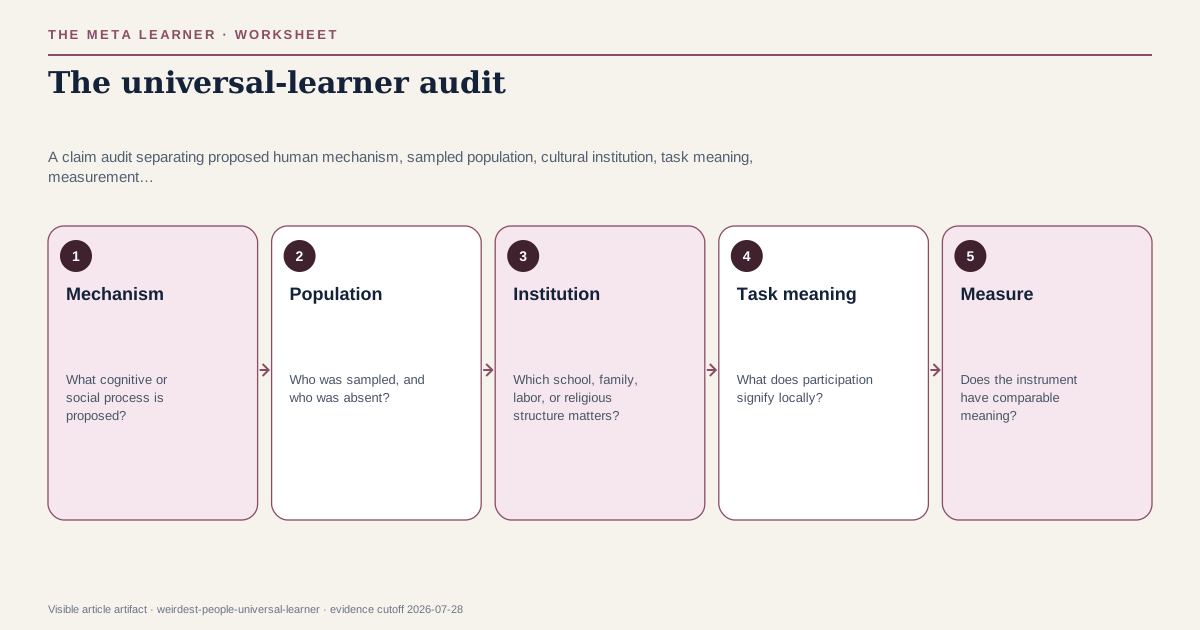
Do not assume a finding from a narrow population is either universal or useless elsewhere. State the proposed mechanism, sample, cultural institutions, task meaning, measure, and outcome. Replicate across settings, examine within-group variation, and adapt the environment rather than assigning cultural essences to individual learners. Cultural categories contain substantial internal variation, and observed group differences do not by themselves establish a historical cause.
Intellectual inheritance behind the WEIRDest People in the World
The intellectual genealogy includes cultural anthropology, Vygotskian and cultural-historical psychology, modernization debates, dual-inheritance theory, and longstanding criticism of psychology’s population boundaries. Henrich’s distinctive move is to connect experimental variation to a large institutional history through cultural evolution.
The genealogy also supplies criticism. Anthropological traditions warn against ranking societies along one development path or turning population patterns into fixed cultural personalities.
The macrohistorical argument
Henrich argues that people in Western, educated, industrialized, rich, and democratic societies are psychologically unusual rather than default humanity. His macrohistorical thesis links changes in kinship and marriage institutions to individualism, impersonal prosociality, analytic thinking, and institutions that later reinforced those patterns.
The book’s learning relevance is indirect but profound. Research subjects, classrooms, motivation theories, and assessments often embody cultural assumptions about individual choice, decontextualized analysis, verbal report, competition, and institutional trust.
The universal-learner audit: evidence, not verdict
The foundational WEIRD paper documents the disproportionate use of narrow samples and reviews cross-population variation. Henrich’s book integrates psychology, anthropology, economics, and history into a causal account of Western divergence. A later review reports progress beyond WEIRD samples while calling for broader questions, methods, collaborators, and sites.
henrich-weirdest, henrich-weird, apicella-beyond-weirdClaim sources: henrich-weirdest, henrich-weird, apicella-beyond-weird
Counterevidence to simple universality
Cross-cultural variation challenges claims that one observed effect maps directly onto human nature. Translation alone does not make tasks equivalent. Schooling, markets, literacy, urbanization, and research participation can change cognition and response style.
But group averages do not authorize predictions about one person. A Shanghai engineer and a rural American farmer cannot be inferred from “East” and “West.” Age, class, language, expertise, migration, and institution crosscut national labels.
Counterevidence to the grand causal story
Macrohistory faces difficult identification. Institutions coevolve; records are uneven; selection and measurement change; and many causal paths can fit broad patterns. Evidence that two historical processes align does not isolate one church rule as the sufficient engine of modern psychology.
The book’s synthesis is most valuable as a generative causal program with testable intermediate links, not a closed explanation of the West. Strong local studies can support pieces without validating the entire chain.
What remains universal?
Human beings share biological development, memory constraints, social dependence, language capacity, and the ability to learn from experience. Yet environments train attention, supply categories, assign meaning, and distribute practice.
The correct response is mechanism-plus-boundary. Retrieval can strengthen later access across populations while the material chosen, acceptable testing format, stakes, prior knowledge, and social meaning alter outcomes. “Universal” should name the level at which the claim operates.
A learning-science case
A study finds that giving learners individual choice increases persistence. An educator exports the intervention globally. The universality audit asks whether choice is experienced as autonomy, abandonment, family conflict, or trivial preference; whether persistence is individually measured; and whether options are equally meaningful.
The underlying mechanism—experienced agency—may travel while its implementation changes. In one setting, agency may involve individual selection. In another, meaningful participation in a collective decision may support it better.
Build a universality audit
For a learning claim, record:
| Layer | Question | |---|---| | Mechanism | What cognitive or social process is proposed? | | Population | Who was sampled, and who was absent? | | Institution | Which school, family, labor, or religious structure matters? | | Task meaning | What does participation signify locally? | | Measure | Does the instrument have comparable meaning? | | Variation | How much difference exists within groups? | | Transfer | Has the effect replicated across settings and outcomes? |
The audit avoids two errors: automatic universality and automatic cultural relativism.
Use a construct-translation protocol
Before comparing populations, write the construct without using the survey item that measures it. Then ask local researchers and participants how the behavior is recognized, which situations make it appropriate, and which translation changes its social meaning. Pilot the task for comprehension and response strategy, not grammar alone.
Next separate three questions: does the measure behave similarly, does the average differ, and does the proposed cause explain that difference? These questions require different evidence. A reliable translation can still lack measurement equivalence. An average difference can coexist with enormous within-group variation. A cultural association does not identify a historical mechanism.
Finally, state the portability boundary. A learning intervention validated with university students in one institutional setting should travel as a hypothesis, not a universal law. Preserve the mechanism that may generalize while retesting language, norms, incentives, prior schooling, and task interpretation. This is more demanding than adding demographic variety, but it produces knowledge that can survive contact with another world.
Reversal conditions for the universal-learner audit
Increase generality when preregistered studies with measurement equivalence replicate across populations, researchers and participants share interpretive authority, and the mechanism predicts both commonality and variation.
Narrow a claim when effects depend on one institution, translation changes the construct, subgroup variation exceeds between-group difference, or local knowledge predicts failure. Adapt design without stereotyping the learner.
Cultural-boundary errors
- Treating American undergraduates as generic humans.
- Treating a nation as one culture.
- Explaining a group difference with an untested history.
- Translating words without testing construct equivalence.
- Confusing contextual adaptation with learning styles.
- Declaring every mechanism culturally incommensurable.
- Using “culture” while ignoring class, power, and institution.
- Applying population averages to an individual decision.
The boundary of this reading of the WEIRDest People in the World
The book’s causal scope is unusually broad and remains contested. Cross-cultural comparisons face sampling, translation, measurement, and historical identification problems. This audit cannot determine universality from one study; it specifies evidence needed to widen or narrow a learning claim.
Reject fixed labels with learning-styles evidence, add age and opportunity through adult expertise, and evaluate opportunity as capability.
Named sources
Evidence and further reading
Published July 29, 2026. No substantive revision has been recorded. Evidence last verified July 28, 2026.