Development as Freedom: Why Capability Matters More Than Output
Test Amartya Sen’s capability approach against GDP, preference, measurement, paternalism, inequality, conversion factors, and the difference between resources and freedom.
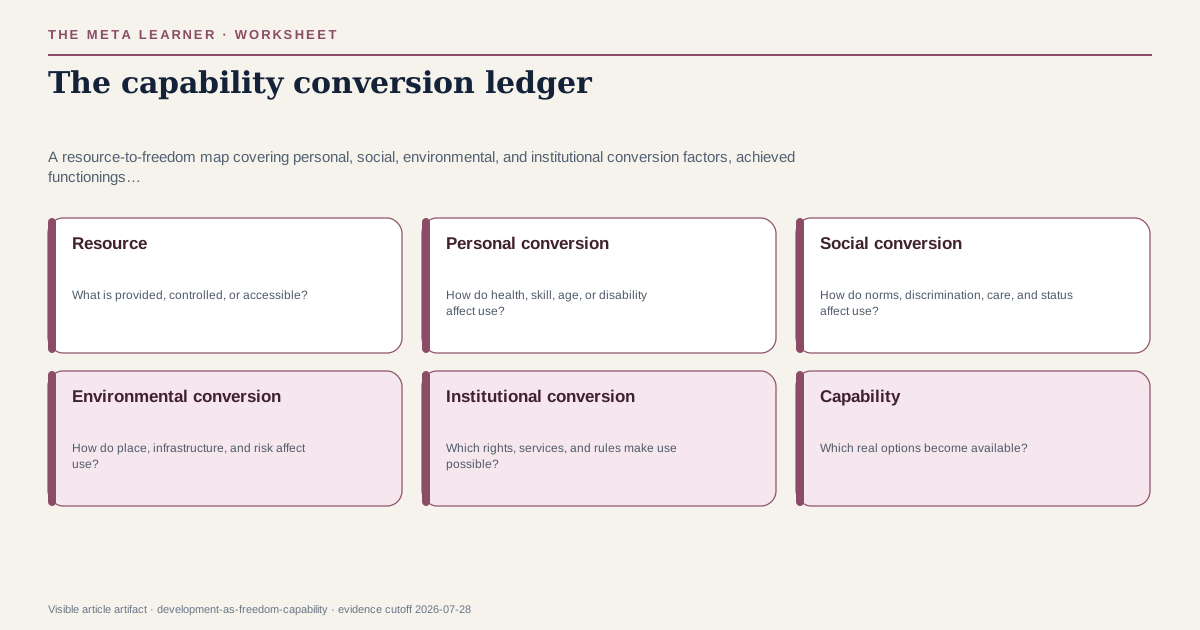
Measure what people are genuinely able to be and do, not only what resources they receive or outputs they produce. Trace the personal, social, environmental, and institutional factors that convert a resource into a real option. Then examine who chose the valued capabilities, how freedom is distributed, and whether people can exercise agency rather than receive a prescribed outcome.
Reconstructing development as freedom
Sen argues that development is the expansion of substantive freedoms. Income, goods, infrastructure, and economic growth are means whose value depends on the capabilities they enable. Two people with the same resources may possess very different real opportunities because of disability, discrimination, health, care obligations, public services, or geography.
The approach also distinguishes capability from functioning. A person who chooses to fast and a person who cannot obtain food may share an observed functioning while having radically different freedoms. Development concerns the option set and agency, not only the recorded outcome.
Intellectual inheritance behind Development as Freedom
The intellectual genealogy reaches to Aristotle on flourishing, Adam Smith on the social conditions of appearing in public without shame, Marx on human freedom, welfare economics, and debates with utility and resource-based accounts. Sen’s dialogue with Rawls is especially important: equal primary goods do not guarantee equal capability to convert them.
The human-development tradition extends this argument into policy indicators. Its success makes the critique visible: what begins as resistance to one metric can become another administrative score.
Counterevidence: capability is difficult to measure
Capabilities are counterfactual option sets; researchers often observe resources and functionings instead. Selecting dimensions and weights can turn public reasoning into expert administration. A large dashboard may create precisely the legibility problem the approach was meant to correct.
Multidimensional measures are therefore evidence tools, not complete moral accounts. Show thresholds and weights, test sensitivity, disaggregate distribution, and preserve qualitative evidence about why conversion fails.
The paternalism challenge
If policymakers decide which capabilities matter, they may impose a preferred life. If every individual preference is treated as final, deprivation can adapt expectations downward: people denied an option may cease to report wanting it.
Sen’s emphasis on public reasoning avoids a closed universal list, but procedure alone does not remove power. Participation must be accessible, consequential, and protected. Rights can also set floors that do not depend on current preference.
capability conversion ledger: the claim-bearing evidence
Sen presents freedom as both an evaluative end and a means of development. UNDP human-development work institutionalizes multidimensional assessment beyond income. Research on multidimensional poverty measurement clarifies indicator, cutoff, weighting, and identification choices, showing that operationalization requires explicit normative and technical decisions.
sen-freedom, undp-human-development, alkire-povertyClaim sources: sen-freedom, undp-human-development, alkire-poverty
A worked education metric
A government supplies every adult learner with access to an AI tutor and reports one million accounts as educational progress. The ledger finds differences in connectivity, language quality, disability access, privacy, foundational literacy, time, and trusted human support.
Account creation is a resource measure. Completed lessons are an output. Capability would ask whether people can use the system to understand, decide, communicate, and pursue goals they value—and whether non-digital alternatives remain available.
The intervention may still be valuable. The framework changes what counts as success and where support belongs.
Output still matters
The counterargument to capability enthusiasm is practical. Hospitals need survival outcomes; schools need evidence of learning; climate policy needs emission reduction. Option sets without achieved functionings can become aspirational language.
Use a paired record: capability and outcome. Ask whether people had a real option, what they chose, what occurred, and what constraint remained. Neither side substitutes for the other.
Use the capability conversion ledger
For any resource or intervention, record:
| Stage | Question | |---|---| | Resource | What is provided, controlled, or accessible? | | Personal conversion | How do health, skill, age, or disability affect use? | | Social conversion | How do norms, discrimination, care, and status affect use? | | Environmental conversion | How do place, infrastructure, and risk affect use? | | Institutional conversion | Which rights, services, and rules make use possible? | | Capability | Which real options become available? | | Functioning | What does the person actually choose and achieve? | | Agency | Could the person shape the goal and refuse the option? |
Do not infer capability from the existence of a tool.
Preserve distribution and refusal
An intervention can increase average capability while narrowing the options of a minority. Report the distribution across relevant circumstances, not only a single population gain. Ask who acquired a real option, who lost one, and whether the new system made an older path practically unavailable.
Refusal is an especially revealing capability. If an AI service improves average access but education, employment, or public benefits become conditional on surrendering sensitive data, the apparent option contains coercion. A rights-preserving alternative may be less efficient and still necessary for substantive freedom.
Adaptive preference creates the opposite danger. People can lower aspirations under deprivation, but an institution cannot simply replace their judgment with an expert’s preferred life. The defensible response joins evidence about conversion barriers with public reasoning, participation, and agency. The capability approach improves evaluation precisely when it makes these value choices visible rather than smuggling them into an index.
Reversal conditions for the capability conversion ledger
Favor a capability lens when equal inputs produce unequal use, choice matters, conversion barriers are plausible, or aggregate output hides exclusion. Favor a narrower outcome metric for bounded technical processes with agreed goals, while retaining rights and distribution checks.
Reject a capability claim when dimensions are unexplained, participation cannot alter them, access is counted as freedom, or an intervention removes valued options while improving its selected score.
Capability-language failures
- Counting access as capability.
- Assuming equal resources create equal freedom.
- Listing many indicators without a theory of conversion.
- Hiding weights and thresholds.
- Calling consultation public reasoning when it cannot change the decision.
- Romanticizing choice without material options.
- Ignoring achieved outcomes.
- Using capability language to market a predetermined product.
The boundary of this reading of Development as Freedom
Capability is normatively attractive but difficult to observe, aggregate, and compare. Public reasoning can remain unequal, and multidimensional indices simplify. This editorial ledger does not select a universal capability list or replace domain-specific outcome evaluation and rights analysis.
Add cultural boundaries from The WEIRDest People, test technical missions through public purpose, and preserve non-monetary value when using opportunity cost.
Named sources
Evidence and further reading
Published July 29, 2026. No substantive revision has been recorded. Evidence last verified July 28, 2026.