The Technological Republic: Can Public Purpose Guide Technical Power?
Test Alexander Karp and Nicholas Zamiska’s case for public-purpose technology against democratic authorization, procurement, rights, accountability, and conflicts of interest.
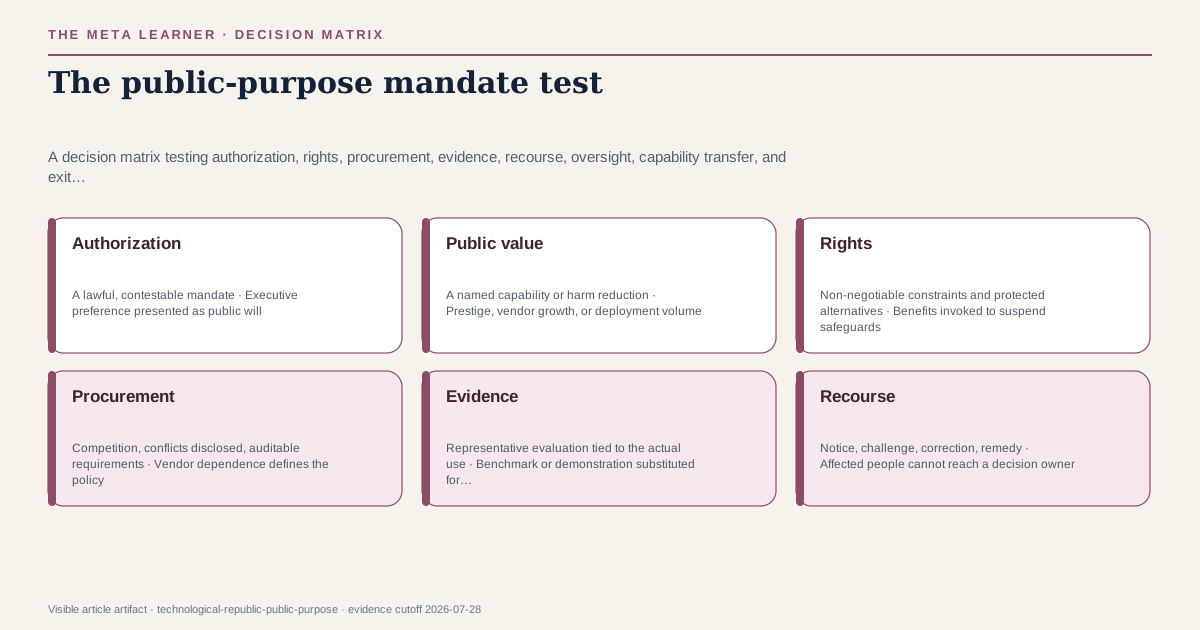
Public purpose can guide technical power, but only if “public” describes the authority and accountability of the mission—not merely its scale or patriotic language. Test who authorized the goal, whose rights constrain it, how vendors were selected, which evidence permits deployment, who can appeal, who audits outcomes, and when the system must stop.
Reconstructing the case for public purpose
Alexander Karp and Nicholas Zamiska argue that a substantial part of the technology sector withdrew from the difficult work of national and collective purpose. Consumer convenience and advertising captured talent that could have served defense, infrastructure, state capacity, and other consequential missions. Their central argument is cultural as much as industrial: builders should recover the confidence to choose commitments rather than pretend that markets or technological inevitability choose for them.
The book identifies a real deficiency. A society that cannot build, maintain, or govern essential systems is not protected by good intentions. Technical talent, operational competence, and durable institutions matter. Yet the move from private optimization to public mission creates a second problem: who speaks for the public, under what constraints, and with what route for dissent?
That is the argument this article tests. “Purpose” may correct market short-termism while also concentrating technical and political power.
Intellectual inheritance behind the Technological Republic
The intellectual genealogy includes the republic as a project of civic self-government, the public-works tradition, wartime mobilization, the research university, and Bush’s vision of publicly supported basic science. It also includes the military-industrial complex: the recognition that state need, contractor expertise, secrecy, and concentrated budgets can form a durable power system.
A later lineage runs through industrial policy, mission-oriented innovation, public-interest technology, digital government, and debates over state capacity. Its critics draw on civil-liberties law, democratic theory, anti-colonial analysis, and scholarship on surveillance and administrative power.
The genealogy produces a necessary tension. Government can coordinate long-horizon capabilities that a consumer market underprovides. Government authority can also scale coercion. A serious public-purpose doctrine must hold both facts at once.
Counterevidence and conflict of position
The strongest counterargument to the book is institutional. Karp leads a company that sells consequential systems to governments. That position can supply operational knowledge unavailable to detached commentary. It also gives the authors’ defense of state–industry collaboration a material conflict that readers must keep visible.
Conflict is not automatic refutation. It changes the evidentiary burden. Readers should compare normative claims with procurement records, independent evaluations, affected-party evidence, and alternative institutional designs.
A second challenge comes from the consumer sphere the book criticizes. Consumer technologies can expand access, coordination, expression, and everyday capability. State missions can be wasteful, exclusionary, or coercive. The defensible distinction is not serious government versus trivial market. It is whether an institution can justify its objective and remain accountable for power.
public-purpose mandate test: the claim-bearing evidence
Karp and Zamiska make a normative case for technical commitment to national missions. Vannevar Bush’s postwar report offers an influential predecessor: publicly supported science linked discovery, education, health, security, and institution building. The U.S. Government Accountability Office’s AI framework shows the additional burden of deployment through governance, data, performance, and monitoring dimensions. Mission and accountability are complements, not substitutes.
karp-technological-republic, bush-endless-frontier, gao-ai-accountabilityClaim sources: karp-technological-republic, bush-endless-frontier, gao-ai-accountability
Democratic authorization is a technical requirement
Engineers sometimes treat authorization as context supplied before the “real” work begins. In consequential systems, it shapes the technical object. Rights alter permissible features. Recourse requires logs and reversible decisions. Oversight changes documentation. Procurement rules affect architecture and interoperability. Exit conditions determine whether data and models can be retired.
Democratic design is therefore not a ceremonial consultation layer. It creates requirements that should be visible in system boundaries and tests.
Apply the public-purpose mandate test
Score a proposed technical mission before debating its sophistication:
| Test | Passing evidence | Failure signal | |---|---|---| | Authorization | A lawful, contestable mandate | Executive preference presented as public will | | Public value | A named capability or harm reduction | Prestige, vendor growth, or deployment volume | | Rights | Non-negotiable constraints and protected alternatives | Benefits invoked to suspend safeguards | | Procurement | Competition, conflicts disclosed, auditable requirements | Vendor dependence defines the policy | | Evidence | Representative evaluation tied to the actual use | Benchmark or demonstration substituted for impact | | Recourse | Notice, challenge, correction, remedy | Affected people cannot reach a decision owner | | Oversight | Independent access to records and outcomes | Self-attestation only | | Capability transfer | Public learning, interoperability, maintainability | Permanent opaque dependence | | Exit | Suspension and retirement conditions | Mission success always demands expansion |
This is not an efficiency score. A system can be technically impressive and fail the mandate.
A procurement case
Suppose a government procures an AI system to prioritize inspections of critical infrastructure. The public purpose is plausible: limited inspectors should reach high-risk sites before failure.
The mission statement does not settle the design. Historical inspection data may reflect uneven reporting. A vendor may claim model secrecy. Operators may defer to rankings. Facilities may be unable to contest incorrect records. Security concerns may limit disclosure, while the same secrecy shields weak evaluation.
The mandate test changes the procurement specification. The agency defines protected rights and human decision authority; tests on representative and adversarial cases; logs overrides; separates vendor claims from agency findings; supplies correction and appeal; assesses dependence; and sets suspension thresholds. The public mission becomes a chain of accountable decisions rather than a justification attached after purchase.
When the recommendation reverses
Direct scarce technical capacity toward public missions when the problem is genuinely collective, the mandate is lawful and contestable, rights are preserved, evidence is obtainable, and accountability can survive urgency.
The recommendation reverses when the objective depends on indiscriminate surveillance, affected people lack recourse, procurement creates unreviewable dependence, evaluation is impossible, or “emergency” has no end condition. In those cases, refusing to build can itself be public service.
Mission-driven category errors
- Calling a national-scale customer a public purpose.
- Treating state authorization as democratic legitimacy.
- Equating technical difficulty with social value.
- Using secrecy to avoid independent performance evidence.
- Letting vendor capability define the policy objective.
- Counting deployment while ignoring freedom, distribution, and recourse.
- Assuming a mission should persist because institutions were built around it.
The boundary of this reading of the Technological Republic
This article evaluates a normative argument through two U.S. institutional sources; it does not endorse a company, procurement, defense program, or national strategy. Public authority and legal constraints differ by jurisdiction, while some evidence may be classified or unavailable. Any real high-consequence deployment requires current law, independent technical evaluation, affected-party input, conflict review, and named accountable decision makers at the publication cutoff.
Define public value with the capability approach, trace its translation through alignment, and test governance at scale through The Coming Wave.
Named sources
Evidence and further reading
Published July 29, 2026. No substantive revision has been recorded. Evidence last verified July 28, 2026.