Thinking in Systems: Where the Framework Clarifies—and Where It Hides Power
Test Donella Meadows’s systems framework against contested boundaries, institutional power, strategic actors, unequal harms, and the politics of intervention.
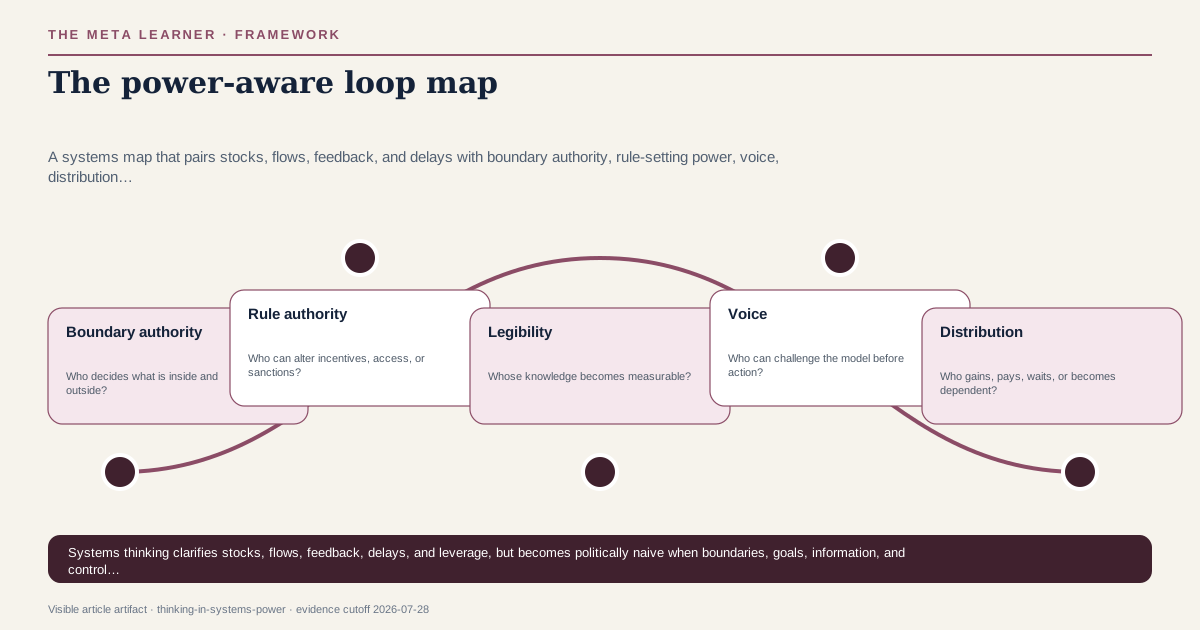
Use systems thinking to explain dynamic behavior, then ask who defined the boundary, chose the goal, controls information, can change rules, absorbs delay, and bears externalized cost. A loop diagram is incomplete when actors appear as identical particles or when unequal authority is hidden inside a neutral arrow. A qualitative map does not estimate effect size, establish causality, or represent every conflict and lived experience.
The framework and its strongest claim
Meadows teaches readers to stop treating events as isolated. Stocks accumulate; flows change them; reinforcing feedback amplifies movement; balancing feedback resists it; delays separate action from consequence; and system structure can produce behavior no participant intended.
The central argument is explanatory and practical. If recurring problems arise from structure, repeatedly reacting to visible events will disappoint. Better intervention may change information flows, rules, goals, or the capacity of a system to organize itself—not merely adjust one parameter.
The power-aware loop map: the claim-bearing evidence
Meadows offers a clear synthesis of system dynamics and leverage. Sterman documents why feedback, nonlinearity, accumulation, and delay make learning about complex systems difficult. Ostrom’s work on polycentric governance challenges simple market-versus-state binaries and shows that institutional arrangements depend on rules, levels, and local conditions.
meadows-systems, sterman-learning, ostrom-nobelClaim sources: meadows-systems, sterman-learning, ostrom-nobel
Add power to the loop map
For every stock, flow, goal, and feedback signal, append:
| Power question | What to record | |---|---| | Boundary authority | Who decides what is inside and outside? | | Rule authority | Who can alter incentives, access, or sanctions? | | Legibility | Whose knowledge becomes measurable? | | Voice | Who can challenge the model before action? | | Distribution | Who gains, pays, waits, or becomes dependent? | | Exit | Who can leave, recover, or refuse? |
The addition changes some arrows. “Employee resistance balances AI adoption” might become “workers reduce use because monitoring risk increased while decision rights remained unchanged.” The second statement has actors, mechanisms, and governance.
A worked AI system
A university maps declining instructor uptake of an AI platform. The first loop says low use leads to less training investment, which further lowers use. Management proposes mandatory adoption.
The power-aware map adds privacy rules, workload, student consent, procurement, disciplinary variation, and authority over assessment. Interviews show that many instructors can use the tool but reject its fit for the target task. Capability and adoption are not the same variable.
The intervention becomes plural: approve bounded uses, preserve non-AI paths, fund evaluation time, and let disciplines set evidence thresholds. Signposts include error burden, student outcomes, data incidents, and voluntary continued use—not login count alone.
Counterevidence: not every pattern is a loop
Systems vocabulary can become a universal solvent. Any result can be described post hoc as feedback; any delay can explain why the predicted effect has not appeared. A complex diagram can contain more speculation than evidence.
Strategic actors also differ from thermostats. They conceal information, anticipate intervention, build coalitions, contest categories, and change goals. Power is not simply another stock unless the representation preserves agency and institutional rules.
The counterargument does not defeat dynamics. It requires each arrow to state a mechanism, evidence, time scale, and alternative explanation.
Counterargument to the power critique
Adding politics to every map can make analysis unmanageably dense. Some engineering questions have stable objectives and legitimate authority. A narrow inventory model need not reproduce the political theory of the firm.
The practical boundary is consequence. Add deeper power analysis when the model allocates rights, risk, visibility, or irreversible dependency; when affected people cannot exit; or when boundary choices drive the recommendation. Use the smallest model that preserves what the decision can harm.
Intellectual inheritance behind Thinking in Systems
The intellectual genealogy includes cybernetics, control theory, ecology, Forrester’s system dynamics, organizational learning, and the earlier Limits to Growth project. Meadows also belongs to a tradition of ecological and institutional thought that asks how wholes constrain parts.
Ostrom provides a complementary predecessor and critic. Complex resource problems do not imply one central controller; communities can create nested, polycentric rules. This shifts attention from abstract “system behavior” to the people authorized to monitor, sanction, revise, and participate.
What the framework reveals
A stock–flow representation defeats several common errors:
- mistaking a slowed rate of harm for a shrinking accumulated harm;
- expecting an intervention to show results before its delay expires;
- overlooking reinforcing loops that create lock-in;
- blaming individuals for behavior rewarded by structure;
- optimizing one flow while depleting the stock that sustains it.
These are genuine gains in explanatory discipline. A diagram can also expose where a proposed policy has no plausible causal path to the target.
Reversal conditions for the power-aware loop map
Trust a systems map more when it predicts behavior outside the cases used to draw it, its links have evidence, affected actors can contest boundaries, and alternative models produce meaningfully different tests. Trust it less when complexity is invoked to avoid falsification, the goal is smuggled in as given, or externalities disappear by definition.
High leverage does not mean morally legitimate leverage. Changing a goal or information flow may be powerful precisely because it concentrates control.
Systems-language failures
- Calling a list of factors a system.
- Drawing arrows with no mechanism or time scale.
- Treating the model boundary as natural.
- Naming “culture” where authority and incentive are observable.
- Assuming a central optimizer is necessary.
- Ignoring people who bear delayed cost.
- Using complexity to defeat accountability.
- Treating every unintended effect as unforeseeable.
The boundary of this reading of Thinking in Systems
Systems maps are selective representations, not causal estimates. Power itself has competing definitions, and adding stakeholder labels does not create participation. Some decisions require quantitative modeling, legal analysis, or ethnographic knowledge beyond this framework. The method should reveal uncertainty rather than convert it into diagrammatic authority.
Begin with the core systems method, trace second-order effects, and examine how maps create blindness in Seeing Like a State.
Named sources
Evidence and further reading
Published July 29, 2026. No substantive revision has been recorded. Evidence last verified July 28, 2026.