Seeing Like a State in the AI Era: Why Legibility Creates Blindness
Use James C. Scott’s critique of high-modernist planning to examine AI classification, metrics, local knowledge, administrative scale, and coercive simplification.
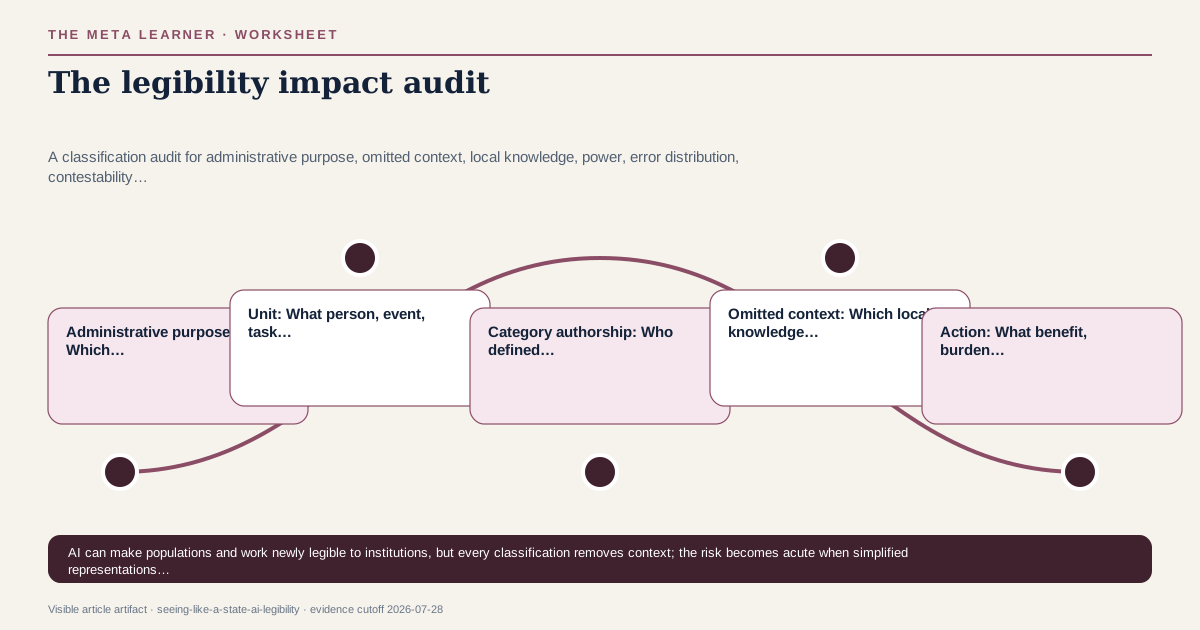
AI creates legibility by turning people and practices into standardized data, labels, scores, and predictions. That can coordinate useful services. It also creates blindness when local knowledge, exceptions, and contested values vanish from the representation. Audit who defines the category, who can appeal, and what coercive action follows before optimizing the model.
Intellectual inheritance behind Seeing Like a State
The intellectual genealogy includes Weber on bureaucracy, Hayek on dispersed knowledge, Foucault on classification and discipline, modernist planning, and anthropological attention to local practice. Scott’s distinctive contribution is the conjunction of legibility, ideology, coercion, and weak social resistance.
In AI, the lineage meets statistical classification. A training label, risk score, or benchmark is a map made operational. Unlike a paper report, it may act repeatedly and invisibly at great scale.
Scott's four-part warning
Scott’s argument concerns a dangerous combination, not simplification alone: administrative ordering, high-modernist confidence, authoritarian power, and a civil society too weak to resist. Maps, surnames, cadastral surveys, grids, and standard measures make populations visible to central administration. They can support public goods and taxation. They can also enable destructive schemes when the representation is mistaken for the living system.
The central claim is epistemic and political. Local practical knowledge cannot always be compressed into a plan; coercive power prevents reality from correcting the plan before harm scales.
The legibility impact audit: evidence, not verdict
Scott develops historical cases in which schematic representations and authoritarian implementation erased complex interdependencies. Selbst and coauthors identify abstraction traps in algorithmic-fairness work, including failures to model institutions, contexts, and feedback. Ostrom supplies counterevidence to simple centralized binaries through empirical work on polycentric governance.
scott-seeing, selbst-abstraction, ostrom-nobelClaim sources: scott-seeing, selbst-abstraction, ostrom-nobel
Counterevidence: legibility can protect
Standard records can reveal discrimination, enforce rights, direct resources, coordinate epidemics, and make officials accountable. Local discretion can hide favoritism or abuse. Illegibility is not automatically freedom; it may leave vulnerable people unseen.
The counterargument reverses a simplistic Scott reading. The choice is not central knowledge versus authentic local wisdom. It is which representation, at which scale, under which authority, with which avenues for correction and plural knowledge.
Misusing the legibility critique
- Treating every standard as oppression.
- Romanticizing local hierarchy and exclusion.
- Criticizing abstraction without proposing an operable alternative.
- Assuming private platforms cannot exercise administrative power.
- Auditing prediction but not downstream action.
- Asking affected people for input after categories are fixed.
- Using a complex model to claim more context was preserved.
- Calling an irreversible deployment a pilot.
Design counter-legibility
If institutions need categories to allocate resources, affected people need ways to resist the category’s false finality. Counter-legibility is the capacity to see how the system sees you, add missing context, challenge an incorrect record, and make the correction travel downstream.
Consider an eligibility model that uses household income, address, and employment status. A transparent score is insufficient if temporary care work, informal income loss, disability expense, or housing instability cannot enter the record. The remedy is not unlimited narrative discretion. It is a bounded exception channel with evidence standards, accountable review, response time, and an appeal that can change the operative decision.
The design test is reciprocal: administrators need enough structure to act, while people need enough visibility and standing to contest simplification. When only the institution can inspect and amend the representation, legibility has become one-way power even if the model itself is technically explainable.
A worked educational system
A school district uses an AI score to identify students “at risk of disengagement.” The model combines attendance, platform activity, grades, and administrative records. The category helps allocate outreach, but it cannot see caregiving, disability, distrust, offline learning, or a teacher’s local knowledge.
If the score offers optional support and teachers can add context, some simplification may be tolerable. If it narrows curriculum, triggers discipline, or becomes part of a permanent record, the same abstraction acquires coercive force. Students need explanation, correction rights, and a path not governed by the score.
When the analogy to AI breaks
Many AI systems are built by firms rather than states, and users may adopt them voluntarily. Yet private platforms can still make work legible, set categories, and govern access. Conversely, not every classifier embodies high-modernist ideology or coercive ambition.
Use Scott when simplification connects to concentrated, difficult-to-contest power. Use ordinary model validation when the task is bounded, the objective legitimate, and error recoverable. Historical resemblance is a prompt for mechanism, not proof.
Run the legibility impact audit
For a proposed AI classification, record:
- Administrative purpose: Which decision requires simplification?
- Unit: What person, event, task, or institution becomes a row?
- Category authorship: Who defined labels and thresholds?
- Omitted context: Which local knowledge cannot enter?
- Action: What benefit, burden, surveillance, or denial follows?
- Error distribution: Who receives false positives and false negatives?
- Contestability: Can a person see, challenge, and correct the record?
- Alternative: Can a smaller, plural, or human-led process achieve the aim?
The audit follows the representation into power. A biased label with no consequence differs from one that blocks housing, employment, or education.
Reversal conditions for the legibility impact audit
Confidence in a legible system should rise when its categories predict the bounded target, local knowledge can alter action, errors are visible, affected people can appeal, and alternatives remain. It should fall when administrators optimize the score instead of the purpose, context loss aligns with vulnerable groups, or the system creates dependency before evaluation.
Small pilots are not automatically safe. A pilot can still collect durable data or normalize a category that later expands.
The boundary of this reading of Seeing Like a State
The book’s historical cases concern particular states, ideologies, and civil societies; analogies to AI require mechanism-level evidence. Local knowledge can also be partial or unjust, and large-scale coordination can be essential. This audit does not replace legal, statistical, accessibility, or impact assessment.
Add power to systems thinking, compare legibility with tacit knowledge, and inspect value choices through the alignment problem.
Named sources
Evidence and further reading
Published July 29, 2026. No substantive revision has been recorded. Evidence last verified July 28, 2026.