The Tacit Dimension in the AI Era: What Cannot Be Reduced to Instructions?
Test Michael Polanyi’s account of tacit knowing against codification, deliberate practice, expert intuition, AI imitation, apprenticeship, and organizational memory.
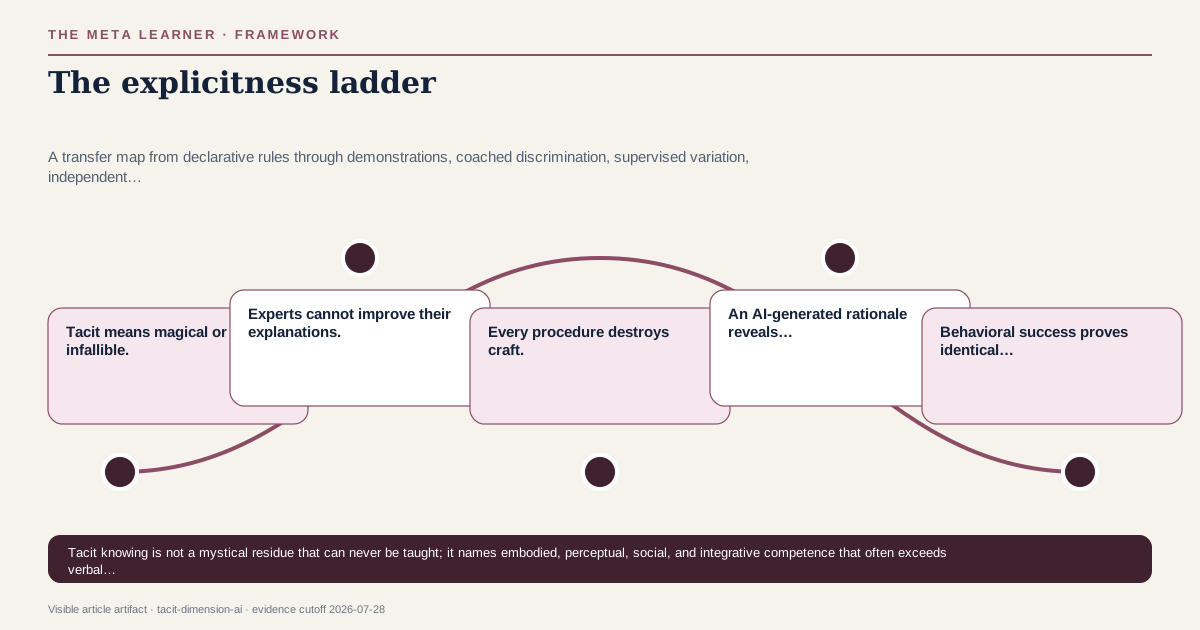
Tacit knowledge includes perceptual distinctions, embodied coordination, situation recognition, and integrative judgment that people use without being able to state a complete rule. Do not conclude that it is unteachable. Transfer it through demonstration, guided attention, representative practice, feedback, participation, and tests on unfamiliar cases. Inability to verbalize a judgment does not prove its accuracy, uniqueness, or impossibility of partial codification.
Reconstructing tacit knowing
Polanyi’s argument begins from a gap between performance and report. A person can recognize a face, ride a bicycle, diagnose a pattern, or attend from particular clues to a coherent whole without enumerating the complete operation. Knowing is personal and participatory, not the mechanical application of fully specified propositions.
The central claim challenges a fantasy of total codification. Rules work against a background of learned attention, judgment, tradition, and skill. Explicit instructions depend on people who know how to interpret and apply them.
Intellectual inheritance behind the Tacit Dimension
The intellectual genealogy includes Aristotle’s practical wisdom, apprenticeship traditions, Gestalt perception, phenomenology, Gilbert Ryle’s distinction between knowing how and knowing that, and Polanyi’s philosophy of science. Later work in communities of practice and naturalistic decision making carries the insight into organizations.
AI introduces a new branch. A system may reproduce expert-like outputs from patterns in data without sharing embodied participation, responsibility, or lived understanding. Behavioral similarity does not settle whether the same knowledge is present.
Counterevidence: tacit is often a temporary label
Experts may say “I just know” because nobody has elicited their cues, because the work is automatic, or because status rewards mystique. Cognitive task analysis, video, comparison of cases, and error review can make some hidden knowledge more explicit.
Collins’s distinctions resist the move from “not yet articulated” to “cannot in principle be articulated.” Codification can also democratize access and reduce dependence on gatekeepers. The burden lies on a specific competence, not a romantic category.
Counterargument: outcomes are what matter
If an AI system consistently outperforms people on representative, high-quality tests, why care whether its knowledge is tacit? For bounded tasks, performance may indeed be the correct criterion.
The argument changes when environments shift, errors are hard to observe, people need explanations or recourse, and the system affects rights. Then the origin, stability, and governance of competence matter alongside average output.
explicitness ladder: the claim-bearing evidence
Polanyi develops the philosophical account of tacit knowing. Collins later distinguishes different forms of tacit and explicit knowledge, showing that the category is not one indivisible mystery. Kahneman and Klein identify conditions for intuitive expertise: sufficiently regular environments and opportunities to learn those regularities through timely, valid feedback.
polanyi-tacit, collins-tacit, kahneman-kleinClaim sources: polanyi-tacit, collins-tacit, kahneman-klein
A worked organizational transfer
A senior editor reliably detects when an article’s evidence cannot support its title. The organization asks for a style guide. The editor lists source hierarchy and claim types, but junior reviewers still miss problems.
The explicitness ladder adds paired examples, think-aloud demonstrations, contrast cases, and supervised review. Juniors must identify the hidden inferential bridge and propose a narrower title. Feedback focuses attention on the relation, not merely the answer. Later, unfamiliar articles test transfer.
The organization retains a checklist and an apprenticeship process. Neither is declared sufficient alone.
What AI changes
AI can elicit examples, compare cases, simulate variation, and capture explanations during work. It may help experts articulate cues. It can also produce convincing rules from outputs without access to the causal conditions that make a judgment reliable.
When AI imitates an expert decision, test:
- whether the task environment matches training examples;
- performance on rare exceptions;
- sensitivity to causal rather than surface change;
- ability to signal uncertainty;
- who reviews irreversible outcomes;
- whether human skill decays through non-use.
The practical concern is capability and accountability, not metaphysical competition between human and machine.
Use the explicitness ladder
Instead of classifying knowledge as either documented or ineffable, locate it:
- Rule: Can a proposition or threshold be stated?
- Demonstration: Can an expert show a representative case?
- Attention cue: Can the learner be directed to diagnostic features?
- Coached discrimination: Can near cases be compared with feedback?
- Supervised variation: Can performance adapt across changing contexts?
- Independent exception: Can the learner recognize when the rule should not govern?
Documentation is valuable at every rung, but its role changes. A checklist may preserve critical steps while failing to supply perceptual judgment.
Run a teachability experiment
When someone says a capability is tacit, test which layer resists expression. Ask the expert to predict a novice’s next error, compare two borderline cases, demonstrate while narrating attention, and mark the instant a cue changes the decision. Let the novice attempt the task, then compare the expert’s stated rule with the correction actually given.
The result may reveal several kinds of hidden knowledge. Some becomes an explicit checklist. Some requires perceptual examples. Some can be taught only through coached participation. Some is not knowledge at all but an untested habit or status claim.
This experiment avoids two mistakes: declaring all expertise ineffable, and assuming every useful cue can be detached from practice. The aim is not total codification. It is to find the next representational layer that improves learning while preserving contact with real performance and its accountable standards.
Reversal conditions for the explicitness ladder
Codify more when rules are stable, exceptions are observable, compliance is critical, and explicit records reduce preventable variation. Invest in apprenticeship when perceptual discrimination, timing, interaction, and contextual exception dominate.
Confidence that AI can carry a tacit function should rise with independent, representative evaluation and reliable exception handling. It should fall when performance depends on hidden context, feedback is sparse, or human recovery capacity disappears.
Tacit-knowledge myths
- Tacit means magical or infallible.
- Experts cannot improve their explanations.
- Every procedure destroys craft.
- An AI-generated rationale reveals its actual mechanism.
- Behavioral success proves identical understanding.
- Apprenticeship means imitation without criticism.
- Documentation and participation are substitutes.
- Experienced intuition transfers to any environment.
The boundary of this reading of the Tacit Dimension
Tacit knowledge has multiple contested meanings. Philosophical arguments do not measure how much of a particular skill can be codified, and performance studies cannot settle whether a machine understands. Any organizational transfer claim needs representative tasks, expert review, and longitudinal evidence about independent capability.
Compare externalization with the extended mind, test intuition through Sources of Power, and allocate human–AI roles with Co-Intelligence.
Named sources
Evidence and further reading
Published July 29, 2026. No substantive revision has been recorded. Evidence last verified July 28, 2026.