Co-Intelligence: Does Working With AI Make Us More Capable?
Test Ethan Mollick’s practical case for AI collaboration against the jagged frontier, automation bias, skill transfer, homogenization, workflow adoption, and accountability.
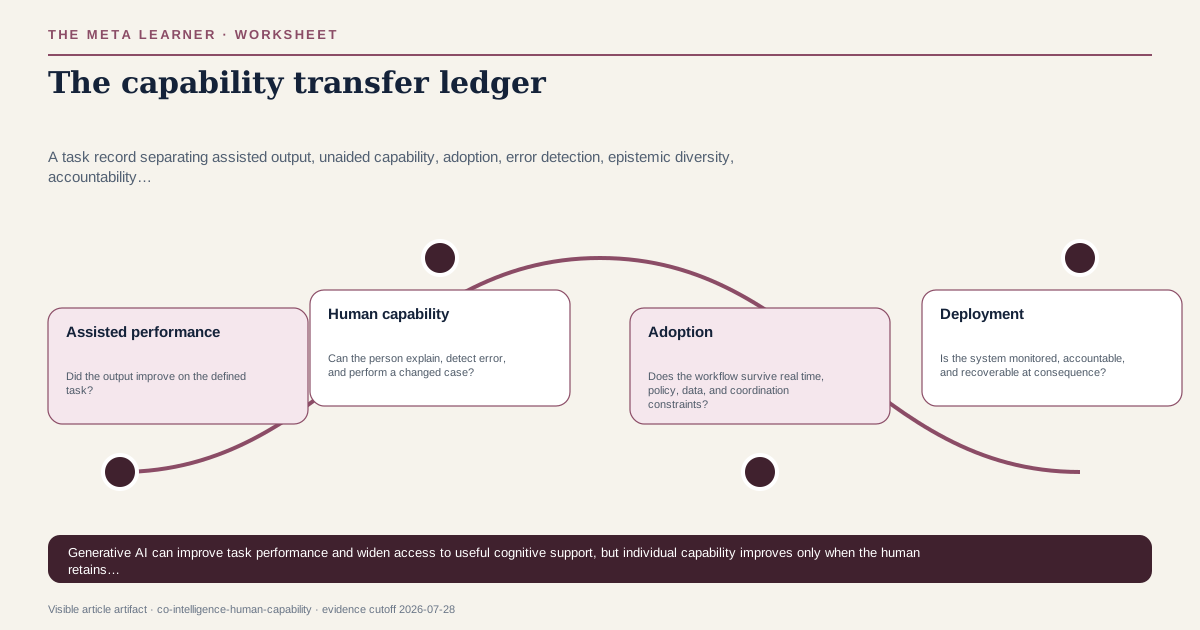
Working with AI improves capability only if gains persist beyond one assisted output. Separate task performance, human learning, workflow adoption, and accountable deployment. Test a representative task with AI, inspect errors, then repeat a changed case with support reduced. Keep human ownership where failure is hard to detect, costly, or irreversible.
Intellectual inheritance behind Co-Intelligence
The intellectual genealogy includes Engelbart’s vision of augmenting human intellect, human–computer interaction, distributed cognition, intelligent tutoring, centaur chess, and automation research. “Co-intelligence” reframes AI from isolated automation to an interactive partner.
This lineage contains its own warning. Automation can change vigilance, skill, authority, and work design. Collaboration is not established because a person and system both touched the output.
The invitation and its strongest claim
Mollick asks readers to treat general-purpose AI as collaborator, teacher, coach, and creative partner. His practical stance is experimental: invite AI to the task, learn its strange strengths and weaknesses, maintain human responsibility, and expect rapid change.
The strongest version of the argument is not that AI always makes people smarter. It is that access to a broadly capable, conversational tool changes the economics of cognition. Drafting, explanation, simulation, feedback, and variation become cheaper. The user’s job shifts toward direction, judgment, and accountability.
The capability transfer ledger: evidence, not verdict
Mollick synthesizes hands-on experience and emerging research. A controlled writing experiment found faster completion and higher evaluated quality for selected tasks. A field experiment with consultants found gains on tasks inside the model’s capability frontier and worse performance on a task outside it when participants relied on AI. Effects are bounded by task and system.
mollick-co-intelligence, dellacqua-frontier, noy-zhangClaim sources: mollick-co-intelligence, dellacqua-frontier, noy-zhang
Counterevidence: the frontier is jagged
AI capability does not rise smoothly with how difficult a task feels to a human. A system may excel on a complex-looking synthesis and fail on a simple constraint. Users can be least vigilant after impressive success.
Task-level evaluation is therefore essential. “AI is good at writing” is too broad. Which genre, facts, audience, sources, and consequences? The frontier also changes across versions, prompts, tools, and time, so the last verified result is not a permanent capability map.
The skill-substitution challenge
AI can free time for higher-level work, but organizations may fill the saved time with more production. A junior worker can produce senior-looking prose without acquiring the diagnostic experience that formerly developed through drafting. The question is not whether old tasks are sacred. It is which learning function they served and how the new workflow replaces it.
Use representative deliberate practice for critical checks. Experts may delegate routine form while retaining exception judgment. Novices often need more internal structure before they can evaluate plausible output.
The hardest objection to The capability transfer ledger
Requiring unaided performance everywhere can waste the point of tools. Nobody tests a modern accountant by removing spreadsheets from every task. Capability can be distributed across a reliable human–tool system.
The reply is risk-sensitive redundancy. Internalize what is needed to select, verify, recover, and remain autonomous under expected failure. Offload what is stable, inspectable, and cheap to recover. The correct unit may be team capability, but accountability must still have an owner.
A learning case
A learner uses AI to solve statistical problems. Scores rise during practice. The ledger separates possible mechanisms: AI may give useful feedback, or it may complete the reasoning.
The learner now attempts first, asks for a hint tied to the error, verifies the principle, explains the solution, and later solves a structurally similar problem without AI. If performance collapses unaided, the tool improved local output but did not establish transfer. That result is not failure; it identifies where to redesign collaboration.
Individual gains can create collective loss
If many people use similar systems for ideation and drafting, average output may improve while arguments, styles, sources, or omissions converge. Co-intelligence at the person level can become epistemic monoculture at the population level.
Preserve independent source discovery, non-AI baselines, reviewers not anchored by the same output, and multiple causal models. Diversity is not random contrarianism; it is independence in how errors arise.
Use the capability transfer ledger
Record four distinct outcomes:
| Layer | Test | |---|---| | Assisted performance | Did the output improve on the defined task? | | Human capability | Can the person explain, detect error, and perform a changed case? | | Adoption | Does the workflow survive real time, policy, data, and coordination constraints? | | Deployment | Is the system monitored, accountable, and recoverable at consequence? |
Add the failure boundary: what can the human not reliably detect? A fluent answer can make review harder precisely when the model is wrong.
Reversal conditions for the capability transfer ledger
Expand AI use when controlled comparisons show better outcomes, errors are detectable, people learn the checks, workflow constraints permit responsible adoption, and gains persist across new cases. Narrow it when quality depends on one opaque step, reviewers overtrust, output diversity collapses, sensitive data cannot be governed, or human recovery skill decays.
Some tasks should remain AI-free for assessment or skill formation even when production tasks are AI-assisted. That is an outcome boundary, not nostalgia.
Co-intelligence confusions
- Treating one output gain as learning.
- Generalizing from one task to a profession.
- Calling tool access organizational adoption.
- Counting human review without testing detection skill.
- Using AI to create and independently grade the same work.
- Assuming more prompts create epistemic diversity.
- Preserving old tasks without identifying their learning function.
- Treating model capability as stable until publication.
The boundary of this reading of Co-Intelligence
The cited experiments study particular systems, participants, tasks, and short outcomes. They do not establish long-term capability, labor-market effects, or performance in high-stakes domains. Product behavior changes, so current technical claims are bounded to evidence reviewed through July 28, 2026.
Define the human core through AI-era expertise, protect against epistemic monoculture, and compare output with tacit competence.
Named sources
Evidence and further reading
Published July 29, 2026. No substantive revision has been recorded. Evidence last verified July 28, 2026.