Sources of Power: What Expert Intuition Knows—and When It Fails
Test Gary Klein’s recognition-primed decision model against low-validity environments, feedback quality, automation, overconfidence, and the need for analysis.
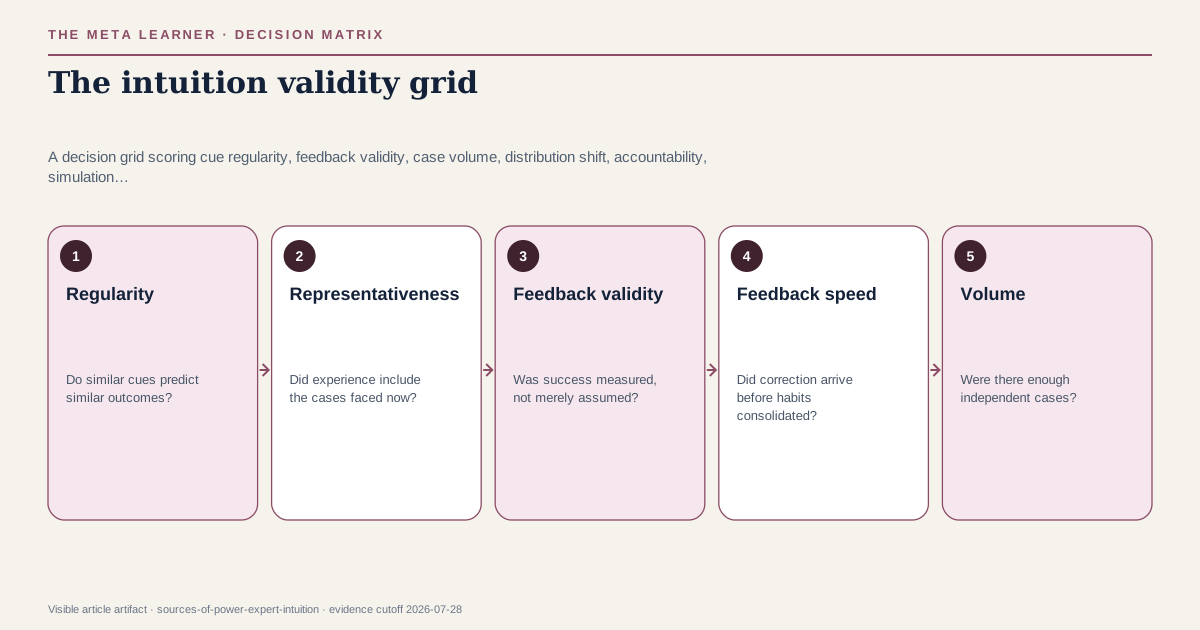
Trust intuition when the expert has extensive experience with representative cases, the environment contains learnable regularities, outcomes provide timely and accurate feedback, and the present case has not shifted those conditions. Otherwise use intuition to notice cues and generate options, then add base rates, explicit analysis, independent checks, and reversible tests.
The naturalistic decision argument
Klein studied people such as firefighters, pilots, military leaders, and nurses making decisions under time pressure, uncertainty, changing conditions, and personal responsibility. The recognition-primed model challenges the picture of decision makers generating a long option list and calculating the best one.
An experienced practitioner often recognizes a situation as typical, retrieves a plausible action, and mentally simulates whether it will work. If the simulation exposes a problem, the person modifies the action or considers the next one. Intuition and analysis are not opposites; rapid recognition feeds a focused simulation.
intuition validity grid: the claim-bearing evidence
Klein’s naturalistic research describes decision processes in consequential field settings. Kahneman and Klein later identified common ground: intuitive expertise is plausible where environments have sufficient validity and people can learn their regularities. Ericsson’s work emphasizes extended, targeted practice and informative feedback in expert performance.
klein-power, kahneman-klein, ericsson-practiceClaim sources: klein-power, kahneman-klein, ericsson-practice
Audit the intuition environment
Rate seven questions:
| Condition | Evidence to seek | |---|---| | Regularity | Do similar cues predict similar outcomes? | | Representativeness | Did experience include the cases faced now? | | Feedback validity | Was success measured, not merely assumed? | | Feedback speed | Did correction arrive before habits consolidated? | | Volume | Were there enough independent cases? | | Distribution shift | Have rules, tools, actors, or incentives changed? | | Accountability | Did the expert observe downstream errors and bear correction? |
The grid evaluates the learning environment, not the person’s confidence.
Keep a cue–outcome calibration record
Recognition becomes auditable when experts record the cue noticed, the pattern inferred, the action selected, the expected outcome, and what actually happened. Cases should include routine successes, near misses, reversals, and events where the expert abstained.
The record does not turn intuition into a simple formula. It tests whether confidence tracks environments with repeatable structure and timely feedback. A cue that predicted deterioration in one unit may be irrelevant after equipment, population, or procedures change. An AI alert may sharpen attention or teach a misleading association if the displayed signal is poorly validated.
Review calibration by cue family rather than one overall accuracy number. Experts may be reliable at recognizing a familiar trajectory and weak at rare causal attribution. The proper response is selective trust: preserve rapid recognition where feedback supports it, add analytic checks where validity is low, and require escalation when consequences exceed the evidence.
A high-validity case
An experienced emergency nurse notices a patient’s pattern has changed before one threshold crosses. The intuition may integrate posture, speech, color, history, and subtle deviation. The nurse still checks vital signs and escalates. The system treats recognition as a valuable alarm, not as an unchallengeable diagnosis.
Years alone are insufficient. The nurse’s experience includes repeated cases, clinical outcomes, peer review, and correction. A manager making one acquisition every five years cannot claim the same learning conditions merely from seniority.
Counterevidence: confidence survives bad feedback
Finance, hiring, geopolitics, and strategy can be low-validity environments. Outcomes are noisy; decisions alter the system; luck receives credit; failures disappear; and feedback arrives after people change roles. Intuition may still feel coherent because humans learn stories as readily as predictive cues.
Kahneman and Klein’s joint analysis is therefore more useful than a contest between “biases” and “expert power.” Ask whether the environment can support skill. Where it cannot, a confident expert may be an eloquent novice with many memories.
The counterargument to analysis
Explicit optimization can be too slow, based on impoverished variables, or blind to tacit cues. Under time pressure, demanding a complete probability model can be worse than a trained first workable action. Analysis also has biases in data selection and model design.
Use analysis to challenge the pivotal assumption, not to replace every skilled movement. Pre-plan thresholds and fallback actions before emergencies so that reflection is embedded in the environment.
Intellectual inheritance behind Sources of Power
The intellectual genealogy includes Herbert Simon’s bounded rationality and pattern recognition, chess expertise research, skilled perception, and the naturalistic-decision-making tradition. It intersects with deliberate practice and with dual-process accounts of fast and slow reasoning.
The crucial correction is that “fast” does not mean irrational and “expert” does not mean reliable. History of learning inside a particular environment links the two.
AI changes the cue ecology
AI can expose more cases, simulate variations, and provide feedback. It can also change the environment on which expertise was built. A teacher’s intuition about student writing may fail when text is AI-generated; a security analyst’s past cues may be spoofed; a physician may inherit automation bias.
Run a distribution-shift check:
- Which cues can now be generated or concealed?
- Has the base rate changed?
- Does the AI filter what the expert sees?
- Is model output independent evidence or another cue?
- Can the expert still recover without the system?
Old expertise remains valuable for mechanism and anomaly detection, but its calibration must be re-earned.
Reversal conditions for the intuition validity grid
Increase intuitive authority when predictions are prospectively recorded, performance remains calibrated on current cases, peers with independent experience converge, and mental simulation reveals relevant failure modes.
Decrease it when the expert cannot name feedback, incentives suppress bad news, the case is outside the learned distribution, outcomes are rare, or prestige is the main warrant. Where others bear irreversible harm, require stronger verification even from a well-calibrated expert.
Intuition myths
- Intuition is a mystical gift.
- Experience always creates expertise.
- Analysis is objective by definition.
- Experts can always explain their cues.
- One spectacular success establishes calibration.
- Confidence reveals pattern quality.
- AI is an independent expert rather than part of the cue environment.
- Base rates always defeat local recognition.
The boundary of this reading of Sources of Power
Naturalistic cases provide ecological richness but do not estimate one universal advantage for intuition. The validity grid requires domain evidence, and some outcomes cannot provide timely feedback. High-stakes medical, legal, safety, and financial decisions remain governed by professional standards beyond this article.
Add base rates, preserve the strengths and limits of tacit knowing, and match expertise strategy to environmental validity with Range.
Named sources
Evidence and further reading
Published July 29, 2026. No substantive revision has been recorded. Evidence last verified July 28, 2026.