Range: When Generalists Win—and When They Do Not
Test David Epstein’s case for sampling and breadth against deliberate-practice research, kind and wicked learning environments, selection effects, and career constraints.
Generalize while the problem, environment, and your comparative advantage remain uncertain; specialize when feedback is representative, performance compounds, and depth unlocks opportunities that sampling cannot. Breadth is not an escape from practice. Its value is better search, analogy, and recombination before and alongside selective depth. Evidence from elite performers is vulnerable to selection and survivorship, and broad career advice does not determine the best path for one person.
Intellectual inheritance behind Range
The intellectual genealogy connects Herbert Simon’s work on expertise and bounded rationality, research on deliberate practice, March’s exploration– exploitation problem, Holland’s ideas about adaptation, and traditions of liberal education. Range places these predecessors into a narrative about career timing and modern uncertainty.
Its most important move is to combine epistemic and biographical search. People do not only search for solutions; they search for domains in which their motivation, prior knowledge, opportunity, and ability can compound.
The argument beneath the anecdotes
Range challenges a culturally powerful sequence: start early, choose one domain, accumulate practice, and treat deviation as lost time. Epstein’s central claim is not simply that generalists are superior. In uncertain and “wicked” environments, sampling, late commitment, and experience across domains can improve matching, analogy, and adaptation.
The argument turns on environment. In a “kind” domain, rules are stable, patterns repeat, actions receive timely and accurate feedback, and deliberate practice maps closely to future performance. In a wicked domain, goals move, feedback is delayed or misleading, and prior cases do not repeat cleanly.
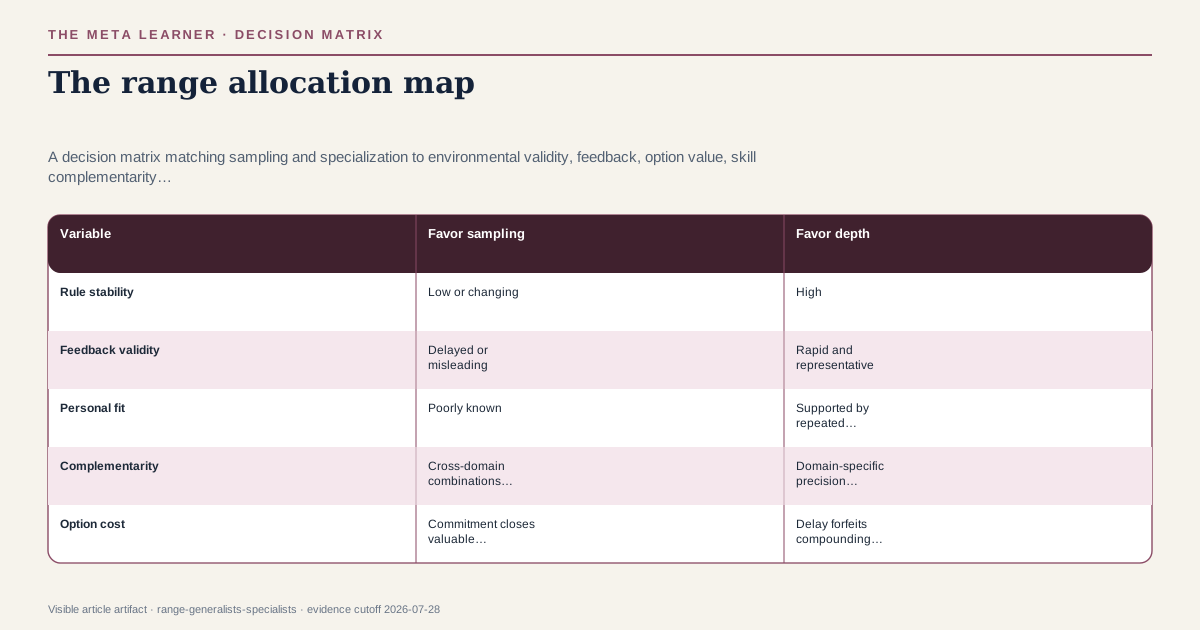
The range allocation map: evidence, not verdict
Epstein synthesizes cases and research across sport, music, science, careers, and forecasting. Ericsson’s influential account explains expert performance through extended, targeted practice under demanding conditions. A later meta-analysis found that deliberate practice explained meaningful but varying shares of performance across domains, leaving substantial variance attributable to other factors. The sources support contingency, not a universal winner.
epstein-range, ericsson-practice, macnamara-practiceClaim sources: epstein-range, ericsson-practice, macnamara-practice
Counterevidence: specialists really do win
Anecdotes about late bloomers can obscure the selection process. Elite musicians, surgeons, mathematicians, and athletes often require long periods of domain- specific practice. In stable tasks, accumulated pattern recognition and technical precision are not replaceable by broad curiosity.
The deliberate-practice literature is not a claim that hours explain everything. Its strongest insight is qualitative: practice must target representative performance, include feedback, and push beyond comfortable repetition. The meta-analysis challenges totalizing accounts of practice, not the value of specific practice.
The counterargument to specialization
Depth can become locally rational and globally fragile. A specialist may optimize a disappearing task, apply a familiar model where rules changed, or miss solutions visible through another discipline. Institutions can also select early specialists because their performance is easier to measure, then confuse selection with the cause of eventual success.
Breadth wins when it changes the hypothesis space. A biologist who understands computation, a historian who can reason statistically, or a product leader who knows the work domain can see structures inaccessible to a generic coordinator. This is integrated breadth, not shallow accumulation of labels.
A worked career decision
A mid-career analyst considers leaving policy research for AI product work. “Become a generalist” is too vague. The map identifies an anchor—causal analysis and evidence evaluation—and three adjacent experiments: prototype a source-verification workflow, collaborate with an engineer, and study one deployment process.
After eight weeks, the analyst evaluates actual work samples, feedback, energy, and market access. If integration work compounds the anchor, the portfolio deepens there. If the experiments produce only surface familiarity, the analyst returns to policy specialization with improved tool literacy. Sampling has a stop rule.
Treat range as a portfolio, not a personality
“Generalist” and “specialist” easily become flattering identities. A better unit is the capability portfolio required by a real problem. List the disciplines that supply core truth, the neighboring fields that expose assumptions, the craft needed for execution, and the depth that cannot be borrowed at the moment of decision.
One person need not own every layer. A team can combine deep specialists with a synthesist who understands interfaces well enough to translate disagreement. Conversely, a nominally interdisciplinary team can remain narrow when every member shares the same training data, incentives, and institutional viewpoint.
Rebalance the portfolio when error reveals a missing layer. If broad analogies generate options but evaluation is weak, add depth. If expert execution solves the wrong class of problem, add external comparison. If coordination consumes the work, strengthen shared representations.
This view makes range conditional and testable. Breadth is valuable when it changes search, framing, or transfer—not when it merely expands the number of topics a person can mention.
Use the range allocation map
Score the current decision:
| Variable | Favor sampling | Favor depth | |---|---|---| | Rule stability | Low or changing | High | | Feedback validity | Delayed or misleading | Rapid and representative | | Personal fit | Poorly known | Supported by repeated evidence | | Complementarity | Cross-domain combinations valuable | Domain-specific precision decisive | | Option cost | Commitment closes valuable paths | Delay forfeits compounding access | | Performance threshold | Exploration acceptable | Reliability or licensure required |
The matrix can recommend a barbell: deep competence in one anchor plus bounded exploration in adjacent domains.
Reversal conditions for the range allocation map
Choose earlier specialization when a domain has high-validity feedback, irreducible prerequisites, age- or access-sensitive windows, costly licensure, or a clear opportunity whose value compounds. Extend sampling when the target is unclear, early signals are noisy, adjacent skills combine strongly, or structural change makes one narrow path fragile.
Runway matters. A wealthy student and a worker supporting a family do not face the same cost of exploration. Advice that ignores financial and geographic constraints moralizes optionality.
Misreadings of range
- “Never specialize.”
- “Practice does not matter.”
- “Every detour will become useful later.”
- “Generalist” as an identity without demonstrable capability.
- Using elite survivor stories as a base rate.
- Sampling courses rather than representative work.
- Treating boredom as proof that the domain is wrong.
- Collecting breadth after feedback already favors depth.
The boundary of this reading of Range
The book ranges across domains whose selection processes, feedback, and performance measures differ. Narrative cases cannot estimate the outcome for one career, and both generalist and specialist samples contain survivorship bias. The allocation map requires local opportunity, runway, and task evidence; it is not a formula for delaying commitment indefinitely.
Add adult-development evidence from late expertise, forecast productive learning episodes, and build a specialist–generalist–synthesist portfolio.
Named sources
Evidence and further reading
Published July 29, 2026. No substantive revision has been recorded. Evidence last verified July 28, 2026.