The Extended Mind Revisited: What Actually Belongs Outside the Brain?
Test the extended-mind thesis against cognitive offloading, fragile platforms, contested ownership, and the difference between useful support and constitutive cognition.
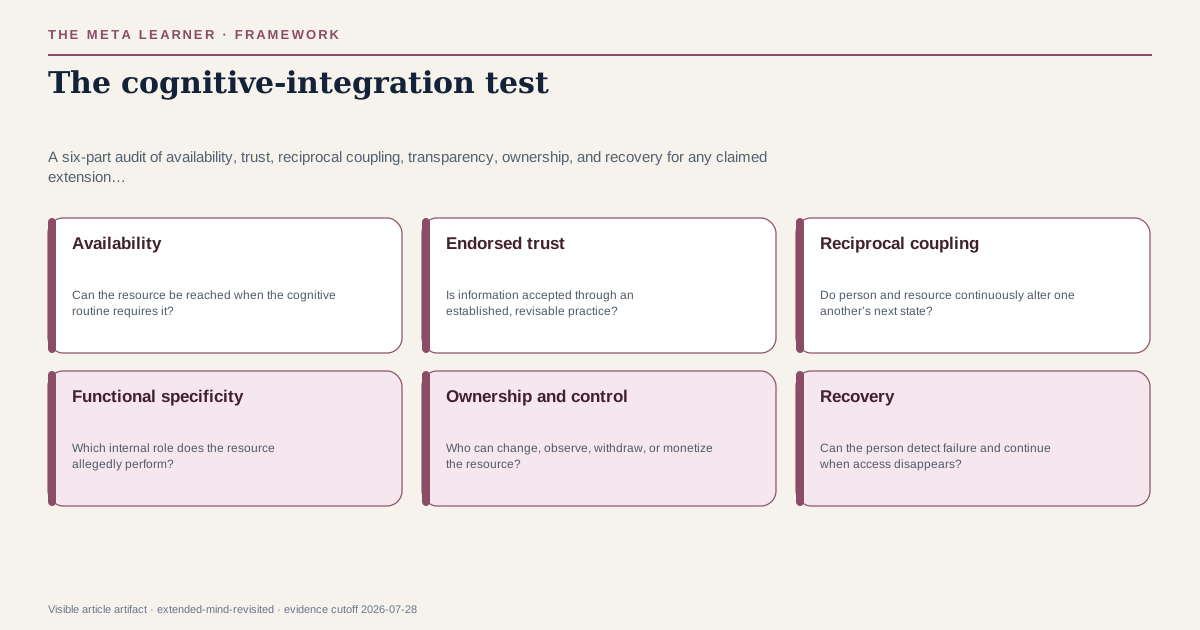
An external resource plausibly belongs to a cognitive process when it is reliably available, automatically trusted for a bounded function, reciprocally coupled to the person’s action, and integrated into ongoing reasoning. AI often fails this stronger test because its outputs change, its operations are opaque, and access, ownership, or incentives can shift without the user’s control.
The argument worth reconstructing
The extended-mind argument is not the banal observation that tools help us think. Its provocative move is parity: if an external process performs the same functional role as an internal process, excluding it merely because it sits outside the skull may be prejudice about location.
The classic case compares ordinary biological memory with a notebook used by a person who cannot reliably form new memories. The notebook is constantly available, its entries are automatically trusted, and consulting it directly guides action. The anthology edited by Richard Menary collects the original argument and sustained objections, making visible a live philosophical dispute rather than a settled slogan.
The cognitive-integration test: the claim-bearing evidence
Clark and Chalmers formulate the parity argument for active externalism. Menary’s volume preserves competing accounts of coupling, constitution, and cognitive practice. Independent research on cognitive offloading documents the use of external action to alter information-processing demands. The empirical finding supports distributed cognitive work; it does not alone prove where mind ends.
menary-extended-mind, clark-chalmers, risko-offloadingClaim sources: menary-extended-mind, clark-chalmers, risko-offloading
Run the cognitive-integration test
Audit six dimensions:
| Dimension | Constitutive question | |---|---| | Availability | Can the resource be reached when the cognitive routine requires it? | | Endorsed trust | Is information accepted through an established, revisable practice? | | Reciprocal coupling | Do person and resource continuously alter one another’s next state? | | Functional specificity | Which internal role does the resource allegedly perform? | | Ownership and control | Who can change, observe, withdraw, or monetize the resource? | | Recovery | Can the person detect failure and continue when access disappears? |
A paper notebook may score high on control and stability but low on dynamic reciprocity. An AI assistant may score high on interaction but low on transparency and stable trust. “Extended” is not one undifferentiated category.
A worked AI case
A researcher uses an AI system to retrieve citations, maintain a project map, and propose relationships across notes. The workflow improves immediate coverage. But a dependency audit finds that source titles can be fabricated, the model version changes, account access is revocable, and the provider can alter retention terms.
The researcher separates functions. Verified bibliographic records live in an exportable database; primary texts remain accessible; the model proposes candidates but does not become the source ledger; and an unaided argument map tests whether the researcher retains the conceptual structure. The system is a powerful cognitive scaffold without being granted epistemic authority.
Counterevidence and the coupling objection
A central criticism is that causal coupling is too permissive. A calculator causes a result in my reasoning, but so do the electricity grid, its manufacturer, and the teacher who taught arithmetic. If every causal support becomes part of cognition, the concept loses explanatory boundaries.
The response is tighter integration: easy availability, habitual use, direct guidance, and reciprocal dependence. Yet AI creates a new challenge. It can generate content the user never encoded, infer from remote data, and silently change across versions. Automatic trust is precisely what responsible use should resist. The property that made the notebook a strong case may make a chatbot a dangerous one.
Intellectual inheritance behind the Extended Mind
The intellectual genealogy runs through functionalism, which characterizes mental states partly by what they do; pragmatist attention to action; Vygotskian and distributed-cognition traditions; and earlier work on embodied and situated mind. The extended thesis radicalizes these predecessors by claiming that some environmental components do not merely cause cognition but partly constitute it.
This lineage matters in the AI era. “The model is my second brain” inherits a philosophical claim whose conditions are stricter than marketing language suggests.
Extension, dependence, and justice
The framework has an ethical consequence that a gadget-centered reading can miss. If a notebook, speech device, navigation aid, or trusted digital system is deeply integrated into a person’s capacity to remember and act, removing access is not equivalent to taking away an optional convenience. A policy, price change, inaccessible redesign, or account suspension can contract that person’s practical agency.
That does not mean every provider owes permanent service under all conditions. It means dependency should be part of the design record. Identify export paths, offline fallbacks, accessibility constraints, recovery procedures, and which knowledge the person can still reconstruct without the system. For a learner, preserve some unaided tests; for an assistive user, do not romanticize unaided performance at the expense of participation.
The conclusion is asymmetric. Greater functional integration raises both the case for calling a resource cognitively important and the duty to make its failure, ownership, and continuity governable.
Reversal conditions for the cognitive-integration test
The case for AI as genuine extension strengthens when the system is stable, inspectable, user-controlled, tightly coupled to a defined process, correctable through feedback, and embedded in a durable practice. It weakens when outputs are episodic, opaque, manipulative, or interchangeable; when the user cannot notice error; or when access is governed by another party.
The practical conclusion does not depend on settling metaphysics. The more a tool functions like part of cognition, the more continuity, portability, privacy, auditability, and recovery become matters of cognitive autonomy.
Category mistakes about extension
- Calling every useful object part of the mind.
- Treating faster output as evidence of integration.
- Confusing stored information with understood knowledge.
- Ignoring the institution that owns the infrastructure.
- Assuming biological memory is perfectly stable and transparent.
- Treating tool dependence as inherently bad rather than risk-sensitive.
- Using philosophical extension to excuse unverified AI claims.
The boundary of this reading of the Extended Mind
This analysis cannot settle whether cognition literally extends beyond the organism. The parity principle, coupling criteria, and boundary of a cognitive system remain disputed. Cognitive-offloading studies examine behavior, not the metaphysics of mind. AI products also change, so system-specific claims require verification at the authorized publication cutoff.
Use the argument to allocate external memory, compare it with tacit knowledge, and examine the population risk of shared cognitive infrastructure.
Named sources
Evidence and further reading
Published July 29, 2026. No substantive revision has been recorded. Evidence last verified July 28, 2026.